


Yes. Burning candles emits VOCs and particles, and fragrance load combined with poor ventilation is what turns a cozy evening into a real exposure concern. A chamber study by Petry et al. measured benzene, limonene, formaldehyde, and fine particulates coming off both scented and unscented candles, with fragrance consistently raising total VOC output. An occasional, well-ventilated burn poses a relatively low risk for most people. Daily use of heavily fragranced candles in a closed bathroom or bedroom is a different story.
What you can do tonight: crack a window, trim the wick to about a quarter inch, and cap your burn sessions instead of letting a candle run for hours unattended.
- Open a window or run an exhaust fan while any candle burns
- Trim the wick before each lighting to cut soot and incomplete combustion
- Choose candles with published, transparent ingredient lists, like the scented candles collection from Wickofhope
Pro Tip: If you burn candles in a room without any airflow, like a windowless bathroom, treat that as a five-star risk factor no matter how “clean” the wax claims to be.
Key Takeaways
Candles reliably emit VOCs and fine particles, and fragrance load, ventilation, and wick condition determine whether that exposure stays trivial or becomes a real irritant.
| Point | Details |
|---|---|
| Candles do emit VOCs | Chamber studies detect benzene, formaldehyde, limonene, and particulates in both scented and unscented candles. |
| Fragrance is the main lever | Floral and fruit fragrance families raise total VOC output more than wax type does. |
| Ventilation changes the risk | Short-term concentration peaks in closed rooms matter more than average long-term exposure for most healthy adults. |
| Vulnerable groups need extra care | Children, pregnant people, asthma or COPD patients, and pets warrant shorter burns and better airflow. |
| Wickofhope offers a transparent option | Candles like the Velvet Ember, Whispers of Oud, and Linen Vanilla lines use coconut soy wax and published ingredient lists rather than vague fragrance claims. |
Table of Contents
- Which VOCs Come From Candles and How They Form
- What the Major Candle Emission Studies Found
- Health Impacts and Who Should Be Cautious
- Wax Type, Fragrance Load, and What Actually Belongs on a Label
- Wickofhope’s Non-Toxic Approach and Product Examples
- How to Burn Candles More Safely, Step by Step
- What the Research Actually Tells You to Prioritize
- Ready to Choose Candles You Can Actually Read the Label On
- Sources
Which VOCs Come From Candles and How They Form
“VOCs” is short for volatile organic compounds, meaning chemicals that evaporate easily at room temperature and mix into the air you breathe. Candles produce a specific, well-studied lineup of them, and knowing the names helps you read a label with a critical eye instead of trusting a “non-toxic” sticker at face value.
Researchers repeatedly detect the following compounds in candle emissions:
- Benzene and toluene — petroleum-derived VOCs more strongly associated with paraffin combustion, per a PubMed-indexed emissions study
- Formaldehyde — a combustion byproduct and a common spike point in fragranced candles
- Limonene and linalool — terpenes drawn from citrus and floral fragrance oils, common even in naturally derived wax blends
- Various aldehydes and ketones — byproducts of both wax volatilization and fragrance breakdown at flame temperature
These compounds form through three overlapping pathways. Fragrance oils off-gas continuously, even from an unlit candle sitting on a shelf. Heat from the flame volatilizes wax and fragrance compounds directly into the air. And incomplete combustion at the wick tip generates combustion byproducts and fine soot particles, especially when a wick is too long or a draft disturbs the flame.
Labs identify these compounds using chamber testing paired with gas chromatography-mass spectrometry, or GC-MS, which separates and identifies individual chemicals in the air sample down to trace concentrations. That’s how researchers can say with confidence which specific molecule spiked, rather than just noting that “smoke” appeared.
What the Major Candle Emission Studies Found
The most cited chamber study on this topic, Petry et al., measured VOCs, semi-volatile organic compounds, polycyclic aromatic hydrocarbons, and particulate matter from burning candles under controlled EN 16738-based conditions. Fragranced candles showed higher total VOC output than unscented ones. The takeaway wasn’t that candles are uniquely dangerous. It was that fragrance is the variable doing most of the work.
Modeled-exposure research tends to land in a more reassuring place for typical use. A review using exposure models like ConsExpo and CONTAM concluded that under normal, ventilated conditions, scented candle use is unlikely to drive long-term health effects for most healthy adults. But that same research flags short-term concentration peaks, particularly in small or sealed rooms, as a real concern for people who are already sensitive to airborne irritants.
Toxicology research adds a caution the modeling papers can’t fully capture. A Frontiers in Public Health study exposed Wistar rats to repeated scented-candle emissions in poorly ventilated conditions and found:
- Elevated inflammatory markers, including TNF-α and IL-6
- Increased oxidative-stress signals
- Measurable lung tissue changes on histopathology
Animal models don’t translate directly to human risk at typical candle-burning frequencies, but they do point toward a plausible mechanism for concern with heavy, chronic, poorly ventilated exposure.
Health Impacts and Who Should Be Cautious
Short-term symptoms reported include eye and throat irritation, headaches, and asthma flare-ups after burning fragranced candles in a closed room. These reactions align with the elevated VOC and particulate readings chamber studies consistently report.
Long-term human data is thinner. Nobody has run a decades-long epidemiological study tracking candle habits against disease outcomes. What exists instead is a signal from animal and cellular toxicology work, including the inflammation and oxidative-stress markers found in the Wistar rat study, suggesting repeated heavy exposure in unventilated spaces may carry cumulative risk. That’s a hypothesis worth taking seriously, not a settled verdict.
A few groups warrant extra caution:
- Children, whose airways are smaller and still developing
- Pregnant people, given general caution around airborne chemical exposure
- People with asthma or COPD, who react more strongly to particulate and VOC spikes
- Elderly individuals, who may have reduced respiratory reserve
- Pets, especially birds and cats, which are more sensitive to airborne irritants than humans
If you fall into one of these groups, shorter burns, better ventilation, and lower fragrance concentrations aren’t optional extras. They’re the baseline.
Wax Type, Fragrance Load, and What Actually Belongs on a Label
Here’s the finding that surprises most people: fragrance load, not wax type, is usually the bigger driver of VOC emissions. A Chemosphere study found that floral, fresh, and fruit fragrance families produced noticeably higher total VOC readings than spice or oriental-leaning scents, with formaldehyde spikes appearing across multiple product types when lit.
That doesn’t mean wax is irrelevant. Paraffin candles are more frequently linked to higher benzene and toluene output, since paraffin is a petroleum byproduct. But natural waxes aren’t a free pass either. Coconut, soy, and beeswax blends can still emit terpenoid compounds and ultrafine particles, just typically less of the petroleum-derived VOCs. If you want the fuller comparison, our breakdown of beeswax versus soy candles walks through where each wax actually differs.
Use this checklist when you shop:
- Look for a full ingredient list, not just “made with essential oils” marketing language
- Check for phthalate-free fragrance claims, ideally with some transparency about fragrance source
- Ask whether third-party testing data exists, since no standardized consumer testing protocol currently governs “low-VOC” or “clean-burning” claims
- Trim the wick to about a quarter inch before every burn to reduce soot and incomplete combustion
- Avoid drafts and multiple candles burning in one small room, both of which push incomplete combustion higher
Pro Tip: A candle that lists “fragrance” as one vague line item, with nothing more specific, is telling you it wasn’t built for transparency. Walk away.
Wickofhope’s Non-Toxic Approach and Product Examples
Wickofhope builds every candle around the checklist above rather than around a marketing slogan. Each candle uses coconut soy wax paired with FSC-certified wooden wicks, vegan and cruelty-free ingredients, and biodegradable packaging, formulated with pet-conscious households in mind. Every purchase also supports women and children escaping crisis, so the impact extends past your living room.
Three candles show how this plays out in fragrance choices with varying intensity:
- The Velvet Ember Candle | Saffron + Tobacco leans into a warmer, spice-forward profile, the fragrance family that chamber studies tend to associate with lower ΣVOC readings than floral or fruit scents
- The Whispers of Oud Candle | Oud + Incense pairs a resinous, incense-adjacent scent with the same transparent ingredient approach
- The Linen Vanilla Candle | Clean Cotton + Vanilla offers a lighter, lower-intensity fragrance option for anyone wanting a gentler daily burn
None of this means zero emissions. No lit candle achieves that. It means you can see what’s actually in the jar, which is the practical standard this entire guide has been building toward. For a deeper look at how wax choice affects air quality, see our guide on non-toxic candles versus traditional options.
| Point | Details |
|---|---|
| Fragrance drives emissions | Floral, fresh, and fruit scents show higher VOC readings than spice-forward fragrances in chamber testing. |
| Wax matters, but less | Paraffin is more linked to benzene and toluene; natural waxes reduce some but not all emissions. |
| Ingredient transparency | No standardized “low-VOC” testing exists, so full ingredient lists matter more than vague claims. |
| Wickofhope’s approach | Coconut soy wax, FSC wooden wicks, and published fragrance profiles across candles like the Velvet Ember and Linen Vanilla lines. |
How to Burn Candles More Safely, Step by Step
A few small habits, repeated every time, do more for your indoor air than any single product swap.
- Before lighting: pick a room with airflow, trim the wick to a quarter inch, and clear away drafts from fans or open doors
- While burning: keep a window cracked or fan running, cap sessions at one to two hours, and never run multiple candles in a small closed room
- After burning: snuff the flame with a proper snuffer rather than blowing it out, ventilate for a few minutes, and store the candle with its lid on to limit off-gassing between uses
None of these steps require buying anything new. They just require treating a lit candle the way you’d treat any other small combustion source in your home.
What the Research Actually Tells You to Prioritize
Most candle safety advice fixates on wax type, and that’s the wrong first question. The chamber data keeps pointing at fragrance load and burn behavior as the bigger levers, yet “soy versus paraffin” still dominates the conversation because it’s an easier story to sell than “read the fragrance ingredient list and trim your wick.”
I think the honest takeaway from this research is that no candle marketed as “clean” is emission-free, and any brand implying otherwise is overstating what the science supports. What separates a reasonable choice from a risky one is transparency about what’s actually in the fragrance oil, plus how you burn it. A naturally waxed candle with a heavy, undisclosed fragrance load can outperform a paraffin candle in bad press and still emit comparable VOC levels, because the fragrance chemistry is doing the damage either way.
If you take one thing from this guide, make it this: stop shopping by wax type alone, and start asking what’s actually in the fragrance. Then trim your wick and open a window. That combination does more for your air quality than any single product swap ever will.
— Andy
Ready to Choose Candles You Can Actually Read the Label On
Most of the “non-toxic” candle market asks you to trust a vague claim on a jar. Wickofhope skips that guesswork by building every candle around the same transparency this article recommends: coconut soy wax, FSC-certified wooden wicks, and fragrance profiles you can actually evaluate before buying, instead of a mystery “fragrance” line item.
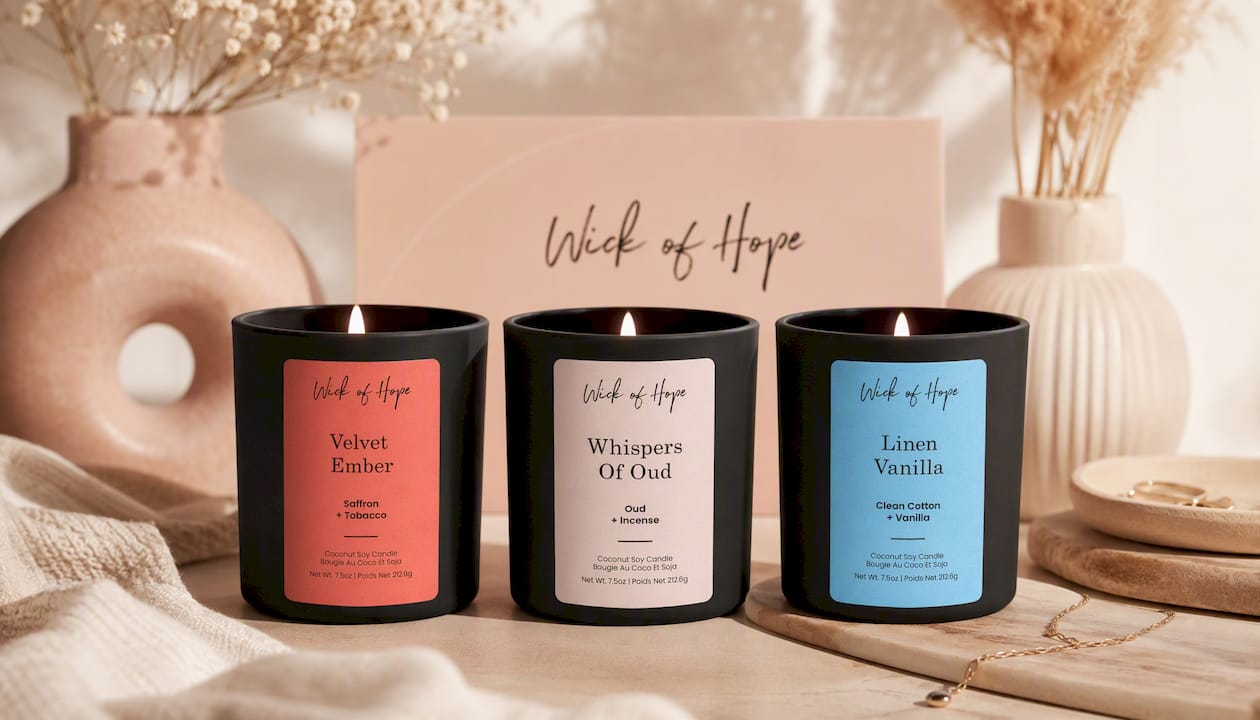
If you’re ready to put the checklist into practice, start with a lower-intensity option like the Linen Vanilla Candle | Clean Cotton + Vanilla for everyday rooms, or go bolder with the Velvet Ember Candle | Saffron + Tobacco or Whispers of Oud Candle | Oud + Incense for evening use. Every purchase also supports women and children escaping crisis, so the safer choice for your home does double duty. Browse the full scented candles collection and pick the fragrance intensity that fits your space today.
This article is general information, not a substitute for advice from a qualified doctor. Consult a qualified healthcare professional about your own circumstances before acting on anything here.
Sources
- Petry et al. — Measurement and evaluation of gaseous and particulate emissions from burning scented and unscented candles (2014)
- Toxicological evaluation of VOCs emitted from scented candles (Frontiers in Public Health, 2025)
- Study: VOC emissions from candles (PubMed entry)
- Increase of the indoor concentration of volatile organic compounds after the use of incense and scented candle in studio apartments (Chemosphere, 2024)


