


Fragrance notes are the scent impressions a perfume or candle releases as it wears or burns, grouped into top, heart, and base layers based on how quickly each one evaporates. They aren’t a literal ingredient list; they’re a shorthand for how a scent behaves from first spritz (or first light) to final trace. Understanding this vocabulary matters whether you’re choosing a perfume for daily wear or picking a candle to warm a room, because the note you smell in the store is rarely the note you’ll live with an hour later.
TL;DR:
- Top notes evaporate quickly within 15 minutes, often giving a bright, sharp impression that may not reflect the scent’s overall character.
- Heart notes emerge after 15 minutes to an hour and form the true essence of a fragrance, lasting several hours or more.
- Base notes are slow to evaporate, anchoring the scent with deep, lingering accords that can last into the next day.
- Fragrance notes are impressions built from synthentic aromachemicals and accords, not single chemical ingredients, affecting transparency and labeling.
- Hot throw in candles matters more than cold throw, as warming the wax can dramatically change the perceived scent intensity and profile.
Table of Contents
- What Are Fragrance Notes and the Fragrance Pyramid?
- Top Notes: What You Smell First (and Why It’s Misleading)
- Heart Notes: The True Character of a Fragrance
- Base Notes: What Makes a Scent Last
- Fragrance Note Families: A Practical Reference Guide
- Notes Are Impressions, Not Ingredients: Accords and Aromachemicals
- How to Identify Fragrance Notes When You’re Testing
- Cold Throw vs. Hot Throw: How Notes Behave in Candles
- How Wick of Hope Turns Fragrance Notes Into Non-Toxic Candles
- Why Fragrance Notes Carry Centuries of Cultural Weight
- How Notes Shape Perfume Classification and Style
- The Emotional Pull of Different Fragrance Notes
- Rules of Thumb for Picking a Scent You’ll Actually Enjoy All Day
- Find Non-Toxic Candles Built Around Notes You’ll Actually Love
- Sources
What Are Fragrance Notes and the Fragrance Pyramid?
The fragrance pyramid is the model perfumers and candle makers use to organize scent by volatility, the speed at which a molecule evaporates and reaches your nose. Top notes sit at the peak because they vanish fastest. Heart notes form the body. Base notes anchor the bottom because they linger longest, sometimes for hours after everything else has faded.
The system traces back to evaporation coefficient rankings developed by chemist William Poucher), who assigned numerical brackets to raw materials based on how fast they leave a blotter or the skin. Top notes generally fall between 1 and 14 on that scale, heart notes between 15 and 60, and base notes from 61 to 100. Lower numbers mean faster evaporation. A citrus oil might rank around 5. A resin like labdanum can sit above 80.
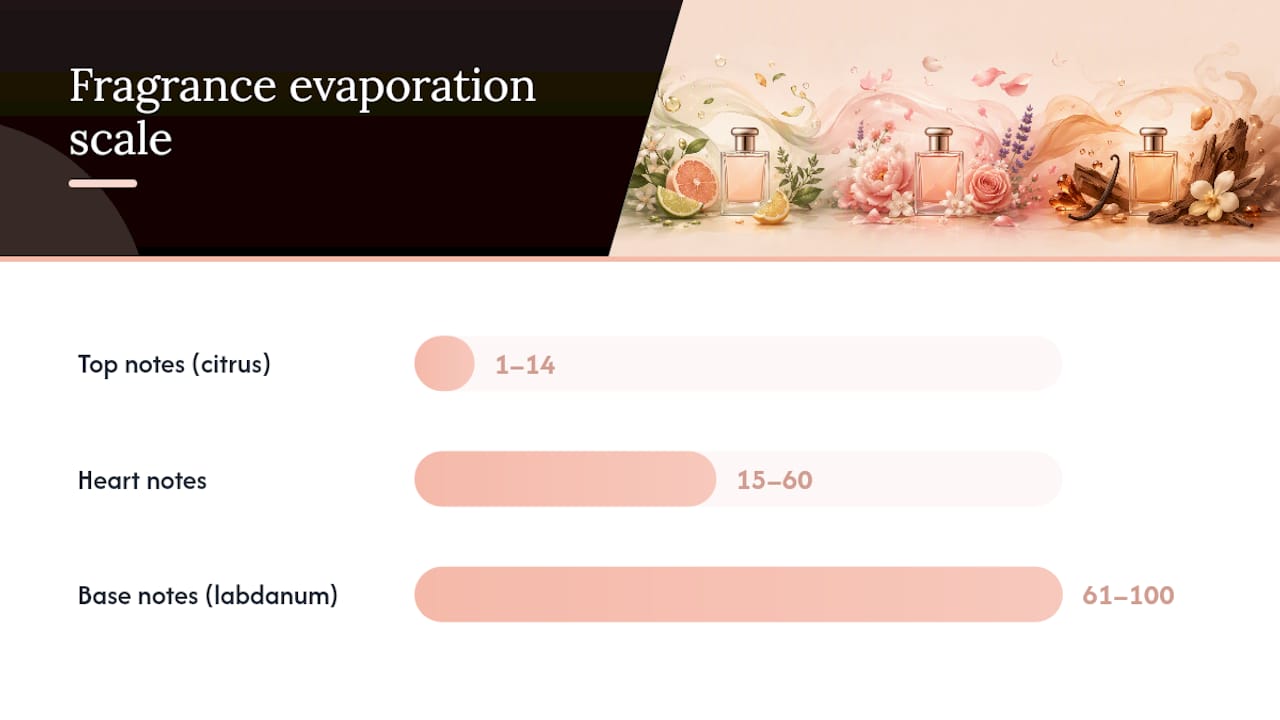
Those brackets aren’t rigid boundaries, though. Real fragrances overlap constantly. A heart note might start releasing within minutes of application, right alongside the top notes, and a base note is often present from the very first spray even if you can’t consciously smell it yet under everything else. Concentration changes this timeline too: an eau de toilette unfolds faster and fades sooner than a parfum extract built from the same formula, because higher oil concentration slows the whole evaporation curve.
Here’s what the pyramid actually communicates:
- Top notes (evaporation coefficient 1–14): the opening impression, gone within 5 to 15 minutes on skin
- Heart notes (15–60): the main character of the scent, emerging as top notes fade and lasting one to several hours
- Base notes (61–100): the foundation and dry-down, often detectable for many hours or into the next day
Think of the pyramid less as a formula and more as a communication tool. It gives you, the shopper, a rough map of what to expect and when, so you’re not judging a $150 bottle of perfume on the first 90 seconds alone.
Top Notes: What You Smell First (and Why It’s Misleading)
Top notes are the introduction, and introductions are brief on purpose. They’re built from small, volatile molecules that evaporate quickly, which is exactly why they read as bright, sharp, or fresh rather than deep or complex. A fragrance’s top notes are doing a specific job: hook your attention in the first few minutes, then step aside.
Common top-note materials include:
- Citrus oils like bergamot, lemon, and grapefruit
- Light herbs such as basil, mint, or lavender’s fresher aspects
- Fruity accents like green apple or pear
- Aromatic spices, especially pink pepper or cardamom
The sampling trap here is real. Spray a perfume in a department store, catch that first burst of bergamot and pepper, and decide you love it, only to find the scent you actually wear all day is something entirely different once the citrus burns off. This is the single most common mistake in how to identify fragrance notes correctly: mistaking the opening act for the whole performance.
Pro Tip: Give any new fragrance at least 15 minutes before forming an opinion. If you’re comparing multiple scents at a counter, spray each on a separate blotter strip rather than layering them on your wrist, where they’ll blend into a confusing mess.
Top notes still matter. They set the mood and, in candles, they’re often what pulls a shopper toward a jar on a shelf. Just don’t let them be the only note you judge.
Heart Notes: The True Character of a Fragrance
Heart notes, also called middle notes, are where a fragrance reveals what it’s actually about. They surface as the top notes evaporate, typically somewhere between 15 minutes and an hour after application, and they form the emotional core that most people end up describing when they talk about how a perfume “smells.”

This is the layer worth waiting for. Heart notes tend to be built from less volatile florals, spices, and softer fruits, materials with more molecular weight than the sharp citrus and herbs up top. They read as warmer, rounder, and more textured.
Typical heart-note materials include:
- Florals such as rose, jasmine, ylang ylang, and lavender
- Warm spices like cinnamon, clove, and nutmeg
- Creamy or ripe fruits, including peach and fig
- Green, herbaceous accents that bridge from the top layer
If top notes are the handshake, heart notes are the actual conversation. A fragrance described as “rosy” or “spicy” is almost always describing its heart, not its opening. This is also the smartest point in the testing process to decide whether you like a scent enough to buy it, since it’s the layer you’ll be wearing for the bulk of the day. Skipping straight from top notes to a purchase decision is how people end up with a bottle of perfume they never reach for again.
Base Notes: What Makes a Scent Last
Base notes are the reason a fragrance still smells like something on your sweater at the end of the day. Built from heavy, slow-evaporating molecules, they’re the last layer to arrive and the last to leave, sometimes lingering for eight hours or more depending on concentration and skin type.

Base materials are typically dense, resinous, or musky, and they do double duty as fixatives, meaning they physically slow the evaporation of the lighter notes above them. A perfume built entirely from top and heart notes with no base would smell bright for twenty minutes and then simply disappear. The base is what gives a fragrance staying power.
Common base-note materials include:
- Woods like sandalwood, cedar, and vetiver
- Vanilla and other gourmand elements
- Amber accords, built from resins like labdanum and benzoin
- Musks, both natural-derived and synthetic
- Patchouli and oakmoss for depth and earthiness
A well-built fragrance uses its base to quietly support everything above it from the very start, even though you may not consciously register the sandalwood or musk until hours later. That’s the fixative effect at work: the base note doesn’t just show up late, it’s been slowing down the whole evaporation curve the entire time.
Fragrance Note Families: A Practical Reference Guide
Note names get thrown around constantly on candle and perfume labels, but they cluster into a manageable number of families. Knowing these families helps you translate an unfamiliar name into a real scent impression before you buy.
| Family | Typical layer | Common examples |
|---|---|---|
| Citrus | Top | Bergamot, lemon, grapefruit, mandarin |
| Floral | Heart | Rose, jasmine, lavender, lilac, ylang ylang |
| Fruity | Top to heart | Peach, apple, fig, blackcurrant, pear |
| Green/aromatic | Top to heart | Basil, mint, galbanum, fresh-cut grass |
| Spice | Heart to base | Cinnamon, clove, nutmeg, saffron, pink pepper |
| Woods | Base | Sandalwood, cedar, vetiver, oud |
| Gourmand | Base | Vanilla, caramel, coffee, tonka bean |
| Resins/amber | Base | Labdanum, benzoin, amber accords |
| Musks | Base | White musk, ambrette, synthetic musks |
A few families deserve a closer look. Green and aromatic notes often bridge the top and heart, softening the transition so a fragrance doesn’t feel like it’s changing personality abruptly. Gourmand notes, the vanilla-and-caramel category that dominates fall candle collections, almost always sit in the base because sugar-adjacent molecules tend to be heavier and slower to evaporate.
Amber deserves a specific flag: it isn’t a single raw material at all. It’s an accord, a blended construction usually built from labdanum, vanilla, and benzoin to recreate the warm, resinous smell associated with aged amber gemstone, which itself has no fragrance. Lilac works the same way. The living flower yields almost no usable essential oil, so every “lilac” note you’ve ever smelled was built synthetically from scratch. Knowing this changes how you read a label, because “note” almost never means “this exact substance is in the bottle.”
Notes Are Impressions, Not Ingredients: Accords and Aromachemicals
A listed fragrance note describes a scent impression, not a single chemical compound sitting in the bottle. That distinction is the most misunderstood part of how to read fragrance notes, and it’s worth sitting with for a moment.
Formulators build these impressions using aromachemicals, synthesized molecules valued for consistency, stability, and safety in ways that natural extracts often can’t match. A natural rose oil’s exact composition shifts with the harvest, the weather that year, even the soil. An aromachemical performs the same way every single time, which is why perfume houses rely on them heavily even in expensive, natural-leaning formulas.
Some representative molecules behind familiar notes, according to industry breakdowns of common fragrance materials:
- Vanillin: the backbone of nearly every vanilla note on the market
- Ambroxan: a synthetic amber and musk material, now one of the most widely used base ingredients in modern perfumery
- Iso E Super: a woody, velvety molecule that adds smoothness to countless base accords
- Linalool: a naturally occurring compound in lavender and citrus, also produced synthetically for consistency
An accord is what happens when two or more of these materials are blended to create an impression that reads as something new entirely, the way labdanum, vanillin, and benzoin combine to become “amber,” a smell that doesn’t correspond to any single raw ingredient. This blending is also why ingredient transparency has become a bigger conversation in the industry. Starting April 12, 2026, Health Canada will require disclosure of certain fragrance allergens on cosmetic labels, a shift that will make it easier for Canadian shoppers to see some of what sits behind a note name like “floral bouquet” or “amber.”
None of this makes natural materials better or synthetics worse. It just means the note on the label is a promise about the experience, not a chemistry report.
How to Identify Fragrance Notes When You’re Testing
Reading fragrance notes accurately takes a method, not just a good nose. Here’s a routine that works whether you’re standing at a department store counter or sampling candles at home.
- Apply to skin, not just a blotter. Paper strips are useful for quick comparisons, but skin chemistry changes how notes develop, so a fragrance you’ll actually wear needs a skin test eventually.
- Check in at the 5 to 15 minute mark. This is the top note phase. Note what you smell, but don’t decide anything yet.
- Check again at 30 to 60 minutes. The heart note should be established by now. This is usually the truest read of the fragrance’s character.
- Check a final time after 3 or more hours. You’re now smelling the base, the note that will still be there when everyone else has gone home.
- Test in a neutral environment. Strong coffee, cigarette smoke, or another fragrance nearby will distort what you perceive. Perception research on olfaction and fragrance chemistry confirms that scent evaluation is highly sensitive to both skin chemistry and surrounding conditions, which is exactly why multiple checkpoints matter more than a single sniff.
- Compare like against like. Test two florals side by side, or one citrus-forward scent against another, rather than jumping between wildly different categories, which fatigues your nose fast.
Pro Tip: Your sense of smell adapts to a scent within a few minutes and starts filtering it out, a phenomenon called olfactory fatigue. If you’re testing several fragrances in one sitting, step outside or smell your own wrist between each one to reset.
Cold Throw vs. Hot Throw: How Notes Behave in Candles
Candle shopping runs on a different physics problem than perfume shopping, and this is where a lot of buyers get tripped up. Cold throw is how strongly a candle smells unlit, straight from the jar. Hot throw is how the fragrance fills a room once the wax is melted and warm. The two can be dramatically different, and hot throw is the one that actually determines whether you’re happy with your purchase.
Heat accelerates volatility across the board, so a top note that’s barely noticeable in cold throw can dominate the room once the wax pool warms up, while a heavy base note might need real burn time (often a full melt pool) before it shows itself at all. Wax composition changes this further. Coconut soy wax, for instance, tends to carry scent cleanly without the sooty interference that some paraffin blends introduce, letting more delicate top and heart notes actually reach your nose instead of getting muddied.
- Bright citrus and green notes work well in kitchens and bathrooms, where you want a quick, clean lift
- Warm gourmand and spice notes suit living rooms and bedrooms, where a slow, lingering base note pays off over hours
- Woody and musk-forward blends hold up best in larger or open-concept spaces, since they need time and airflow to fully unfold
If you’re deciding which scent profile fits which room in your home, hot throw performance matters more than whatever you smelled through the lid at checkout.
How Wick of Hope Turns Fragrance Notes Into Non-Toxic Candles
Every scent Wick of Hope develops starts with the same pyramid logic covered above, then gets tested specifically for how it performs in natural coconut soy wax with an FSC-certified wooden wick, since wax and skin release notes at different speeds. That means checking hot throw at multiple burn stages, not just cold throw off the shelf, and formulating with non-toxic fragrance oils instead of the synthetic loads found in mass-market candles.
A few examples map cleanly onto the note families discussed above. The Coffee Crumble Wax Melt pairs a fresh coffee top note with a vanilla butter base, a textbook case of layering a sharp opening over a lingering, gourmand foundation. The Velvet Ember Candle, built on saffron and tobacco, leans on spice and resinous depth for a heart and base that carry real hot throw in larger rooms. The Dew Kissed Mornings Wax Melt, with honeydew and cucumber, stays almost entirely in the light, green top and heart register, which is exactly why it reads so clean and quick.
Author: Andy, on behalf of Wick of Hope’s fragrance development team.
Why Fragrance Notes Carry Centuries of Cultural Weight
Fragrance notes didn’t start as a marketing convention. Ancient Egyptian, Mesopotamian, and later French perfumers built entire trade economies around specific materials: frankincense and myrrh for ritual, civet and musk for status, orange blossom for the French court of Versailles. The three-tier pyramid itself is a modern organizing tool, formalized in the 19th and 20th centuries as chemistry advanced, but the raw materials behind it carry history that stretches back thousands of years.
Certain notes still carry cultural signatures today. Oud, a resinous wood note, holds deep significance across Middle Eastern perfumery and remains one of the most prized (and expensive) base materials in the world. Lavender is inseparable from Provence and French soap-making traditions. Vanilla’s gourmand warmth traces to colonial-era trade routes that reshaped how the material moved into European and North American perfumery.
Understanding this history changes how you read a fragrance note. “Amber” isn’t just a modern accord name, it echoes centuries of resin trade across the Arabian Peninsula and North Africa. When a candle or perfume leans on a specific note family, it’s often, intentionally or not, drawing on that cultural lineage, and part of what makes certain notes feel instantly evocative is the weight of everything they’ve represented for generations before they ever reached a store shelf.
How Notes Shape Perfume Classification and Style
Perfume families, the broad style categories like floral, oriental, woody, and fresh, are built directly from which notes dominate a fragrance’s pyramid. A “floral” classification means florals anchor the heart. A “woody” or “oriental” classification (sometimes now called “amber”) means resins, musks, and warm spice dominate the base. This classification system exists specifically because note behavior over time is the most reliable way to group fragrances that might smell completely different at first spray but share a structural DNA.
Sub-families refine this further. A “fresh floral” leans on citrus top notes supporting a floral heart, while a “floral oriental” pairs those same florals against a heavy amber or musk base instead of a light finish. This is why two perfumes can both be labeled “rose” and smell like entirely different fragrances: the rose might be sitting atop a green, aquatic base in one and a deep, spicy amber base in the other.
For shoppers, this classification system is a genuine shortcut. If you know you gravitate toward woody orientals, you can predict with real confidence that a new release in that family will lean warm and long-lasting rather than bright and fleeting, well before you ever test it. It’s also why perfume counters and candle collections group products by family rather than alphabetically. The note structure, not the brand or the price point, is what actually determines whether a fragrance will suit your taste.
The Emotional Pull of Different Fragrance Notes
Scent is the sense most directly wired to memory and emotion, processed through the olfactory bulb’s close neural proximity to the amygdala and hippocampus. This is part of why fragrance note choice feels so personal, and why the right candle in a room can shift a mood almost instantly.
Different note families tend to trigger different psychological responses, though individual memory always plays a role too. Citrus and green top notes read as energizing and clarifying, which is why so many “morning” or “focus” blends lean on bergamot, lemon, and mint. Warm gourmand base notes like vanilla and tonka bean read as comforting and nostalgic, often because they echo food memories from early in life. Woody and resinous bases like sandalwood and amber tend to read as grounding, even meditative, which explains their popularity in wellness and self-care contexts.
This is also why fragrance choice shifts with season and mood far more than most other purchases. A bright citrus-and-green blend that feels perfect for a spring morning can feel jarring on a dark December evening, when a spice-and-amber base note suits the emotional register of the season much better. Choosing a fragrance note isn’t just about what smells pleasant. It’s about what mood you’re trying to create in a room, or in yourself, at that specific moment.
Rules of Thumb for Picking a Scent You’ll Actually Enjoy All Day
After walking through the pyramid, three rules do most of the heavy lifting. First, always wait for the heart note before deciding. The opening is a preview, not the movie. Second, weight your decision toward the heart, since that’s the layer you’ll live with the longest during active wear. Third, factor in setting and season deliberately: a scent that’s perfect for a summer patio can feel wrong in a closed winter bedroom.
On complexity: simple, linear scents (a single dominant note carried through with minimal shifting) suit daily wear and smaller rooms, where you want something pleasant but not attention-demanding. Complex, multi-layered pyramids reward slower environments, evenings, gift-giving, or larger spaces where the fragrance has room to unfold in stages.
Before buying, ask yourself three things: Have I smelled the heart note, not just the opening? Does this note family match the room or season I’m buying for? Am I choosing this because I like it, or because I liked the first ten seconds? That last question saves more return trips than anything else.
— Andy
Find Non-Toxic Candles Built Around Notes You’ll Actually Love
Once you know how top, heart, and base notes behave, shopping for a candle stops being guesswork and starts being a real decision about mood, room, and season. Wick of Hope builds every fragrance in natural coconut soy wax with a wooden wick, so the notes you’re drawn to on the label are the ones you actually get in hot throw, without the synthetic haze that paraffin blends can leave behind.
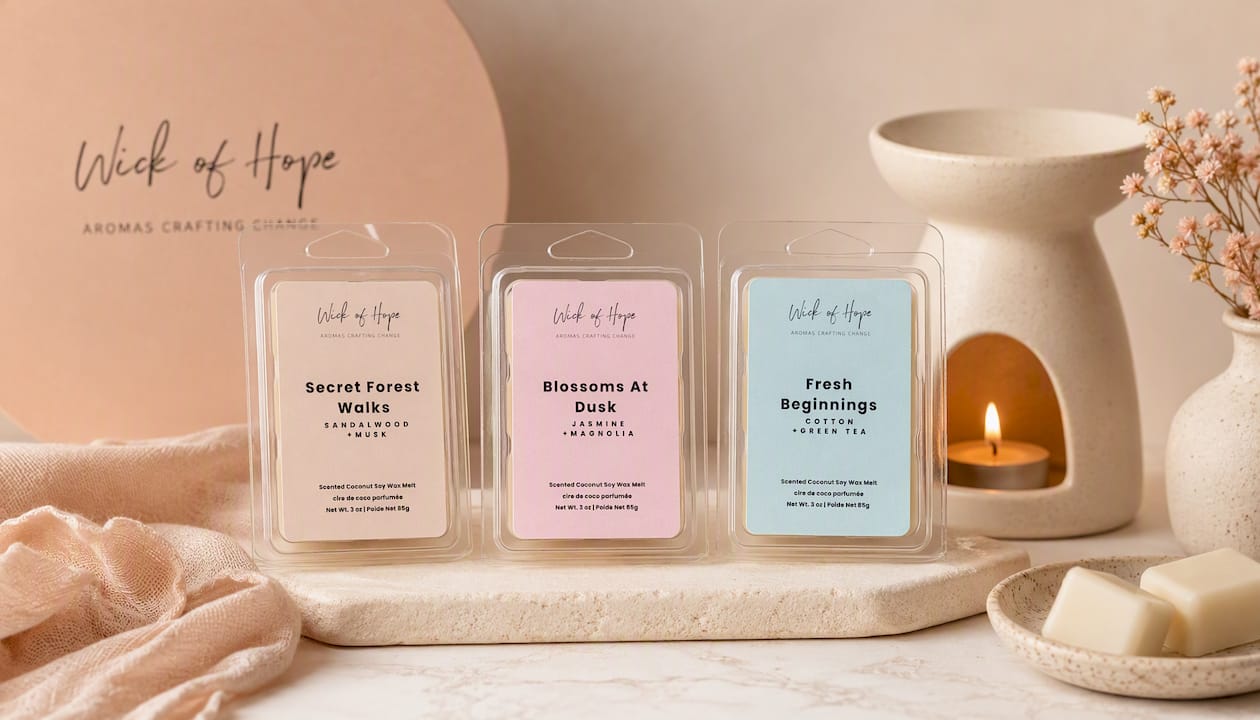
If you’re drawn to gourmand warmth, the Cozy Spice Embrace Wax Melt pairs an amber romance heart with a vanilla base built for slow, cozy rooms. Prefer something brighter for mornings? The Dew Kissed Mornings Wax Melt stays light and green from top to heart. For a candle built on spice and depth, the Velvet Ember Candle carries saffron and tobacco through a long, warm base. And if clean, soft simplicity is what you’re after, the Linen Vanilla Candle rests cotton’s crispness over a gentle vanilla foundation.
Take the Find Your Scent quiz to match your preferred note families to the right product before you buy, and every purchase helps fund crisis support for women and children through Wick of Hope’s Empower Change initiative.
Sources
- PMC review on olfaction and fragrance chemistry — NCBI PMC
- What Do Fragrance Notes Mean? — PerfumeDom
- CIRS — Health Canada mandates fragrance allergen disclosure (Apr 12, 2026)


