


An IFRA-compliant fragrance is one used within the limits set by the IFRA Standards: banned outright, capped at a specific percentage, or allowed only under certain conditions. The one thing you need in hand to confirm this is the per-fragrance Certificate of Conformity, matched to your product’s category maximum. Your supplier issues that certificate. You, as the brand selling the finished candle or melt, carry the responsibility for making sure it actually applies.
TL;DR:
- A fragrance must have a valid, category-specific Certificate of Conformity issued by the manufacturer to verify IFRA compliance, not just a vague claim.
- The relevant product category, such as candles in Category 12, determines the maximum fragrance percentage allowed, which is always a share of the finished product, not the concentrate.
- Certificates should specify limits based on the current amendment number, and older certificates may no longer reflect the latest safety standards, requiring periodic re-verification.
- Non-compliance risks include retail rejection, damage to brand reputation, and potential regulatory issues if the certificate lacks proper details or if limits have been tightened.
- Small brands benefit from checking and logging amendment numbers and dates to prevent unintentional violations when standards update over time.
Table of Contents
- What Is IFRA and What Does “IFRA Compliant” Really Mean?
- How Do IFRA Product Categories and Usage Limits Work?
- What Is an IFRA Certificate of Conformity and Who Issues It?
- How Do You Verify a Supplier’s IFRA Compliance Claims?
- How Do You Calculate a Safe Fragrance Load for Candles?
- How Does Wick of Hope Apply IFRA Standards to Its Candles?
- How Often Are the IFRA Standards Revised?
- How Is Fragrance Safety Actually Tested and Assessed?
- How Does IFRA Compliance Shape Fragrance Formulation and Innovation?
- What Happens If a Product Isn’t IFRA Compliant?
- What Does IFRA Compliance Look Like in Real Production?
- Why Standards and Creativity Aren’t Actually in Tension
- Explore Wick of Hope’s IFRA-Aware Candles and Wax Melts
- Sources
What Is IFRA and What Does “IFRA Compliant” Really Mean?
IFRA stands for the International Fragrance Association, and it doesn’t test your candle, inspect your workshop, or hand out gold stars. It publishes a set of Standards that the fragrance industry treats as the benchmark for safe use, built from a specific scientific pipeline: independent researchers at the Research Institute for Fragrance Materials (RIFM) assess an ingredient, an Expert Panel of toxicologists reviews the data, and IFRA translates the outcome into a usable limit.
That limit lands in one of three buckets:
- Prohibited — the material can’t be used in fragrance compounds at all, full stop.
- Restricted — it’s allowed, but only up to a maximum percentage that depends on how the finished product is used.
- Specified — it comes with conditions attached, like a required purity level or a companion ingredient.
Here’s where a lot of confusion creeps in: IFRA membership is voluntary, and the Standards themselves are an industry self-regulation system, not government law. Compliance is mandatory only for IFRA’s own members, and even full compliance with IFRA never replaces your obligation to meet local regulatory requirements in whatever country you’re selling into.
The other trap is the bare claim. “This fragrance is IFRA compliant” with no numbers attached tells you almost nothing. Compliance is always relative to a product category and an amendment date. Without category-specific figures, the phrase is marketing language, not documentation.
How Do IFRA Product Categories and Usage Limits Work?
IFRA’s Standards library organizes every finished product type into one of 12 categories, and the category you fall into determines how much fragrance you’re allowed to use. The logic is exposure, not product type for its own sake. A lip balm sits in a much stricter category than a room spray because your skin absorbs far more from something you wear on your mouth for hours than from a candle burning across the room.
The categories that matter most for home fragrance and personal care makers include:
- Category 1 covers lip products, where exposure is the highest relative to body weight.
- Category 4 covers leave-on skin products like lotions and perfumes applied directly and not rinsed off.
- Category 5 covers rinse-off products such as soaps and shampoos.
- Category 9 covers products with limited skin contact and inhalation, including some cosmetics.
- Category 11 covers products with intended skin contact but negligible inhalation exposure.
- Category 12 covers products not intended for skin contact, which is where candles, wax melts, and diffuser oils live.
Every limit in the Standards library is a percentage of the fragrance in the finished consumer product, not the raw fragrance concentrate. That distinction trips up a lot of hobbyists. If the certificate says 0.8% for Category 12, that’s the maximum share of your entire finished candle, wax and all, not the fragrance oil bottle sitting on your workbench.
Amendment numbers matter as much as the percentage itself. IFRA revises the Standards periodically, and each revision carries an amendment number (the current version is Amendment 51 as of this writing, with new ones issued roughly every year or two). A certificate referencing an outdated amendment may cite limits IFRA has since tightened or reversed. Before trusting any percentage, check it against the current Standards library and cross-reference specific ingredients against the Transparency List, which functions as a public inventory of what’s actually in fragrance mixtures.
What Is an IFRA Certificate of Conformity and Who Issues It?
The Certificate of Conformity is the document that turns a vague compliance claim into something you can actually verify. IFRA provides the certificate template, but it doesn’t issue certificates itself; that job falls to whoever manufactures the fragrance mixture. When your supplier hands you paperwork claiming Standards compliance, it should originate from the company that actually blended the oil.
A genuine certificate typically includes:
- The fragrance name and internal reference code
- The IFRA amendment number the assessment is based on
- Maximum usage percentages broken out by product category (not just one blanket number)
- The date of issue
- Contact details for the issuing manufacturer
A short statement that just says “meets IFRA standards” without any of the above is not the same thing as a certificate, and treating it as equivalent is one of the more common mistakes among newer makers. If there are no per-category numbers on the page, ask what exactly is being certified.
It’s worth being clear about what the certificate does not cover, too. It confirms the fragrance mixture’s usage limits under IFRA’s framework. It does not double as a full product safety assessment for your finished candle, and it does not clear you of local regulatory obligations, like labeling rules or cosmetic notification requirements, that vary by country. Those sit on top of, not instead of, IFRA compliance.
One more distinction worth knowing: certificates usually apply to fragrance mixtures, the blended oils you buy to scent a product. Single raw materials, like a pure essential oil, are handled differently and often referenced through the Standards library directly rather than a mixture-specific certificate.
How Do You Verify a Supplier’s IFRA Compliance Claims?
Trusting a label is not the same as verifying one, and with fragrance sourcing, the gap between the two shows up fast once you actually ask for paperwork. Here’s what to request before you commit to a fragrance oil for a production run.
Ask your supplier for:
- The full IFRA Certificate of Conformity for that specific fragrance, not a general company statement
- The Safety Data Sheet (SDS)
- The ingredient disclosure level, since some suppliers only disclose down to a certain concentration threshold
- Batch numbers tied to the certificate, so you know which production run the paperwork actually covers
- The amendment number and issue date
Once you have the documents, cross-check them. Compare the certificate’s amendment number against the current one in the Standards library; a certificate referencing an amendment from several years back needs a second look, since limits do get revised. If the SDS lists specific constituents, spot-check a few against the Transparency List to confirm nothing on it has since moved into restricted or prohibited territory.
Watch for red flags: a certificate with no date, no amendment number, or a single blanket percentage instead of category-specific figures. Vague verbal assurances (“yeah, it’s compliant”) without paperwork are the biggest one. If a supplier genuinely can’t produce a certificate, ask for a written numeric conformity statement at minimum, or have a qualified technical reviewer look at the constituent data before you formulate anything with it.
Pro Tip: Keep a simple spreadsheet logging every fragrance’s amendment number and certificate date. When IFRA issues a new amendment, you can scan your list in minutes instead of digging through old email threads to figure out which oils need a fresh look.
How Do You Calculate a Safe Fragrance Load for Candles?
Turning a certificate into an actual production decision takes a few concrete steps, and candle making is a useful example because the math is simple once you know where to look.
- Identify your product category. Candles, wax melts, and similar products with no intended skin contact fall under Category 12 in the IFRA framework.
- Read the certificate’s Category 12 percentage. Note the amendment number it’s based on, since that pairing is what tells you both how much you can use and whether the figure is current.
- Calculate the fragrance load for your finished product. If a certificate lists a Category 12 maximum of 0.8%, and you’re pouring an 8oz (227 gram) candle, the ceiling is roughly 1.8 grams of fragrance oil for that entire candle, not per pound of wax alone, but as a share of the total finished weight.
- Document everything. Keep the supplier’s certificate, the SDS, your batch records, and your own formulation notes together for every production run, not just the first one.
The single most useful figure on the entire certificate, more than any other detail, is the per-category maximum paired with its amendment date. Those two numbers answer both questions that actually matter: how much can I use, and is this assessment still current.
One caveat trips up a lot of makers who lean on essential oils: natural doesn’t mean exempt. Several naturally occurring constituents, citral, limonene, eugenol, and cinnamic aldehyde among them, carry their own specific limits inside the Standards regardless of whether they showed up in a synthetic blend or a cold-pressed citrus oil. When a Standard applies to a natural complex substance like an essential oil, the documentation usually treats it through its individual constituents and impurity thresholds rather than granting the whole oil a pass. Check the constituent breakdown before assuming a “pure” or “natural” label sidesteps the rules.
How Does Wick of Hope Apply IFRA Standards to Its Candles?
We build our sourcing around one non-negotiable: fragrance suppliers need to hand over a real, per-fragrance IFRA certificate before an oil goes anywhere near production, not a generic compliance statement.
In practice, that looks like:
- Requesting full disclosure and per-category numbers for every fragrance we source
- Checking amendment dates against the current Standards before approving a scent for a production run
- Tracking batch numbers so any single candle can be traced back to its certificate and formulation notes
- Pairing that paperwork discipline with our broader material choices: coconut soy wax, wooden wicks, and biodegradable packaging
It’s the same instinct behind our 4.9-star rating across more than 650 reviews: people trust what they can verify, not just what they’re told.
How Often Are the IFRA Standards Revised?
The Standards aren’t a document IFRA writes once and leaves alone. They get revised through a formal amendment process, and each new version is numbered sequentially, which is why checking the amendment number on a certificate matters as much as the percentage itself.
The cycle typically starts with new safety data. RIFM continues assessing fragrance materials on an ongoing basis, and when new toxicology, environmental, or exposure data emerges on an ingredient already covered by a Standard, or one not yet covered, that data moves through the Expert Panel for review. If the panel’s conclusions call for a change, whether tightening a restriction, lifting one, or adding a brand-new material to the list, IFRA folds it into the next amendment.
Amendments don’t arrive on a fixed monthly or quarterly calendar. Major amendments have historically rolled out every year or two, sometimes with interim updates addressing a single urgent ingredient concern in between. Each one comes with a compliance transition period, giving fragrance and finished-product manufacturers time to reformulate before the new limits become the expected standard.
This is exactly why a certificate’s date matters so much to a hobbyist or small brand. An oil certified compliant under an old amendment might reference limits that have since shifted. It doesn’t necessarily mean the oil is unsafe, but it does mean the paperwork in your files may no longer reflect the current benchmark, and re-verifying periodically, especially for fragrances you use in ongoing production, is worth building into your routine rather than treating as a one-time check.
How Is Fragrance Safety Actually Tested and Assessed?
Fragrance safety assessment isn’t a single test; it’s a layered process that looks at how an ingredient behaves across different kinds of exposure before any limit gets set.
RIFM’s assessments typically draw on toxicology data covering several angles: skin sensitization (does the material trigger allergic reactions with repeated contact), irritation potential, phototoxicity (does it become harmful under UV exposure), and broader systemic toxicity depending on how the ingredient is likely to be used. Environmental data on persistence and aquatic toxicity factors in too, since fragrance materials wash down drains and end up in wastewater.
The methodology leans heavily on exposure modeling. A raw toxicity number on its own doesn’t tell you much; what matters is how much of that ingredient a real person is likely to encounter given typical usage patterns for a given product type. That’s the underlying reason Category 12 candle products get more headroom than Category 4 leave-on skin products using the exact same fragrance material. The dose that matters is the dose someone actually absorbs, not the dose theoretically present in the bottle.
Once RIFM completes an assessment, it goes to the independent Expert Panel, made up of toxicologists and dermatologists who review the data and either endorse a proposed limit or send it back for more work. Only after that endorsement does IFRA formalize the number into a Standard. It’s a slower process than a single lab test, but it’s the reason the resulting limits carry credibility across an industry that otherwise has no single legal enforcer holding everyone to the same bar.
How Does IFRA Compliance Shape Fragrance Formulation and Innovation?
IFRA limits don’t just restrict what perfumers can use; they actively shape how new fragrances get built in the first place. A material that gets restricted or banned doesn’t disappear from the industry’s toolkit so much as force chemists to find a substitute that delivers a similar scent profile within a safer margin.
This has pushed real innovation in ingredient chemistry. When certain musk compounds faced tighter restrictions over environmental persistence concerns, the industry didn’t quietly drop musky notes from its palette; it invested in alternative musk molecules that could deliver a comparable effect while clearing the new bar. The same pattern has played out with several allergens once common in citrus and floral accords.
For small makers and hobbyists, the practical impact is usually a formulation constraint rather than a creative dead end. If your favorite fragrance oil comes back from a supplier with a lower Category 12 maximum than you expected, that’s a signal to either dial back your fragrance load, blend it with a complementary scent that has more headroom, or ask your supplier whether a reformulated version of that fragrance exists that hits the same character with a friendlier limit.
There’s also a quieter benefit: brands that build IFRA compliance into their formulation process from the start tend to spend less time firefighting later. Reformulating a bestselling scent after a customer complaint or a retailer’s compliance audit is far more disruptive than checking a certificate before the first production run. Compliance, approached early, is a formulation habit rather than a paperwork afterthought.
What Happens If a Product Isn’t IFRA Compliant?
Because IFRA Standards are industry self-regulation rather than statute, there’s no government fine that automatically follows a non-compliant fragrance the way there might be for, say, a mislabeled food product. That doesn’t mean the consequences are minor.
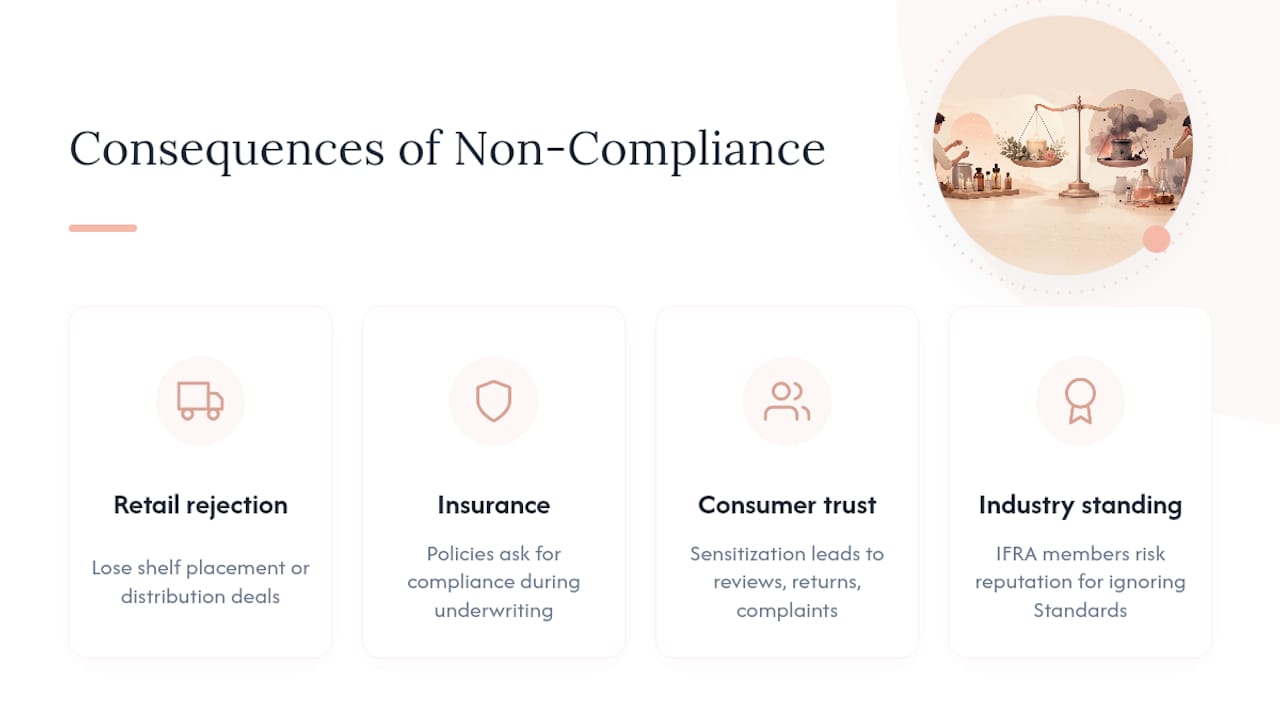
The most immediate risk is retail and wholesale rejection. Many retailers, marketplaces, and wholesale partners now require IFRA documentation as a condition of stocking a fragranced product, and a brand that can’t produce a certificate on request can lose a shelf placement or a distribution deal before a single unit ships. Insurance is another quiet pressure point: some product liability policies for cosmetics and home fragrance makers ask about compliance documentation during underwriting.
There’s also the consumer-facing risk, which is really a trust risk. A sensitization reaction traced back to an over-limit allergen doesn’t just cost one customer; it becomes a public review, a return, or worse, a safety complaint that regulators or retailers take seriously even absent a specific law citing IFRA by name. And because IFRA membership requires compliance, a member company caught ignoring its own Standards risks its industry standing, not just a single product’s reputation.
Layered on top of all this sits actual law. IFRA non-compliance often correlates with regulatory non-compliance too, since many countries’ cosmetic and consumer product regulations either reference IFRA limits directly or set comparably strict thresholds for the same allergens and irritants. Skipping IFRA verification frequently means skipping a check that local regulators expect to see documented somewhere in your files.
What Does IFRA Compliance Look Like in Real Production?
The clearest way to see how this plays out is to walk through where makers commonly get tripped up, and where a quick certificate check would have caught it.
A frequent scenario: a candle maker sources a popular “spiced vanilla” fragrance oil marketed with a generic “IFRA compliant” label on the product page. No amendment number, no category breakdown. They scale up production, selling several hundred units before a customer reports skin irritation from handling a wax melt.
Compare that to a maker who requests the full certificate before finalizing a new scent. They see the Category 12 maximum, calculate their fragrance load against their exact wax weight per candle, and log the amendment number alongside their formulation notes. Eighteen months later, when IFRA issues a new amendment tightening that same fragrance’s limit, they catch the change during a routine documentation review rather than after a complaint.

The difference between those two outcomes isn’t formulation skill. It’s whether the certificate got read in the first place, and whether someone bothered to write the numbers down where they’d actually be checked again.
Why Standards and Creativity Aren’t Actually in Tension
The idea that IFRA limits box in creative fragrance work doesn’t hold up once you’ve watched what happens without them: guesswork, inconsistent products, and brands that can’t answer a simple safety question when a customer asks. Certificates and transparent documentation aren’t red tape sitting on top of good scent design; they’re what let a small brand make a specific, defensible claim instead of a hopeful one.
Compliance also does something quieter but more valuable over time. It shrinks your liability exposure and gives customers a real reason to trust a product beyond a nice label, which matters more the longer you’re in business, not less. Brands that treat certificates as a formality now are the ones scrambling to reformulate later. The ones that build the habit early tend to still be around when the next amendment lands.
— Andy
Explore Wick of Hope’s IFRA-Aware Candles and Wax Melts
We check the same paperwork we just walked you through, per-fragrance certificates, current amendment numbers, and full category disclosure, before any scent goes into a Wick of Hope candle or wax melt. That’s the difference between buying a product labeled “safe” and buying one where the safety claim actually has numbers behind it.
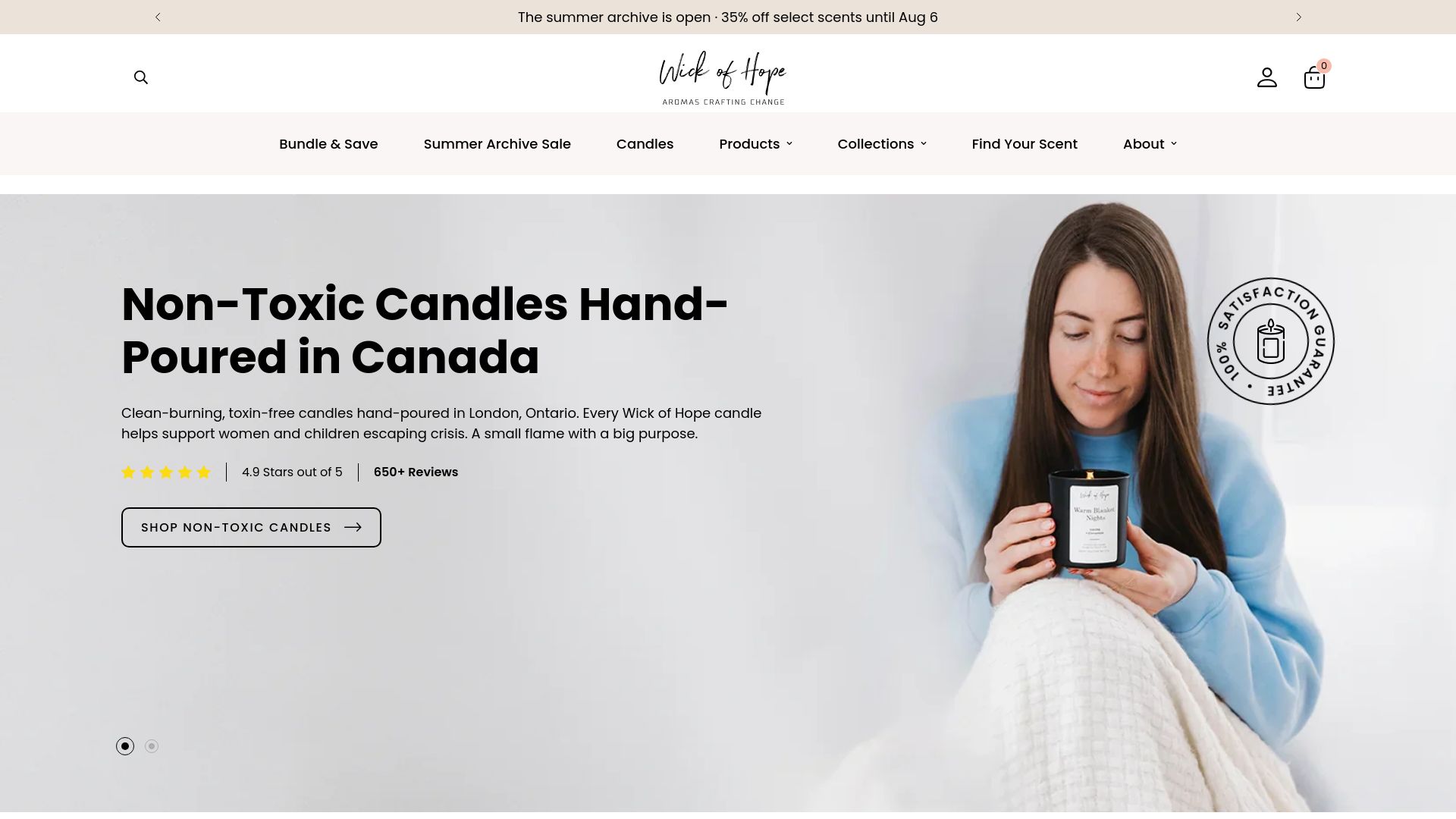
You’ll find that same documentation discipline across our fragranced lineup, from the Velvet Ember Candle in Saffron and Tobacco to the Linen Vanilla Candle in Clean Cotton and Vanilla, the cozy Pumpkin Spice Candle with Nutmeg and Cinnamon, and our simple Tealight for everyday burning. On the wax melt side, the Cozy Spice Embrace Wax Melt in Amber Romance and Vanilla, the Fresh Beginnings Wax Melt in Cotton and Green Tea, and the Coffee Crumble Wax Melt in Fresh Coffee and Vanilla Butter all carry the same sourcing standard, along with our budget-friendly Tealight Seconds for anyone who wants the same clean fragrance at a lower price point. Every purchase also helps fund support for women and children escaping crisis. Browse the full scented candle collection and pick the scent that fits your space tonight.


