


Essential oil candles are safe for most healthy adults when burned in a ventilated room for no more than 3 to 4 hours at a time, according to Health Canada’s candle-safety guidance. They become riskier around pets, pregnant people, infants, and anyone with asthma, since certain oils like tea tree and cinnamon carry documented hazards flagged by Medical News Today. If that describes your household, start with a pet-conscious, unscented, or low-VOC option instead of guessing.
TL;DR:
- Burning essential oil candles for more than three to four hours increases exposure to VOCs and soot, especially in poorly ventilated spaces.
- Oils with low flash points or high concentration levels significantly raise fire hazards and soot production if not properly formulated and tested.
- Pet owners, pregnant individuals, and people with asthma or respiratory conditions should avoid essential oils like cinnamon, tea tree, sage, and eucalyptus due to toxicity risks.
- Using candles made from coconut-soy or beeswax with FSC-certified wooden wicks reduces emissions and soot compared to paraffin-based products.
- Proper storage in cool, shaded, and child-proof containers prolongs candle safety and prevents fragrance degradation or accidental misuse.
Table of Contents
- Essential Oil Candles Safety: What the Research Actually Shows
- What Risks Does Burning Essential Oils In Candles Create?
- Technical Safety: Flash Points, Wax Temperature, and Formulation Problems
- Who Is Vulnerable: Pets, Kids, Pregnancy, and Respiratory Conditions
- Your Safety Checklist: For Everyday Users and Small-Batch Makers
- Choosing a Safer Candle: Wax, Wick, and Fragrance Type
- Why Wickofhope Builds Around This Research
- Disposal and Environmental Impact of Essential Oil Candles
- What to Do if a Candle Causes a Burn or Breathing Trouble
- Storing Essential Oil Candles Safely at Home
- The Take: What Actually Matters Here
- Where to Find Pet-Conscious, Clean-Burning Candles
- Sources
Essential Oil Candles Safety: What the Research Actually Shows
Safety here isn’t a yes or no question. It hinges on three variables: which oil you’re burning, how concentrated it is, and who’s breathing the air nearby. That’s the honest, unsatisfying answer, and it’s the one backed by actual research instead of marketing copy.
The standard industry term for what’s happening when you burn scented wax is “combustion byproduct emission,” and it matters more than most candle shoppers realize. A candle scented with real essential oils isn’t just releasing pleasant aroma molecules into your living room. It’s releasing whatever those molecules become once they pass through a flame.
Health-conscious buyers tend to assume “essential oil” automatically means “gentler than synthetic fragrance.” That’s not necessarily true once combustion enters the picture. Heat changes chemistry. A compound that’s calming when diffused cold can behave differently when it’s been through a flame at several hundred degrees. That single fact is why this topic deserves more scrutiny than it usually gets, and why the rest of this guide walks through the specific risks, the technical rules makers should follow, and the practical steps that keep a candle habit closer to safe than not.
What Risks Does Burning Essential Oils In Candles Create?
Burning any scented candle, essential-oil-based or not, releases volatile organic compounds (VOCs), fine particulates, and in some cases polycyclic aromatic hydrocarbons (PAHs) into the air. Chamber studies referenced by CNN have detected compounds including acetone, toluene, and benzene coming off scented wax, alongside visible soot. These aren’t exotic contaminants. They’re the same category of pollutant found in vehicle exhaust and cigarette smoke, just at far lower concentrations.
The short-term symptoms are familiar to anyone who’s lit a candle in a stuffy room: headache, throat irritation, a mild cough, or eye watering. Those reactions usually fade once the room airs out. The bigger concern is what happens during combustion itself. Flame heat can transform some fragrance compounds into secondary pollutants, including formaldehyde, a reaction chemists call oxidative byproduct formation. Separate chamber testing found that unscented candles consistently emit the fewest compounds of any wax type tested, which tells you the fragrance load itself, not just the wax, drives most of the emissions.
Here’s what typically shows up in candle-emission testing:
- Volatile organic compounds like benzene, toluene, and acetone
- Fine particulate matter and visible soot near the wick
- PAHs, a byproduct group also linked to incomplete combustion
- Trace formaldehyde formed as fragrance compounds break down under heat
Statistic to know: Health authorities specifically caution that adding essential oils to indoor air is not recommended as an asthma or COPD management strategy, and one cited study found daily inhalation of an hour or more was associated with increased heart rate and reduced lung function in the group studied.
Context matters. An occasional, well-ventilated burn is a different exposure profile than a candle running for hours every day in a closed bedroom. Frequency and duration change the math substantially, which is exactly why burn-time limits show up again and again in official guidance.
Technical Safety: Flash Points, Wax Temperature, and Formulation Problems
If you make candles rather than just burn them, the numbers matter more than the vibe. Every essential oil has a flash point, the temperature at which it releases enough vapor to ignite near an open flame. Get this wrong and you’re not making a scented candle, you’re building a fire hazard.
Technical guidance recommends keeping a safety margin of roughly 5 to 10°C between your wax’s working temperature and the oil’s flash point. Most soy and coconut-soy wax blends have a working (pour) temperature in the range where lower-flash-point oils become genuinely risky to incorporate directly. As an unattributed but widely used rule among candle makers, essential oils with flash points above roughly 65°C tend to work reasonably well in single-pour formulations; oils that flash lower usually need a different approach, like a cooler-melting wax or a second-pour technique that adds fragrance after the initial cure.
Volatility and loading rate (how much oil per pound of wax) both affect how the candle performs and how safe it is. Overload a wax with fragrance, and you don’t just risk a stronger scent throw. You risk sooting, poor flame stability, and in worse cases, a wick that can’t sustain a clean burn. According to technical guidance on candle-making protocols, incorporation temperature and technique, including whether you do a single pour or a second pour, materially change both safety and scent performance.
Common formulation mistakes include:
- Adding oil directly at pour temperature without checking its flash point first
- Exceeding conservative loading ranges to chase a stronger scent throw
- Skipping a documented burn test before scaling up a batch
- Using a wick sized for plain wax instead of a fragrance-loaded blend
Pro Tip: If an oil’s flash point sits close to your wax’s pour temperature, don’t guess. Drop the incorporation temperature by a few degrees and test a single candle before committing to a full batch.
Who Is Vulnerable: Pets, Kids, Pregnancy, and Respiratory Conditions
Some households simply carry more risk than others, and the research is specific about which oils cause the most trouble. Medical News Today identifies cinnamon, tea tree, sage, and eucalyptus as essential oils known to be toxic to pets, particularly cats and dogs, whose smaller body size and different liver metabolism make them far more sensitive than adult humans.
Watch for these signs in a pet after candle exposure:
- Excessive drooling or pawing at the mouth
- Lethargy or unsteady movement
- Tremors or visible respiratory distress
- Vomiting shortly after exposure
If you see any of these, extinguish the candle immediately, ventilate the room, and contact a veterinarian.
Pregnant people, infants, and anyone managing asthma or COPD sit in a similarly cautious category. The American Lung Association specifically advises against adding essential oils to indoor air as part of any asthma or COPD management approach, noting that clean air, not scented air, is the safer baseline for sensitive respiratory systems. If you fall into one of these groups, talk to a healthcare provider before making scented candles part of your daily routine.
The practical fallback isn’t giving up ambiance entirely. Unscented candles, flame-free wax melts used in a ventilated space, or a candle drawn from a pet-conscious collection all reduce exposure while keeping some sensory warmth in the room. Cat owners in particular should check feline-specific safety guidance before assuming a “natural” candle is automatically cat-safe.
Your Safety Checklist: For Everyday Users and Small-Batch Makers
Two different audiences need two different checklists here, and conflating them is where a lot of general candle advice goes wrong.
If you’re burning candles at home:
- Cap continuous burn sessions at 3 to 4 hours, then let the room air out before relighting.
- Crack a window or run an exhaust fan, especially in smaller rooms or bedrooms.
- Keep lit candles away from pets, sleeping infants, and anyone with a known respiratory sensitivity.
- Trim the wick to roughly a quarter inch before each burn to reduce soot output.
- Extinguish the candle right away if you notice heavy black smoke, a strong chemical smell, or personal irritation like coughing or headache.
If you make candles for personal use or sale:
- Confirm the flash point of every oil before formulating, and keep that 5 to 10°C safety buffer from your wax’s working temperature.
- Start with a conservative fragrance load, well under any maximum the wax supplier lists, and increase gradually across test batches, not in one jump.
- Document a small-batch burn test at 30, 60, and 120 minutes, tracking melt pool behavior, soot, scent throw, and any off-odors.
- Run a simple tolerance check by burning a test candle yourself in a ventilated room before wider distribution.
- Keep written records of formulation changes so you can trace back any issue to a specific batch.
Pro Tip: Treat your first burn test like a lab experiment, not a victory lap. A candle that looks and smells perfect at minute 30 can start sooting heavily by minute 90 if the wick is undersized for the fragrance load.
For a printable version of the everyday checklist, Wickofhope’s 10-point candle safety guide walks through each step in more detail.
Choosing a Safer Candle: Wax, Wick, and Fragrance Type
Not every “essential oil candle” on the market is formulated with the same care, and the fragrance source is only part of the equation.
Pure essential oils bring authenticity but also unpredictability. Flash points vary batch to batch depending on the plant source and extraction method. Engineered fragrance oils, by contrast, are formulated specifically for candle use, often with more consistent flash points and lower VOC output, which is why many safety-conscious makers blend the two or lean on tested fragrance formulations rather than straight essential oil.
Wax choice matters just as much:
- Coconut-soy blends burn cooler and cleaner than paraffin, with lower documented VOC output
- Beeswax is naturally aromatic and burns with minimal soot when the wick is properly sized
- Wooden wicks tend to produce a steadier, quieter flame than cotton wicks in coconut-soy blends
- Paraffin wax is derived from petroleum and has been associated with higher VOC and soot output in comparative chamber testing
When you’re comparing candles on a shelf or online, look for a labeled pet-safe or low-VOC claim, a visible ingredient list rather than a vague “fragrance” line, and a brand that publishes its own safety resources instead of burying that information. For a deeper look at how indoor air quality connects to wax and wick choice, Wickofhope’s guide to candles and indoor air quality breaks down what actually changes the numbers.
Why Wickofhope Builds Around This Research
Wickofhope’s line runs on coconut soy wax and FSC-certified wooden wicks specifically because that combination burns cooler and cleaner than paraffin, with a wick crackle instead of the usual synthetic hiss. The pet-conscious collection exists as a direct answer to the oils flagged earlier, cinnamon, tea tree, sage, eucalyptus, formulated to skip the ones veterinary sources flag as risky.
Every candle also funds crisis support for women and children, backed by a 4.9-star rating across more than 650 customer reviews. Options worth a look for a safer first burn include the Pure Glow Candle in Rose and Currant and the Linen Vanilla Candle in Clean Cotton and Vanilla, both formulated with the same clean-burning approach.
Disposal and Environmental Impact of Essential Oil Candles
An empty candle jar isn’t trash you should toss without a second thought, especially with wax that carried real essential oils. Leftover wax residue can still release trace fragrance compounds, so let the jar cool completely, then scrape out remaining wax with a spoon or paper towel before recycling glass containers where your municipal program accepts them.
Soy and coconut-soy wax are plant-derived and biodegradable, which makes them considerably easier to dispose of responsibly than paraffin, a petroleum byproduct that behaves more like a fossil fuel residue in landfill conditions. If you’re melting down old wax remnants, avoid pouring liquid wax down a drain. It solidifies and can clog pipes the same way cooking grease does.
Packaging is the other half of the environmental picture. Biodegradable or recyclable packaging reduces the footprint of a candle habit considerably compared to shrink-wrapped, multi-material packaging that can’t be separated for recycling. Wooden wicks also have an edge here: unlike some metal-core cotton wicks, they’re fully compostable once the wax is gone.
If you’re a maker discarding failed test batches, don’t pour hot wax into household trash while it’s still liquid. Let it solidify first, then dispose of it as solid waste, or better, remelt and repurpose it into a new test pour rather than wasting the material outright.
What to Do if a Candle Causes a Burn or Breathing Trouble
Most candle accidents fall into two categories: minor burns from hot wax or a knocked-over jar, and respiratory irritation from smoke, soot, or a heavy fragrance load in an unventilated room. Both call for quick, specific action rather than guesswork.
For a wax burn: Run cool (not ice-cold) water over the affected skin for about 10 minutes. Don’t pick at hardened wax stuck to skin. Let it cool and remove gently, or seek medical attention if it’s adhered to broken skin. Cover loosely with a clean, dry cloth and avoid ointments or butter, a home remedy that traps heat instead of releasing it.
For inhalation irritation: Move the affected person, or pet, out of the room immediately and into fresh air. Open windows and doors to clear the space. If symptoms include persistent coughing, wheezing, chest tightness, or difficulty breathing, treat it as a medical situation and seek care rather than waiting it out.
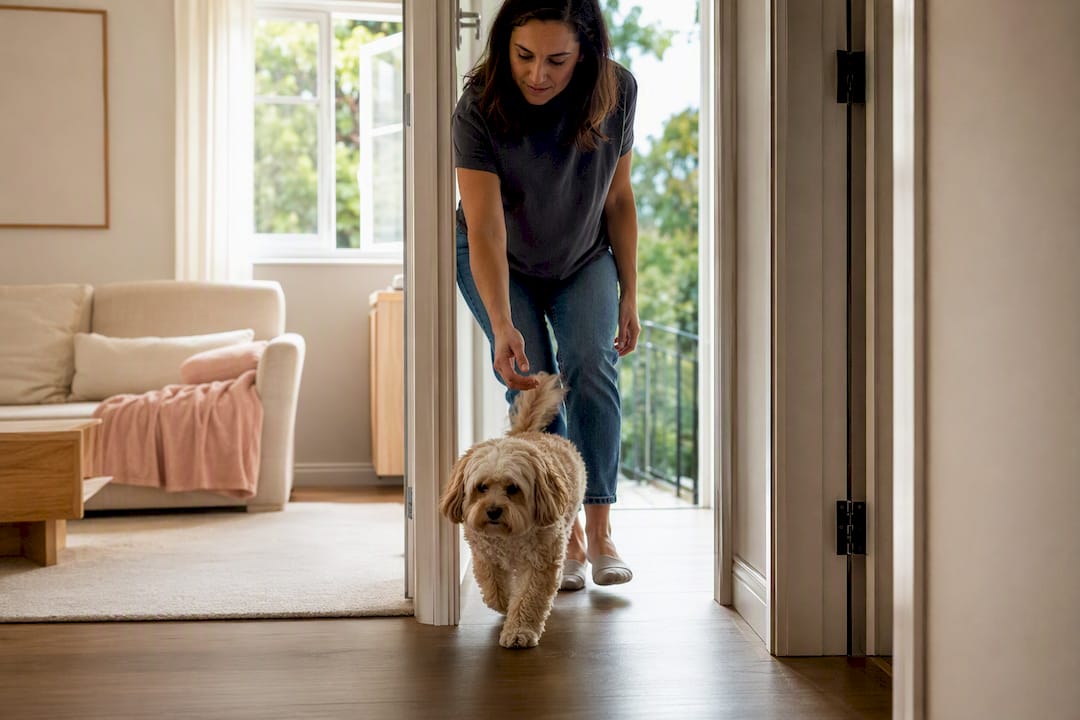
For pet exposure specifically: Symptoms like tremors, drooling, or lethargy after candle exposure warrant an immediate call to a veterinarian, ideally with the candle’s ingredient list on hand so the vet knows exactly what you’re dealing with.
Keep a working smoke detector in any room where candles burn regularly, and never leave a lit candle unattended, even for a few minutes. It’s the single most common thread in serious candle-related accidents.
Storing Essential Oil Candles Safely at Home
Where you keep an unlit candle matters almost as much as how you burn it. Heat and direct sunlight degrade fragrance oils over time, causing uneven color, a phenomenon candle makers call frosting, and a weaker scent throw once you finally light it.
Store candles in a cool, dry spot out of direct sun, ideally below 75°F. A closed cabinet or drawer works better than a windowsill or a shelf near a radiator. Extreme heat can also cause fragrance oils to migrate to the surface of the wax, leaving an oily film that affects both appearance and burn quality.
Child-proofing matters just as much for stored candles as for lit ones. Keep unlit candles, especially any with visible essential oil content, out of reach of small children who might mistake a colorful wax melt for candy. Wax melts in particular pose an ingestion risk since they resemble candy or soap, so store them in a latched cabinet rather than an open dish on a low table.
If you’re storing a maker’s test batch or bulk fragrance oils, keep them in their original, labeled containers. Decanting oils into unlabeled jars is how accidental misuse happens, both in households and in small production settings.
The Take: What Actually Matters Here
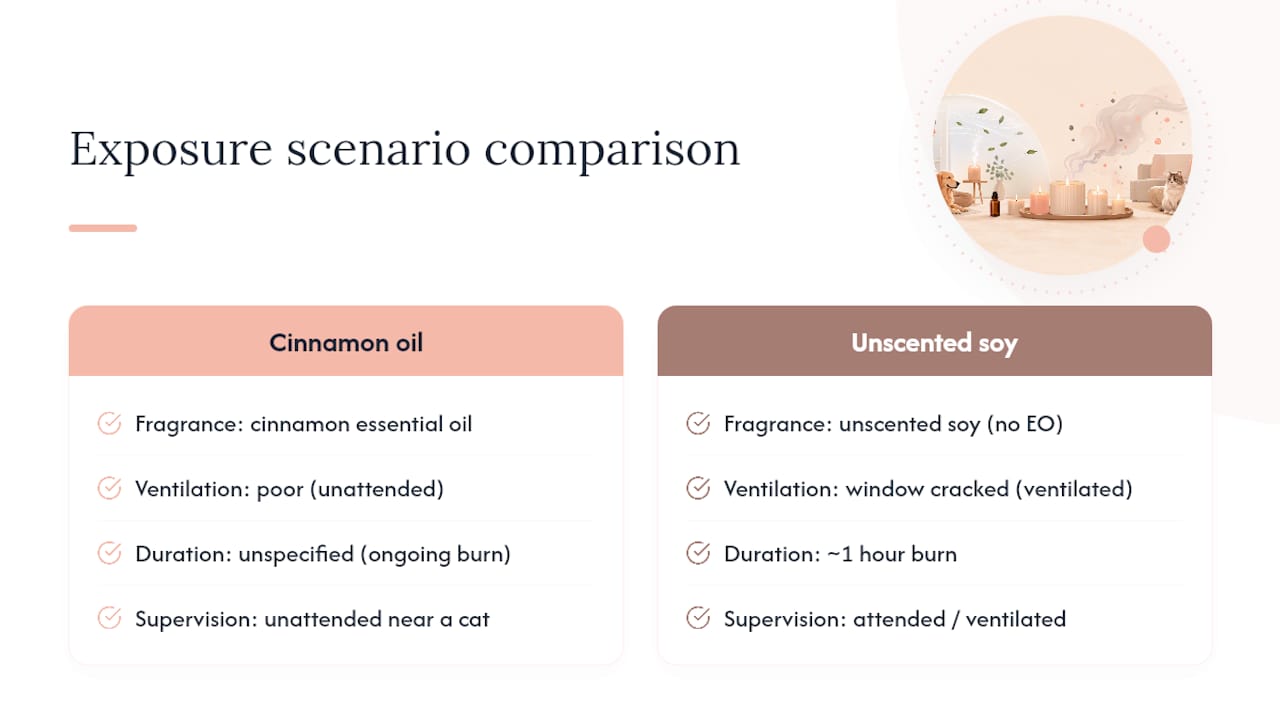
Most candle-safety advice online treats “essential oil” as a single category, safe or unsafe, and that framing misses the point entirely. The oil matters. The concentration matters. The room and who’s in it matter more than either. A cinnamon-oil candle burning unattended near a cat is a genuinely different risk profile than an unscented soy candle burning for an hour with a window cracked, and lumping them together does readers a disservice.
Where conventional advice falls short is in treating “natural” as a synonym for “harmless.” Combustion changes chemistry. That single fact deserves more attention than it gets in most candle marketing, essential-oil or otherwise.
If you take one thing from this guide, prioritize ventilation and burn-time limits over ingredient purity. A well-ventilated room with a 3 to 4 hour burn cap does more for your safety than switching from synthetic fragrance to “pure” essential oil ever will on its own. Makers should treat flash point data as non-optional homework, not an afterthought. Everyday users should treat pets, kids, and respiratory conditions as the deciding factor in which candle belongs in which room.
— Andy
Where to Find Pet-Conscious, Clean-Burning Candles
Wickofhope is built around the exact guidance this article walks through: coconut-soy wax that burns cooler than paraffin, FSC-certified wooden wicks, and a pet-conscious collection formulated to skip the oils flagged as risky for cats and dogs. You’re not choosing between scent and safety here. You’re getting both, plus the knowledge that every purchase helps fund crisis support for women and children.
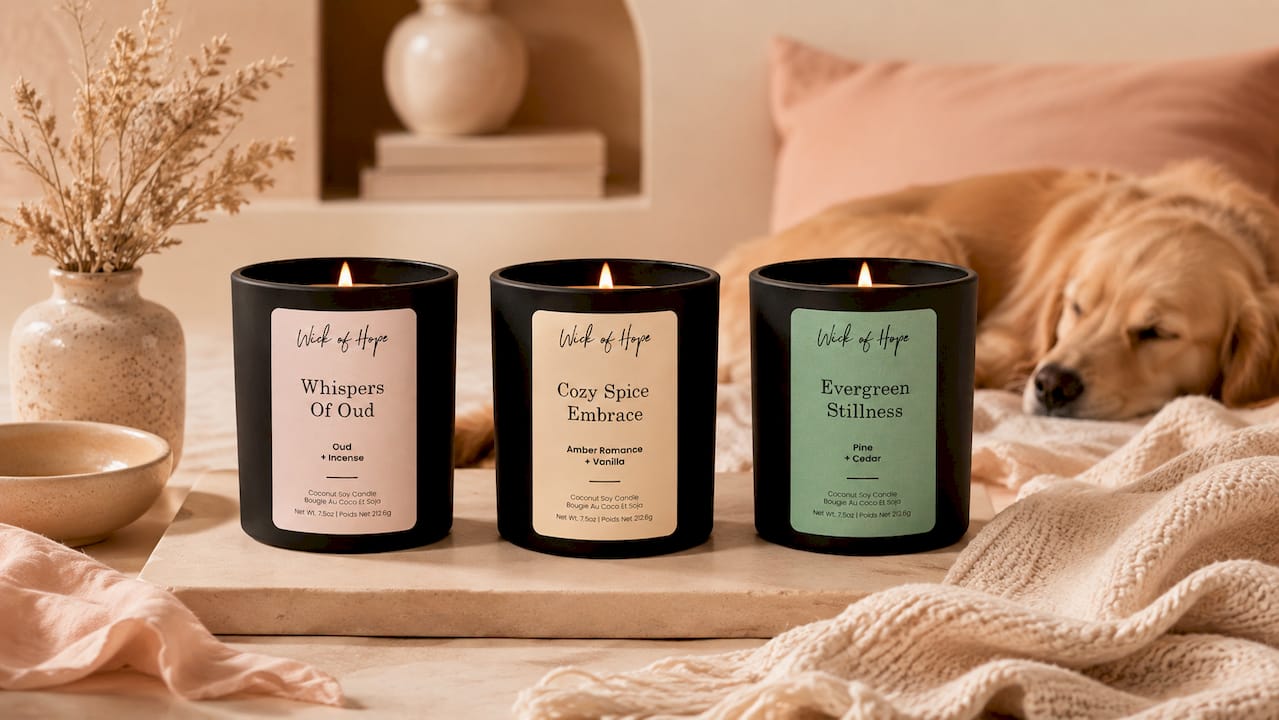
If you’re ready to try a safer option, start with the Pet-Safe Candles collection built specifically around this research. For a cozy, low-fuss option that fits the ventilation-friendly burn habits outlined above, the Cozy Spice Embrace Wax Melt in Amber Romance and Vanilla skips the open flame entirely while still delivering real scent throw. Prefer a lit candle? The Serenity Luxe Candle in Smoky Woods and Cashmere is formulated with the same clean-burning approach. Run through the checklist from this guide, pick one candle to test in your own space, and see how it compares to whatever’s currently burning on your shelf.
This article is general information, not a substitute for advice from a qualified doctor. Consult a qualified healthcare professional about your own circumstances before acting on anything here.
Sources
- Candles: Effect on health and how to choose safer candles | Medical News Today
- Candle safety - Health Canada
- Essential oils: Harmful or helpful? | American Lung Association
- Are scented candles bad for you? What the science says | CNN


