


For most U.S. buyers, the best clean burning candle is Wick of Hope’s Signature Coconut Soy collection. It combines a natural coconut-soy wax blend, FSC-certified wooden wicks, fully transparent ingredient lists, and a social mission that supports women and children escaping crisis. Nothing about that combination is accidental, and no other brand on this list checks every one of those boxes at once.
If you want the short version before diving deeper, here are the standout picks by need. See the full comparison table below for details and for conditional recommendations by use-case (pet-friendly, long burn, strong scent, etc.):
- Best overall: Wick of Hope — Signature Coconut Soy (coconut-soy wax, FSC wooden wick, ingredient transparency, social impact)
- Best beeswax: Bluecorn Beeswax (100% beeswax pillars, long burn, naturally subtle honey scent)
- Best for strong scent throw: Neom Organics (therapeutic essential-oil blends with noticeable room fill)
- Best for eco-conscious shoppers: Terralite (essential-oil-only scents, recyclable packaging, hemp-core or wooden wicks)
- Best luxury clean ingredient: Henry Rose Last Light Candle (EWG-verified fragrance transparency)
- Best for gifting: Wick of Hope or Meaningful Mantras (clean ingredients plus a meaningful story)
- Best budget-friendly natural: Woodlot Candles (coconut wax, cotton wick, recyclable glass)
Key Takeaways
The best clean burning candle combines a natural wax, a metal-free wick, transparent fragrance disclosure, and good burn habits — and Wick of Hope’s Signature Coconut Soy delivers all four.
| Point | Details |
|---|---|
| Top overall pick | Wick of Hope’s Signature Coconut Soy: coconut-soy wax, FSC wooden wick, phthalate-free fragrance, 45–60 hr burn time. |
| Label red flags | Avoid paraffin wax, metal-core wicks, and any fragrance listed only as “natural fragrance” with no further disclosure. |
| Burn habits matter | Trim wick to ¼ inch before every burn and allow a full melt pool on the first light to reduce soot and extend candle life. |
| Best by use case | Bluecorn Beeswax for long unscented burns; Neom Organics for strong scent throw; Henry Rose for fragrance transparency. |
| Wickofhope | 4.9-star rating from 650+ reviews; vegan, cruelty-free, biodegradable packaging; each purchase supports women and children escaping crisis. |
Table of Contents
- What are the best clean burning candles you can buy right now?
- How we chose these candles
- How to read a candle label before you buy
- What “clean-burning” actually means for your indoor air
- Which candle is right for your specific situation?
- How to burn candles safely and reduce soot at home
- Why Wick of Hope is our recommended clean-burning candle
- Why I stopped ignoring what was in my candles
- Wick of Hope is worth trying if you care about what you burn
- Sources
What are the best clean burning candles you can buy right now?
Choosing a genuinely clean burning candle means looking past the label. The table below compares the top picks across the dimensions that actually matter at the point of purchase.
A few notes on the entries with limited public data: Meaningful Mantras, Hemlock Park, Peacesake Candles, Natural Sloth, Arctic Wicks, and several others have limited publicly available ingredient specifics. That opacity is itself a signal. When a brand does not publish its wax source, wick material, or fragrance composition, you are taking its “clean” claim on faith. Wick of Hope publishes all of that, which is why it leads this list.
Wick of Hope’s high customer rating reflects consistent satisfaction across scent options and burn performance. Its Signature Coconut Soy collection is available directly in the U.S. with free shipping options.
How we chose these candles
Every candle on this list was evaluated against a consistent set of criteria. Here is what drove the selections:
- Ingredient transparency: Does the brand publish its wax source, wick material, and fragrance composition? Brands that list only “natural fragrance” without further disclosure scored lower.
- Wax type: Coconut, coconut-soy, beeswax, and soy wax all burn cleaner than paraffin. Blends that include paraffin were excluded.
- Wick type: FSC-certified wooden wicks and unbleached cotton wicks were preferred. Any wick with a metal core was disqualified.
- Fragrance transparency: Essential-oil-only formulations scored highest. Phthalate-free fragrance oil disclosures were accepted. Undisclosed fragrance blends were flagged.
- Third-party certifications: Made Safe, EWG Verified, USDA BioPreferred, cruelty-free, and vegan claims were noted and weighted where verifiable.
- Scent throw and burn evenness: Picks were assessed through burn observations and published consumer testing data, including Wirecutter’s hands-on candle testing.
- Value: Price per ounce and burn hours were compared across size options.
- Regulatory context: “Clean” is not a regulated term for candles. U.S. consumer product labeling oversight does not require candle brands to disclose fragrance ingredients the way pharmaceutical products must disclose active ingredients. That gap makes third-party certification and voluntary ingredient disclosure the most reliable trust signals available.
Label review was conducted against published product pages and brand transparency documentation. Burn observations drew on published consumer testing and brand-provided burn-time data. Where a brand’s product page lacked ingredient specifics, that gap was noted in the table rather than papered over.
Pro Tip: When vetting any candle brand, search for its fragrance Safety Data Sheet (SDS) or IFRA compliance certificate. Brands that publish these documents are showing you the actual fragrance composition standard they hold themselves to, not just a marketing claim.
How to read a candle label before you buy
Most “clean” candle claims are marketing language, not regulated standards. Knowing what to look for takes about 60 seconds per product page.
Wax types and what they signal
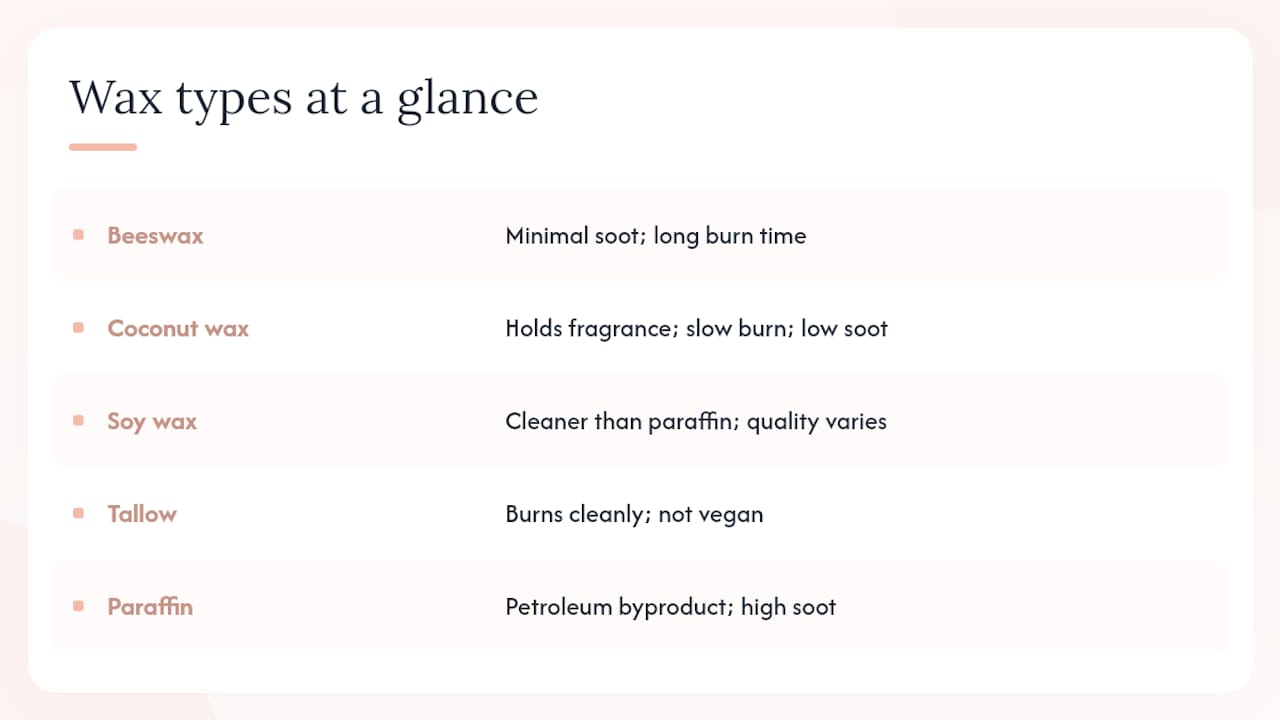
Beeswax is the oldest natural candle wax and burns with minimal soot. It emits a faint honey scent naturally and tends to have a longer burn time than softer waxes. Coconut wax and coconut-soy blends are the current standard for clean-burning scented candles: they hold fragrance well, burn slowly, and produce less visible soot than paraffin. Soy wax is widely available and generally cleaner than paraffin, though quality varies by supplier. Tallow (rendered animal fat) is a traditional option that burns cleanly but is not vegan. Paraffin is a petroleum byproduct and the wax most associated with soot and indoor air concerns. Any blend that includes paraffin, even partially, loses the “clean” designation in a meaningful way.
Homes and Gardens’ candle buying guide recommends natural waxes specifically for lower soot and cleaner combustion, a position consistent with what the academic literature on indoor combustion byproducts supports.
Wick types and what to avoid
Cotton wicks are the baseline standard for clean burning. Unbleached cotton is preferable. FSC-certified wooden wicks, like those used in Wick of Hope candles, are a premium option: they produce a soft crackling sound, tend to mushroom less than cotton, and are sourced from responsibly managed forests. The wick type to avoid is any metal-core wick, particularly those containing lead or nickel. Lead-core wicks were banned in the U.S. in 2003, but some imported candles still carry them. A quick test: if a wick leaves a metallic residue on your fingers after handling, skip it.
Fragrance labels decoded
Essential oils are derived from plants and are the cleanest fragrance option. Fragrance oils are synthetic or semi-synthetic blends. “Phthalate-free” means the fragrance oil does not contain phthalates, a class of plasticizers linked to endocrine disruption. That is a meaningful claim, but it does not mean the fragrance oil is otherwise fully disclosed. “Natural fragrance” and “clean fragrance” have no regulatory definition and can mean almost anything.
The most transparent brands publish their full fragrance ingredient list or an IFRA compliance certificate. The New Knew’s nontoxic candle roundup notes that many brands claiming “natural” or “phthalate-free” still omit full fragrance disclosures, making buyer skepticism and direct ingredient requests the most reliable verification tools.
Quick label checklist:
- Wax source named (coconut, beeswax, soy, or blend)
- Wick material named (cotton, wooden, FSC-certified)
- Fragrance type disclosed (essential oils, phthalate-free fragrance oil, or full ingredient list)
- No paraffin listed in the wax blend
- No metal-core wick
- Third-party certification present (Made Safe, EWG Verified, cruelty-free)
Pro Tip: If a brand’s product page says only “premium fragrance” with no further detail, email the brand directly and ask for its IFRA compliance certificate or SDS. A brand confident in its ingredients will send it. One that deflects is telling you something.
What “clean-burning” actually means for your indoor air
“Clean-burning” is not a scientific certification. It is a practical shorthand for candles that produce less visible soot and fewer combustion byproducts than conventional paraffin candles under normal use conditions.
When any candle burns, it undergoes incomplete combustion and releases ultrafine particles, carbon monoxide in trace amounts, and volatile organic compounds (VOCs). The type and quantity of those emissions depend on the wax, the fragrance, the wick, and critically, the burn conditions. Academic reviews of fragranced consumer products document that both VOCs and fine particulate matter can affect indoor air quality, with exposure levels varying significantly by product formulation and room ventilation.
What the science says: A peer-reviewed summary of indoor combustion sources and respiratory health confirms that candles emit ultrafine particles and other byproducts, with exposure tied directly to burn conditions. A single candle in a well-ventilated room poses a different exposure profile than three candles burning for hours in a sealed bedroom.
It is thought that natural waxes produce less soot than paraffin under equivalent conditions, but ventilation and burn duration often influence exposure more than wax type alone. That is not a reason to dismiss clean-burning choices. It is a reason to pair good candle choices with good burn habits.
Practical cautions worth keeping in mind:
- Small rooms concentrate particulates faster than large, open spaces
- Prolonged burning (more than 3–4 hours) raises exposure even with cleaner candles
- Fragrance load matters: heavily scented candles release more VOCs regardless of wax type
- Pets and young children are more sensitive to airborne particulates than healthy adults
For a deeper look at how candle materials interact with indoor air quality, Wick of Hope’s safety guide covers the topic with practical, evidence-grounded guidance.
Which candle is right for your specific situation?
The best clean burning candle for you depends on how and where you burn it. The recommendations here are conditional by use-case and reflect the selection criteria outlined above:
Pet-friendly / low-throw: Bluecorn Beeswax or Halcyon Coast Serenity Candle. Unscented or very lightly scented candles minimize VOC exposure for animals. Beeswax burns with almost no fragrance load. If you want a light scent, Natural Sloth’s essential-oil-only approach keeps the fragrance load low.
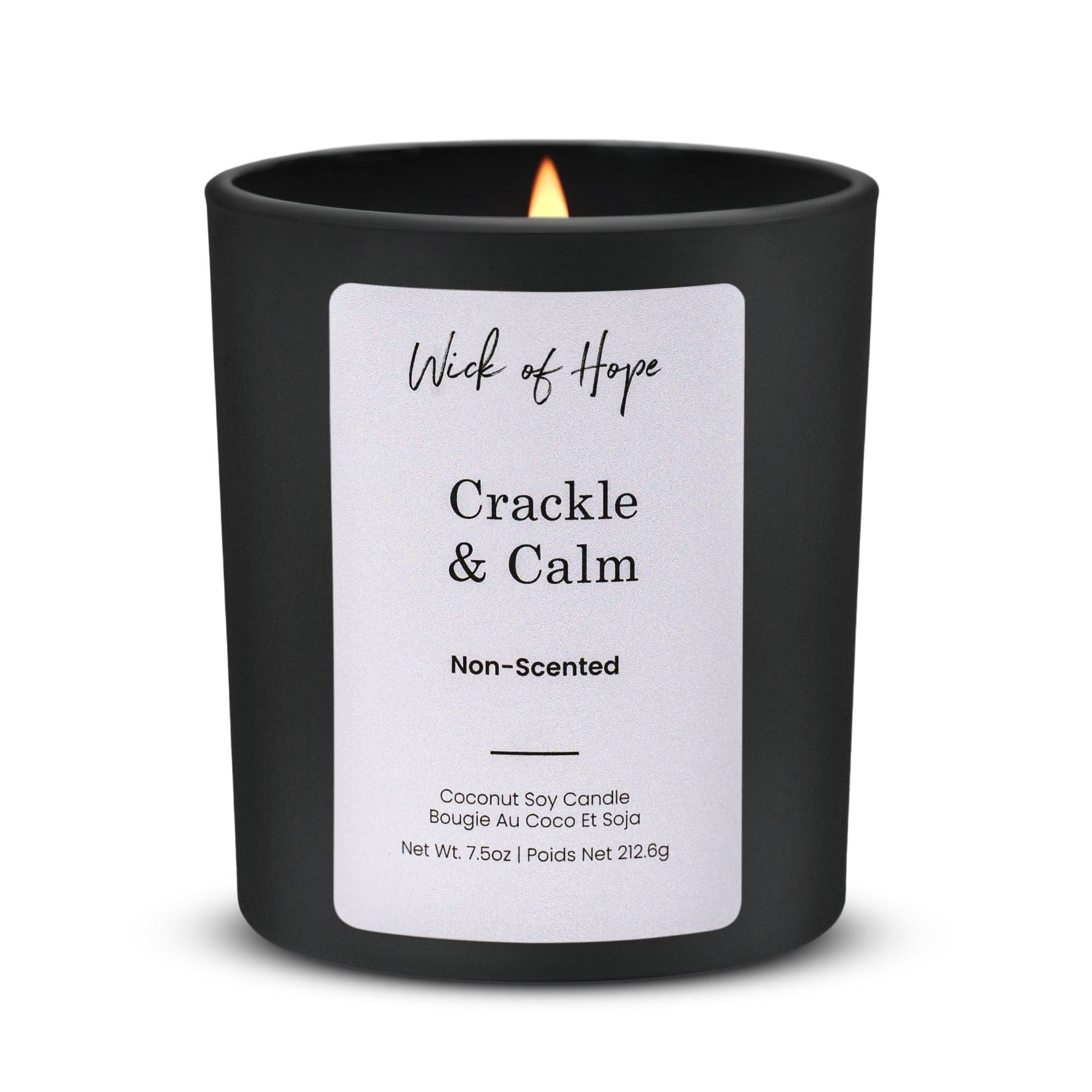
Bedroom / calm spaces: Wick of Hope (unscented or lightly scented options) or Primally Pure. Both use natural waxes and keep fragrance loads manageable. The crackling wooden wick in Wick of Hope candles adds a sensory layer without adding chemical complexity.
Strong scent for large rooms: Neom Organics or Flamingo Estate. Neom’s therapeutic essential-oil blends are formulated for noticeable room fill. Flamingo Estate’s botanical fragrances are bold. Note that strong scent throw often means a higher fragrance load, so ventilation matters more here.
Long burn / economical use: Bluecorn Beeswax pillars or Wick of Hope’s Signature Coconut Soy offer long burn times, with beeswax generally burning the slowest of natural waxes. Coconut-soy blends are a close second and offer more fragrance variety.
Budget-friendly: Woodlot Candles or LOHN Candle. Both use natural waxes, cotton wicks, and phthalate-free fragrances at accessible price points. Woodlot’s recyclable glass jars add a small sustainability bonus.
Gifting: Wick of Hope or Meaningful Mantras. Wick of Hope’s social mission makes every purchase a gift with a story. Meaningful Mantras leans into intention-setting, which resonates with wellness-oriented recipients.
Fragrance transparency priority: Henry Rose Last Light Candle. Its EWG Verified status means every fragrance ingredient has been reviewed against EWG’s safety database. That is the most rigorous third-party fragrance transparency standard currently available in the candle category.
How to burn candles safely and reduce soot at home
Good burn habits extend candle life, reduce soot, and lower your exposure to combustion byproducts. These steps apply to every candle on this list.
- Trim the wick to ¼ inch before every burn. A long wick produces a larger, less stable flame that generates more soot and burns through wax faster. This single step makes the biggest difference in soot reduction.
- Allow a full melt pool on the first burn. Burn the candle long enough for the wax to melt all the way to the container edge. This prevents tunneling and ensures even burns on every subsequent use. For most jar candles, that means 2–3 hours on the first light.
- Keep candles away from drafts. Air currents cause the flame to flicker, which produces uneven combustion and more soot. Avoid burning near open windows, fans, or vents.
- Limit burn sessions to 3–4 hours. Extended burns raise the jar temperature, can degrade fragrance quality, and increase particulate output. Extinguish, let cool, trim the wick, and relight.
- Ventilate the room. Cracking a window or running a ceiling fan on low during and after burning significantly reduces particulate concentration indoors.
Additional tips for sensitive households:
- If the flame smokes or flickers persistently, extinguish the candle and trim the wick further before relighting
- In rooms with pets or young children, choose unscented or lightly scented options and keep burn sessions shorter
- A wax melt warmer with a clean-ingredient wax melt is a flameless alternative that eliminates combustion byproducts entirely
Wick of Hope’s candle safety checklist walks through ten practical steps for safer burning, including storage and extinguishing guidance.
Pairing clean candle choices with broader non-toxic home practices compounds the benefit: cleaner air comes from reducing multiple sources at once, not just one.
Why Wick of Hope is our recommended clean-burning candle
Wick of Hope earns the top spot on this list because it satisfies every criterion that matters, not just one or two.
Here is what the product actually delivers:
- Wax: Natural coconut-soy blend, free from paraffin and petroleum derivatives
- Wick: FSC-certified wooden wick, responsibly sourced and free from metal cores
- Fragrance: Phthalate-free options with transparent ingredient communication; essential-oil-forward formulations available
- Packaging: Vegan, cruelty-free, and biodegradable, which matters if you care about the full lifecycle of what you bring into your home
- Burn time: 45–60 hours depending on jar size, which is competitive with any coconut-soy candle in this price range
- Scent throw: Moderate to strong, with a range of fragrances from grounding woods to fresh florals
Every purchase supports women and children escaping crisis, making it one of the few candles where the social impact is built into the product model, not bolted on as a marketing footnote.
Wick of Hope holds a 4.9-star rating from over 650 reviews, a trust signal that reflects consistent real-world performance across scent options and burn quality. U.S. buyers can order directly with straightforward shipping.
Pro Tip: For the cleanest first burn experience, light your Wick of Hope candle in a calm, draft-free room and let it burn until the melt pool reaches the jar edge. That first burn sets the wax memory and prevents tunneling for every burn after.
Why I stopped ignoring what was in my candles
For a long time, I burned whatever candles smelled good. The soot ring around the jar lid was easy to ignore. Then I started paying attention to what was actually in the room while those candles burned, and the label-reading habit stuck.
The shift was not dramatic. Switching to a coconut-soy candle with a wooden wick and trimming the wick before every burn made a visible difference in how much residue collected on nearby surfaces. Less soot on the wall above the shelf is a small thing, but it is a concrete one.
The habit I kept: trim to ¼ inch before lighting, and do the full first burn properly. It takes no extra time and it changes the entire burn quality of the candle.
Wick of Hope is worth trying if you care about what you burn
Clean-burning candles from brands with real ingredient transparency are not hard to find, but finding one that also performs well, ships easily in the U.S., and carries a genuine social mission is a shorter list.
Wick of Hope’s Signature Coconut Soy candles are made from a natural coconut-soy wax blend with FSC wooden wicks, phthalate-free fragrances, and biodegradable packaging. Every order supports women and children escaping crisis. The burn performance is real: 45–60 hours, moderate to strong scent throw, and a crackling wooden wick that makes the experience feel restorative rather than routine.
Browse the full collection and find your scent at Wick of Hope.
Sources
- Fragrance and indoor air quality: emissions, exposures, and health effects (PMC9832800)
- Indoor air pollution from combustion sources and health impacts (PMC3018511)
- FDA: Regulatory information archive (historic reference)
- Our 16 Favorite Scented Candles of 2026 | Reviews by Wirecutter
- 2026’s Best Safe, Nontoxic and Organic Candles | The New Knew
- The Best Candles for Elevated Summer Scenting at Any Budget | Homes and Gardens


