


Fragrance oils can be safe to use when they are IFRA compliant, backed by a current safety data sheet, and used within the documented percentage for that specific application. That last part matters more than most people realize: a fragrance oil rated safe for a candle can be entirely wrong for skin, and one rated for skin might still carry a limit far lower than the 8% you assumed.
Before you pour, blend, or dab anything on your wrist, run through three quick checks.
- IFRA certificate present. Every reputable supplier can hand you a current IFRA certificate for the exact fragrance oil you’re holding, not a generic company-wide statement.
- Current SDS available. The safety data sheet should be dated within the last couple of years and list hazard statements, flash point, and handling notes.
- Product category and percentage stated. The paperwork should say whether the oil is approved for leave-on, rinse-off, or no-contact use, and at what maximum percentage.
If any of those three items is missing, treat the oil as unverified. Once you’ve confirmed them, the basics of safe handling are straightforward: work in a ventilated room, never apply an undiluted oil to skin, and store bottles somewhere pets and children can’t reach.
Key Takeaways
Fragrance oil safety comes down to verified IFRA compliance, a current SDS, correct dilution for the product category, and sensible ventilation and storage habits.
| Point | Details |
|---|---|
| Verify before you buy | Confirm the IFRA certificate and SDS match the exact fragrance oil and lot, not a general supplier statement. |
| Match category to use | Only use oils with a leave-on limit on skin, and never assume a candle-safe percentage works for lotion. |
| Patch test every skin product | Apply a diluted sample to your forearm and wait 24 to 48 hours before full use. |
| Ventilate and limit sessions | Keep candle or diffuser use to short bursts in airflow, especially around pets, infants, or pregnant people. |
| Choose lower-risk formats where needed | Wickofhope’s coconut soy wax melts, like the Cozy Spice Embrace in Amber Romance + Vanilla, offer a flame-free, documented option for sensitive households. |
Where to Learn More
For deeper reading beyond this guide, a few sources are worth bookmarking directly: the IFRA standards overview for category-specific use limits, the peer-reviewed research on fragrance and indoor air exposure for a look at where scientific consensus is and isn’t settled, the fragrance oil usage-rate guide for practical starting percentages by product type, and the pet-focused fragrance safety guide for households with cats, birds, or other sensitive animals.
If you’re dealing with an active reaction, skip the reading list and call Poison Control or your veterinarian first; save supplier documentation and technical guides for the decisions you make before something goes wrong, not after.
Table of Contents
- What Fragrance Oil Safety Actually Depends On
- What Are the Real Health Risks From Fragrance Oils?
- How Do You Verify a Fragrance Oil Meets Safety Standards?
- Safe Handling and Storage for Concentrated Fragrance Oils
- Using Fragrance Oils on Skin: Dilution, Patch Testing, and Who Should Be Extra Careful
- Is It Safer to Burn a Candle or Use a Diffuser?
- What to Do If Someone Has a Reaction to a Fragrance Oil
- What Does the Actual Research Say About Fragrance Oil Safety?
- Why Wickofhope Treats Fragrance Oil Safety as a Formulation Standard, Not a Marketing Line
- Sources
What Fragrance Oil Safety Actually Depends On
A fragrance oil is a formulated scent blend, usually a mix of synthetic aroma chemicals and sometimes natural extracts, built for a specific end use like candles, soap, or perfume. Suppliers create different versions of what smells like the same scent: a candle-grade blend engineered to survive high heat without scorching, and a cosmetic-grade version reformulated to sit safely on skin. Using fragrance oils safely means matching the version to the job, not assuming one bottle covers both.
Essential oils are a different animal entirely. They’re steam-distilled or cold-pressed extracts from a single plant source, and they carry their own sensitization and phototoxicity concerns. Some citrus-derived oils can cause skin reactions after sun exposure, a problem fragrance oils generally don’t share because they’re synthesized rather than extracted. Fragrance oils formulated for candles also tend to have higher flash points and better oxidation stability than raw essential oils, which is part of why candle makers often prefer them for pouring and storage.
Parfum or “fragrance” on a cosmetic ingredient list refers to a finished perfume compound, which might contain dozens of individual aroma chemicals, some overlapping with what’s in a fragrance oil and some not.
Here’s the point that trips people up: natural origin doesn’t equal safety, and synthetic doesn’t equal danger. Dose and intended use determine risk far more than where an ingredient came from.
- A fragrance oil is a manufactured scent blend, formulated differently depending on whether it’s headed into a candle, a lotion, or a soap bar.
- Essential oils are single-plant extracts with their own allergen and sun-sensitivity profile.
- Parfum/fragrance ingredient concentrates are what perfumers work with, often blending several fragrance materials into one compound.
- Origin (natural vs. synthetic) is not a safety indicator on its own; concentration and application are.
What Are the Real Health Risks From Fragrance Oils?
The concerns that show up most often in consumer questions are phthalates, volatile organic compounds, sensitizing allergens, and a smaller group of phototoxic ingredients. Phthalates, particularly diethyl phthalate (DEP), were historically used as fragrance carriers and have drawn scrutiny over potential endocrine-disruption effects. Regulatory pressure has pushed many suppliers toward phthalate-free formulations, and it’s worth asking directly whether a product qualifies.
Volatile organic compounds and soot are a burning-specific issue rather than a fragrance-oil issue in isolation. A 2024 media review of the scented-candle research found the evidence mixed, and concluded that risk depends heavily on the candle type, how often it’s burned, and how well the room is ventilated, not on scented candles as a category. Separately, peer-reviewed research on fragrance and candle emissions has produced inconsistent results: some studies flag potential respiratory irritation from specific compounds, others find no measurable population-level harm from typical home use.
Sensitizing allergens are a known quantity, at least. IFRA maintains a list of fragrance materials associated with skin sensitization, and reputable suppliers disclose when a blend contains one at a notable level. Phototoxic ingredients, mostly certain citrus-derived fractions, can cause skin reactions after sun exposure, though this is far more common in essential oil blends than in synthesized fragrance oils.
Some groups need more caution than others. Pregnant people, infants, anyone with asthma or reactive airways, and certain pet species carry higher risk from the same exposure that a healthy adult tolerates without issue. Cats in particular lack some of the liver enzymes needed to process certain aromatic compounds efficiently, and birds have famously sensitive respiratory systems. A pet-focused fragrance safety guide recommends ventilated rooms and IFRA-compliant, phthalate-free oils specifically because of this vulnerability, and Wickofhope’s own guidance on candles safe for cats covers the same ground from a household-safety angle.
- Phthalates (especially DEP) carry documented endocrine-disruption concerns and are increasingly phased out by responsible suppliers.
- VOCs and soot are tied to burning specifically, and vary widely by wax type and wick quality.
- Sensitizing allergens are cataloged by IFRA and should appear on a proper SDS.
- Phototoxic fractions matter more for essential oils than for most synthetic fragrance oils.
- Pregnant people, infants, asthma patients, and pets like cats and birds warrant extra caution.
Pro Tip: Run scent sessions in short bursts, thirty to sixty minutes, in a room with airflow, rather than letting a candle or diffuser go for hours unattended. If anyone in the house is pregnant, has respiratory issues, or shares space with a cat or bird, a no-contact format like a wax melt in a well-ventilated room is a lower-risk choice than an open flame running all evening.
How Do You Verify a Fragrance Oil Meets Safety Standards?
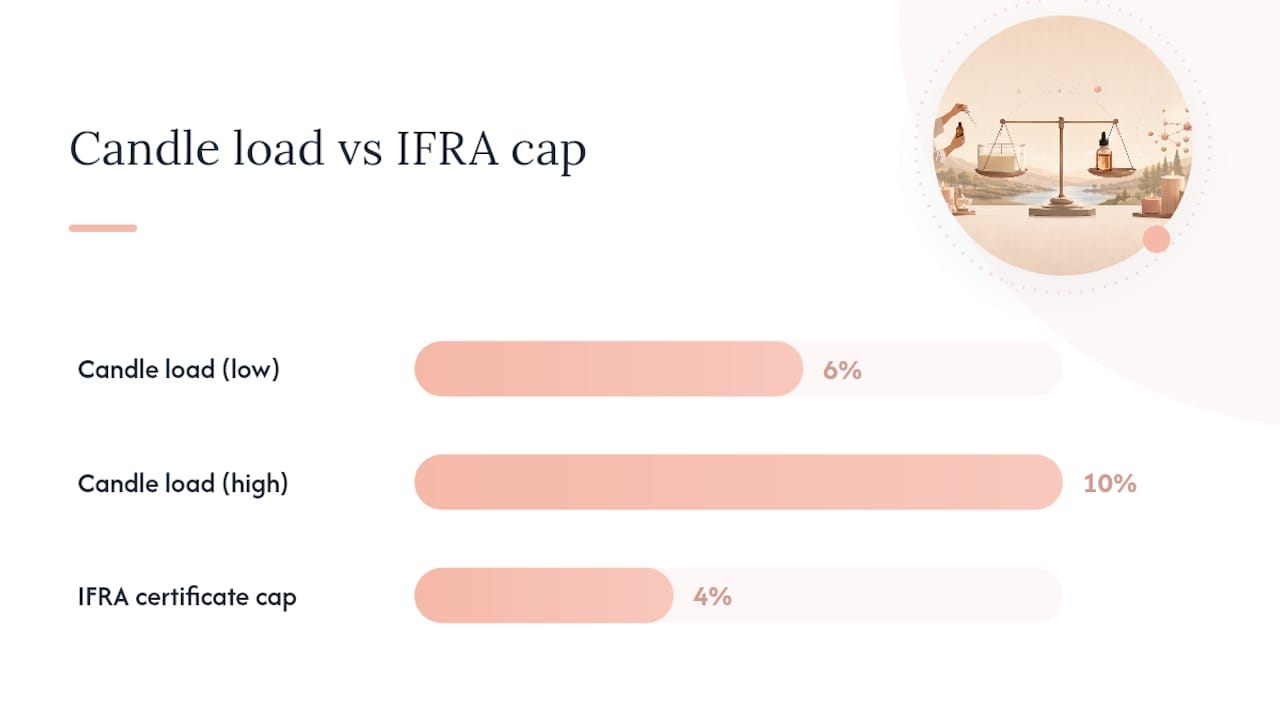
Look for three documents: the IFRA certificate, the SDS, and clear category labeling on the product page. IFRA, the International Fragrance Association, publishes standards that set maximum permissible use levels for fragrance ingredients by product category. That certificate is the controlling ceiling. If a working guide says candles typically run 6 to 10% fragrance load, but the IFRA certificate for your specific oil caps it at 4% for that category, the certificate wins every time.
The safety data sheet, formerly called an MSDS, spells out hazard classification, flash point, storage conditions, and first-aid measures. When you open one, scan for the hazard statements section first. A well-run supplier updates SDS documents periodically, so check the date. If it’s more than a few years old or doesn’t match the current formulation, ask.
Labels like “cosmetic-grade” or “skin-safe” are useful shorthand, but they’re not a substitute for the certificate. A guide to cosmetic-grade fragrance oil terminology explains that these labels generally mean the oil has been assessed for skin contact at some concentration, backed by an IFRA certificate and SDS, but the specific allowable percentage still varies by material. “Phthalate-free” is a straightforward claim, but it only tells you about one category of concern, not the whole safety profile.
A practical verification routine looks like this:
- Ask the supplier for the IFRA certificate matching the exact fragrance oil and lot, not a general company statement.
- Confirm the product category, leave-on, rinse-off, or no-contact, matches your intended use.
- Check the SDS date and read the hazard statements section.
- If anything is missing or unclear, contact the supplier directly before using the product.
Wickofhope’s own breakdown of harmful chemicals to watch for in candle fragrances walks through what to flag when a supplier’s documentation falls short.
Safe Handling and Storage for Concentrated Fragrance Oils
Fragrance oils arrive concentrated, which means the handling rules are closer to working with a mild chemical than with a finished candle. Gloves are a baseline for anyone measuring or pouring regularly. Eye protection matters if you’re working with larger batches or splash-prone containers, and a respirator becomes relevant only in poorly ventilated spaces or with materials that carry strong inhalation warnings on the SDS.
Measure by weight, not volume. Fragrance oils vary in density, and a tablespoon of one oil might weigh meaningfully more or less than a tablespoon of another, which throws off your percentage calculations. The usage-rate guidance that many makers rely on list typical candle fragrance loads in a moderate range, with working ranges for cold-process soap and leave-on products that makers often consider starting points. The IFRA certificate for your specific oil can, and often does, impose a lower ceiling for a particular material, and that number always overrides the general working range.
Storage is where a lot of home makers get sloppy. Keep bottles capped, upright, and out of direct light in a cool space, ideally somewhere in the 60 to 75°F range. Heat and light both accelerate oxidation and can shift a fragrance oil’s chemistry over time, shortening its usable shelf life. If you spill any, wipe it up immediately with a cloth (fragrance oils can stain and some plastics react to them) and ventilate the room while you clean.
- Wear gloves at minimum; add eye protection for larger pours and a respirator only if the SDS flags inhalation risk.
- Weigh ingredients rather than measuring by volume for accurate percentages.
- Store bottles capped, upright, in a cool, dark space away from temperature swings.
- Keep all fragrance oils in secondary containment, on a high shelf or in a locked cabinet, away from children and pets.
Using Fragrance Oils on Skin: Dilution, Patch Testing, and Who Should Be Extra Careful
Only use a fragrance oil on skin if it carries a non-zero leave-on limit on its IFRA certificate. Not every fragrance oil is formulated for skin contact, and even a “skin-safe” label doesn’t mean neat application is acceptable. A supplier support guide on fragrance oil safety is blunt about this: even skin-safe oils require dilution, no exceptions.
Typical dilution ranges depend on the product type, with leave-on products generally requiring lower percentages than rinse-off products, and perfume oils and roll-ons having higher allowable concentrations per IFRA certification.
Weigh your carrier and fragrance oil on a scale rather than eyeballing drops, since volume measurements introduce error that compounds fast at these concentrations.
Patch testing takes a few days but it’s the only reliable way to catch a reaction before it happens on your face or a client’s skin.
- Mix a small diluted sample at your intended percentage.
- Apply a dime-sized amount to the inside of your forearm.
- Leave it uncovered and avoid washing that spot for 24 to 48 hours.
- Check for redness, itching, swelling, or a burning sensation at any point during that window.
- If nothing develops, a second test on a slightly larger area is still smart before full product use.
- Stop immediately and wash the area if you notice irritation, and seek medical advice if symptoms persist or worsen.
Some areas and populations need tighter margins than the standard range. Lip and eye-area products typically require far lower concentrations and materials specifically approved for that category. Children’s skin absorbs more readily relative to body weight, so err toward the lower end of any range. Pregnant people and anyone with a history of sensitive skin or contact dermatitis should patch test every new blend, even ones they’ve used safely before, since formulations change between batches.
Is It Safer to Burn a Candle or Use a Diffuser?
Burning and non-thermal diffusion create different exposure profiles, and neither is automatically the safer choice; it depends on the product and how you use it. Burning a candle or wax melt combusts or heats the wax, releasing fragrance along with combustion byproducts like soot, particularly with lower-quality paraffin blends and poorly sized wicks. Reed diffusers and room sprays release fragrance molecules without heat, avoiding combustion soot entirely, but some ultrasonic diffusers can concentrate certain volatile fractions in a way that a slow-releasing reed diffuser doesn’t.
Practical mitigation looks similar across formats: choose IFRA-compliant oils with documentation you’ve actually checked, don’t overload the wax pool with fragrance beyond the recommended percentage, and size your wick to the vessel so it burns cleanly rather than smoking. Ventilate the room, keep sessions to a reasonable length rather than running a candle or diffuser continuously for hours, and position diffusers where pets and infants have room to move away if the scent bothers them.
Watch for warning signs that mean you should stop: visible black soot collecting on the vessel or nearby surfaces, a harsh or acrid smell rather than a clean fragrance, or anyone in the room developing a headache, cough, or eye irritation. Wickofhope’s guidance on scented candle safety around babies and pets and the pet-friendly wax melt overview both dig deeper into flame-free alternatives for households where an open flame or continuous diffusion isn’t ideal. For homes managing broader air-quality concerns alongside scent, a HEPA air purifier can help clear residual particulates between sessions.
What to Do If Someone Has a Reaction to a Fragrance Oil
Skin contact calls for washing the area with soap and water right away, then watching for redness or swelling over the next few hours. Don’t rub the area, since friction can push the oil deeper into skin.
Eye exposure needs an immediate flush with lukewarm water for a full 15 minutes, holding the eyelid open to make sure water reaches the whole surface. If irritation, redness, or vision changes persist after flushing, that’s a reason to seek medical evaluation rather than wait it out.
Inhalation symptoms, coughing, throat tightness, headache, or dizziness, mean getting the affected person to fresh air immediately and monitoring their breathing. Mild symptoms that resolve within minutes of fresh air are less concerning than anything that persists or worsens.
Ingestion is the scenario where people most often do the wrong thing instinctively. Don’t induce vomiting. Have the SDS and product label ready, since ingredient information speeds up guidance from poison control.
Know when to call for help versus handling it yourself. In the United States, Poison Control is reachable at 1-800-222-1222 for human exposures, and most regions have a separate veterinary poison hotline for pet exposures. Have the SDS, the ingredient list, and an estimate of how much was involved on hand before you call; that speeds up the whole process. Reserve emergency room visits for severe or worsening symptoms, difficulty breathing, significant swelling, or ingestion of a meaningful quantity, and treat milder, resolving symptoms as something you can follow up on with a regular clinic visit if they don’t fully clear.
What Does the Actual Research Say About Fragrance Oil Safety?
The strongest, most consistent evidence sits with IFRA’s regulatory framework itself: IFRA standards assign specific maximum use levels by product category, and that framework is the closest thing the fragrance industry has to a settled safety ceiling. WHO’s Good Manufacturing Practices guidance provides a complementary benchmark for how consumer products should be handled and documented during production, which is where SDS practices originate.
Where the evidence gets genuinely mixed is long-term, everyday exposure from normal candle or diffuser use. Peer-reviewed research on fragrance-related indoor air exposures has produced inconsistent findings, some studies detect measurable irritant compounds, others find no clear population-level harm tied to typical household use. That inconsistency isn’t a dodge; it reflects how much exposure depends on ventilation, frequency, and the specific product involved rather than a single universal risk factor.
The clearest area of documented concern is phthalates, where endocrine-disruption research has been consistent enough to drive real regulatory movement and a broad industry shift toward phthalate-free formulations. If you’re weighing where to be strictest as a buyer, phthalate content is the one item worth double-checking every time, even on products marketed as clean.
Why Wickofhope Treats Fragrance Oil Safety as a Formulation Standard, Not a Marketing Line
We built Wickofhope’s candles around coconut soy wax and FSC-certified wooden wicks specifically because clean-burning performance and documented fragrance sourcing shouldn’t be separate conversations. Every fragrance we work with is chosen with phthalate-free sourcing and IFRA-informed formulation in mind, and we treat SDS documentation as a baseline requirement from our suppliers, not an afterthought we chase down after a customer asks.
That said, we’re candid about the limits of what any brand guide, including this one, can tell you. Nothing here replaces medical advice for a specific reaction, and if you’re formulating your own products or buying from other suppliers, checking their IFRA certificate and SDS for that exact oil remains your responsibility, not something you can assume from a brand’s reputation alone. Our commitment to clean sourcing reflects the same standards this article walks through, which is part of why every candle purchase also supports women and children escaping crisis rather than existing as an unrelated add-on to the product.
If the guidance in this article resonates with how you want to scent your own home, that’s exactly the audience we built Wickofhope for: people who want the mood a good candle creates without wondering what’s actually burning.
A Cleaner Way to Bring Warm, Spiced Scent Into Your Home
If you’ve read this far, you already know that a flame-free, documented fragrance oil is one of the lower-risk ways to scent a room, especially if you share your home with pets, kids, or anyone with respiratory sensitivity. That’s precisely the gap our Cozy Spice Embrace Wax Melt in Amber Romance + Vanilla fills.
It’s made with coconut soy wax rather than paraffin, so there’s no open flame and no soot buildup on nearby surfaces, and the fragrance sourcing follows the same phthalate-free, IFRA-informed standard this entire guide has walked through. Melt it in a well-ventilated room, keep sessions to a reasonable length, and it fits neatly into the safer-scenting habits outlined above. It’s not a substitute for checking documentation on any product you buy, ours included, but it’s a genuinely honest example of what safe-scenting can look like in practice. Browse the full scented candle and wax melt collection if amber and vanilla isn’t your scent, or start with this one and see how a flame-free format changes the way a room feels.
Sources
- IFRA: Standards — Safe use of fragrance materials
- Peer-reviewed study indexed at PubMed on indoor air or fragrance-related exposures
- WHO: Good manufacturing practices (GMP)


