


Parabens are not typically found in candles. They’re water-based preservatives, and most candle wax and fragrance oils are oil-based, so there’s usually nothing for a paraben to preserve. That’s the short answer, and it’s a genuinely reassuring one.
The more useful question is what does show up when you light a scented candle. Phthalates, volatile organic compounds (VOCs), and combustion byproducts are the real candle-specific concerns, and they deserve more of your attention than parabens do.
- Parabens: rare in oil-based candle wax and fragrance oils, common in water-based cosmetics.
- Phthalates and VOCs: the chemicals actually worth checking for on a candle label.
- Your move: prioritize fragrance transparency and phthalate-free claims over paraben-free ones.
Pro Tip: If a candle brand only advertises “paraben-free,” ask about phthalates too. It’s the more relevant claim for anything you’re burning, not applying to skin.
Key Takeaways
Parabens rarely appear in candles because they’re water-based preservatives, while phthalates and VOCs from fragrance and combustion are the chemicals that deserve your attention.
| Point | Details |
|---|---|
| Parabens are uncommon in candles | Oil-based wax and fragrance rarely require a water-based preservative like parabens. |
| Phthalates are the bigger concern | Chamber studies detected DBP, BBP, and DEP in scented-candle emissions at measurable levels. |
| Symptoms are dose-related | A 2023 study found 24.8% of regular scented-candle users reported headaches or breathing symptoms. |
| Ventilation and wick trimming help | Cracking a window and trimming wicks reduces particulate and VOC exposure during burns. |
| Wickofhope prioritizes transparency | Coconut soy wax, wooden wicks, and phthalate-free fragrance define candles like the Serenity Luxe line. |
Table of Contents
- Do Candles Contain Parabens, and When Might They?
- What the Research Says About Parabens Versus Other Candle Chemicals
- How Candle Chemicals Actually Become Airborne
- How to Check Whether a Candle Contains Parabens
- Choosing a Safer Candle: Wax, Fragrance, and Trade-Offs
- A Quick Checklist for Cutting Candle Exposure
- Why We Focus on Phthalates, Not Just Parabens
- If You Want Paraben-Free, Clean-Burning Candles
- Frequently Asked Questions
- Sources
Do Candles Contain Parabens, and When Might They?
Parabens (methylparaben, propylparaben, and similar compounds) exist to stop mold and bacteria from growing in water-containing products like lotions and shampoos. A standard candle has none of that: wax, a fragrance oil, a wick, and sometimes dye. Nothing in that formula holds water, so there’s rarely a reason to add a preservative built for water.
There are a few edge cases worth knowing about. Water-based specialty products, like some gel candles or novelty items, could theoretically call for a preservative system. Complex fragrance blends sourced from third-party suppliers sometimes carry trace preservatives if any water-based components were used upstream in the fragrance manufacturing process. That’s less about the candle maker’s choice and more about what’s buried in the fragrance oil’s own supply chain.
| Candle Type | Water Content | Paraben Likelihood |
|---|---|---|
| Standard soy or coconut wax candle | None | Very low |
| Paraffin wax candle | None | Very low |
| Gel or water-infused novelty candle | Present | Possible |
| Complex synthetic fragrance blends | Trace, upstream | Rare but not zero |
Pro Tip: A Safety Data Sheet (SDS) will list preservatives if any are present. If a brand can’t produce one on request, treat that as a red flag independent of the paraben question.
What the Research Says About Parabens Versus Other Candle Chemicals
Endocrine disruption is the main concern tied to parabens, and the National Institute of Environmental Health Sciences notes that these chemicals can mimic or block hormones, with dose and exposure timing determining the actual risk. That evidence base comes almost entirely from dermal exposure through cosmetics and personal care products, not from inhaling anything. There isn’t a strong body of research tying candle use specifically to paraben-related harm, mostly because parabens simply aren’t a common candle ingredient to begin with.
The stronger, better-documented evidence points elsewhere. Chamber studies analyzing scented-candle emissions have detected VOCs, semi-volatile organic compounds, PAHs, and fine particulates that vary depending on wax type and fragrance load, including compounds like benzene and naphthalene. Separate chamber experiments found measurable dimethyl phthalate, dibutyl phthalate, and butyl benzyl phthalate in scented-candle emissions, with DBP showing up at notably high concentrations.
Real-world data backs this up. A 2023 study of university students found that 65.7% used scented candles regularly, and 24.8% of those users reported symptoms like headache, shortness of breath, or coughing. Longer exposure durations tended to correlate with more symptoms, though not every association reached statistical significance in that sample.
The gap between “detected in a lab chamber” and “causes measurable harm in your living room” is real, and it’s exactly where uncertainty lives. Small-sample studies and short-duration chamber tests can identify what’s present in candle smoke, but they can’t always tell you what a typical evening of candlelight does to your long-term health.
Pregnant people, children, and anyone with asthma or another respiratory condition are the groups most often flagged as needing extra caution, largely because their baseline tolerance for airborne irritants is lower.
How Candle Chemicals Actually Become Airborne
Two things happen when a candle burns. Fragrance molecules volatilize off the hot wax pool surrounding the wick, releasing scent compounds directly into the air as gas. Separately, the flame itself generates combustion byproducts, including VOCs, polycyclic aromatic hydrocarbons, and ultrafine particulates.
- Volatilization: fragrance oils evaporate as the wax pool heats, releasing scent as vapor.
- Combustion: the flame produces particulate matter and gas-phase byproducts as a side effect of burning.
- Particle-bound exposure matters more than you’d think. Airborne profiling research found that phthalate esters like DEP attach to fine particles, and particle-bound forms deposit deeper into the lungs than vapor-phase chemicals alone.
Pro Tip: A trimmed wick burns cleaner and produces less soot, which directly reduces the particulate half of this equation. It’s a thirty-second habit with a real payoff.
How to Check Whether a Candle Contains Parabens
Start with the label, but read it critically. “Paraben-free” is a specific, verifiable claim; “clean” or “natural” alone are marketing words with no fixed definition. Look for full fragrance disclosure, since there’s no legal requirement in most jurisdictions for candle brands to list every ingredient, which means voluntary transparency is often the only signal you get.
- Check the product page and any linked Safety Data Sheet for preservative and fragrance ingredient details.
- Look for phthalate-free language specifically, not just paraben-free, since phthalates are the more relevant candle risk.
- Ask sellers directly whether fragrance oils are IFRA-compliant and whether an SDS is available on request.
Pro Tip: A brand that hesitates to answer a direct ingredient question is telling you something. Transparency shouldn’t require an argument.
Choosing a Safer Candle: Wax, Fragrance, and Trade-Offs
Wax choice changes your exposure profile more than most shoppers realize. Soy and coconut-based waxes generally burn cleaner and produce less soot than paraffin, though even the cleanest wax still releases whatever fragrance compounds are dissolved into it. The wax is only half the equation.
Fragrance source matters just as much:
- Essential oils offer a more natural aromatic profile with fewer synthetic additives, though they’re less thermally stable and can shift in scent as they burn.
- Phthalate-containing synthetic fragrances hold scent longer and more consistently, but they’re the category most tied to the phthalate emissions found in chamber studies.
- Phthalate-free synthetic blends attempt to split the difference, offering scent stability without the specific compounds under scrutiny.
Third-party sourcing statements, ingredient transparency pages, and IFRA compliance are worth prioritizing over price or scent throw alone. You’ll typically pay more for that transparency, but you’re also buying certainty instead of guesswork about what’s actually in the wax.
A Quick Checklist for Cutting Candle Exposure
- Crack a window or run an exhaust fan while burning candles, especially in small rooms.
- Limit burn sessions to an hour or two rather than letting a candle run all day.
- Trim the wick to a quarter-inch before each burn to reduce soot and particulates.
- Avoid running several scented candles at once in one enclosed space.
- Choose unscented or low-fragrance options around pregnant people, kids, or anyone with asthma.
Pro Tip: Pairing good ventilation with a few air-purifying houseplants gives you two layers of protection instead of relying on open windows alone.
Why We Focus on Phthalates, Not Just Parabens
I’ve spent enough time in this research to notice how often “paraben-free” gets marketed as a candle safety win when it’s barely a candle-specific issue at all. The chemistry that actually matters here is phthalates and VOCs. At Wickofhope, that’s why we prioritize fragrance transparency and phthalate-free formulations in coconut soy wax, because that’s where the real trade-offs live.
If You Want Paraben-Free, Clean-Burning Candles
You already know what to look for now: phthalate-free fragrance, transparent sourcing, and a wax that burns cleaner than paraffin. That’s exactly what we build into every candle at Wickofhope.
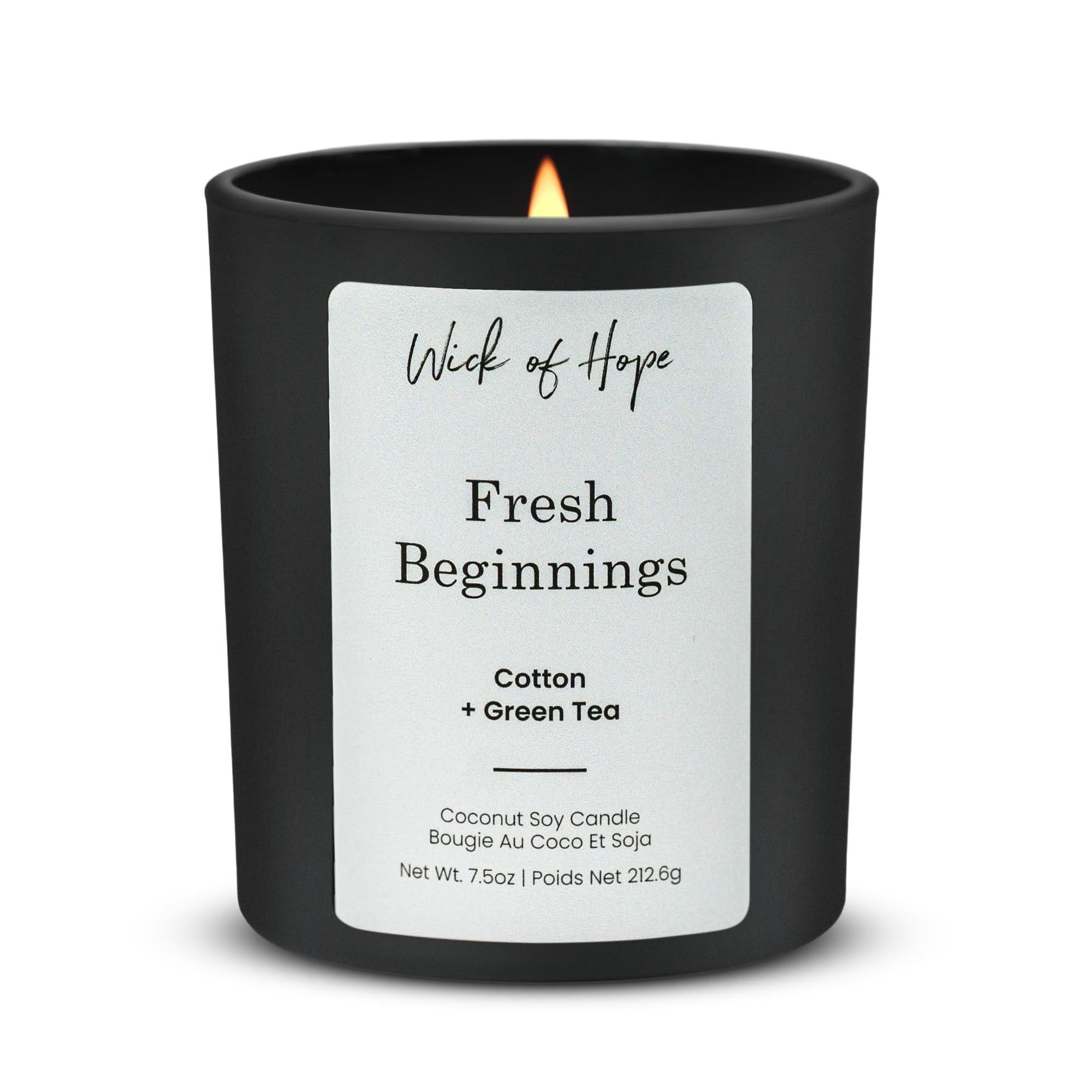
Our Serenity Luxe Candle in Smoky Woods + Cashmere pairs a coconut soy base with a wooden wick for a quieter, cleaner burn, while the Cozy Spice Embrace Wax Melt in Amber Romance + Vanilla gives you the same formulation standards without an open flame at all. Every candle we make skips the synthetic phthalate load found in mass-market fragrance blends, and every purchase also funds crisis support for women and children escaping unsafe situations through our social impact program.
If you’re ready to see the full range, browse our scented candle collection and pick a scent that matches how you actually want your home to feel.
Frequently Asked Questions
Do candles contain parabens? Most don’t. Parabens preserve water-based products, and standard candle wax and fragrance oils are oil-based, so there’s rarely a formulation reason to include them.
Are phthalates in candles harmful? Chamber studies have detected phthalates like DBP, BBP, and DEP in scented-candle emissions, and inhalation is the primary exposure route. Evidence on long-term health effects from typical home use is still limited, though vulnerable groups are advised to take extra precautions.
What does “phthalate-free fragrance” actually mean? It means the fragrance oil was formulated without phthalate compounds commonly used to extend scent longevity, which is a more candle-relevant claim than “paraben-free.”
What are the safest candle ingredients to look for? Coconut or soy wax, a wooden or cotton wick, and a phthalate-free fragrance with transparent sourcing are the combination most likely to reduce airborne chemical exposure.
Should pregnant people avoid scented candles entirely? Not necessarily, but limiting burn duration, improving ventilation, and choosing phthalate-free fragrance are reasonable precautions given the uncertainty around dose and exposure timing.
This article is general information, not a substitute for advice from a qualified doctor. Consult a qualified healthcare professional about your own circumstances before acting on anything here.
Sources
- Extent of exposure to scented candles and prevalence of respiratory and non-respiratory symptoms amongst young university students - PMC
- Beyond Aromatherapy: Illuminating the Underappreciated Risks Associated with Scented Candle Exposure
- Endocrine disruptors (NIEHS)
- Characterization of DEP and other esters in candle and incense emissions and inhalation exposure assessment
- Investigation of phthalate emissions from incense stick, scented candle and perfume through a chamber experiment


