


Burning candles in a ventilated room produces only very small amounts of carbon monoxide, well below levels that cause harm. According to the Institute for Environmental Research and Education, CO poisoning from candles is extremely rare and typically involves extreme, prolonged burns in sealed spaces. That said, a few simple steps keep your home calm and safe:
- Open a window or door before lighting candles, even slightly, to maintain fresh airflow.
- Limit how many candles burn at once and keep sessions under a few hours.
- Place a working CO detector on every level of your home, especially near sleeping areas.
Wickofhope’s coconut-soy candles with FSC-certified wooden wicks are designed for a stable, clean burn that minimizes incomplete combustion from the start.
Pro Tip: Watch your flame. A steady, upright flame signals good combustion. A flickering, dancing flame or visible black soot on the jar means the candle is producing more incomplete-combustion byproducts, including CO. That’s your cue to trim the wick, move the candle away from drafts, or extinguish it.
Key Takeaways
Candles in a ventilated home produce only very small amounts of carbon monoxide, well below WHO indoor air quality thresholds, but simple habits and a working CO detector keep risk negligible.
| Point | Details |
|---|---|
| CO risk is low with ventilation | In ventilated rooms, candle CO concentrations typically stay well below WHO indoor guideline values. |
| Ventilate, limit, and trim | Open a window, burn one or two candles at a time, and trim wicks to 6 mm (1/4 inch) before every burn. |
| VOCs are the more common concern | Scented candles can release formaldehyde and benzene; fragrance loading and ventilation matter as much as CO. |
| CO detectors protect your whole home | Install detectors on every level and near sleeping areas; fuel-burning appliances are a far bigger CO source than candles. |
| Wickofhope for a cleaner burn | Coconut-soy wax, FSC-certified wooden wicks, and managed fragrance loading make Wickofhope candles a lower-emission choice for Canadian homes. |
Table of Contents
- Do candles produce carbon monoxide, and how does it form?
- What do lab measurements actually show about candle CO emissions?
- Which candles, wicks, and habits raise emissions the most?
- What are the health risks, and who is most vulnerable?
- How to burn candles safely at home
- How to choose a cleaner-burning candle
- Do you need a CO detector if you only burn candles?
- What to do if you suspect carbon monoxide exposure
- The candle risk most people get backwards
- Clean-burning candles that take the guesswork out of safety
- Sources
Do candles produce carbon monoxide, and how does it form?
Carbon monoxide forms when combustion is incomplete, meaning fuel burns without enough oxygen to convert all carbon to carbon dioxide (CO2). A candle flame has distinct temperature zones: the hottest inner zones favor complete combustion, while cooler, oxygen-starved outer zones produce CO, soot, and ultrafine particles. Chamber studies confirm that flame stability is the key variable, not wax type alone.
Several conditions push a candle toward incomplete combustion:
- Sealed or poorly ventilated rooms deplete oxygen and allow CO to accumulate.
- Multiple candles burning simultaneously in a small space compound the effect.
- Drafts hitting the flame directly destabilize it, creating cooler combustion zones.
- Long, untrimmed, or mushroomed wicks produce a larger, less controlled flame.
Visible signs of incomplete combustion are easy to spot: a smoky smell, a black soot ring forming inside the jar, or a flame that flickers and leans rather than burning tall and steady. These aren’t just aesthetic issues. They’re practical signals that your candle is releasing more CO and fine particles into the air you’re breathing.
What do lab measurements actually show about candle CO emissions?
The short answer: measured CO from candles in ventilated rooms is typically well below WHO indoor air quality guideline values. The nuance lies in the test conditions.
An 8 m³ chamber study measured CO, NOx, VOCs, and ultrafine particles from both scented and unscented candles across 24 test combinations. Burn rates varied depending on wax and fragrance type, within a controlled range seen in tests. Calculated indoor concentrations for most pollutants, including CO, fell below reference values. Some NO2 readings and specific VOCs exceeded guidance thresholds in limited cases. Critically, the study used four candles burning simultaneously in an 8 m³ chamber, a scenario far more concentrated than a typical Canadian living room with a window cracked.
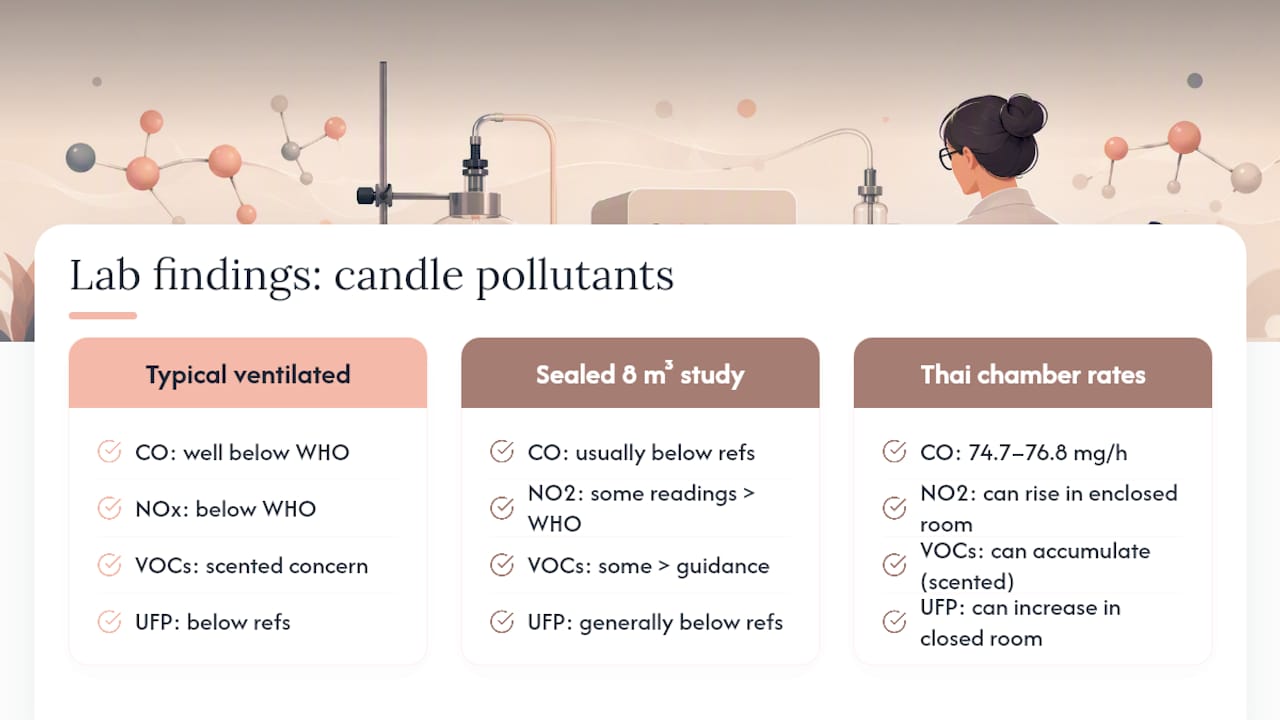
A Thai small-chamber experiment put candle CO emission rates at approximately 74.7–76.8 mg/h for tested samples. For context, incense and mosquito coils produced dramatically higher emission rates in the same study. The researchers’ simulations showed that burning candles in an enclosed, unventilated room could push pollutant levels toward harmful territory over time, reinforcing ventilation as the primary control.
Academic commentary from Professor Christian Pfrang aligns with these findings: a single candle is unlikely to push CO or NOx past WHO indoor guidance limits under typical conditions. The concern shifts to VOCs from scented candles, which can interact with combustion products and raise questions about specific compounds like formaldehyde and benzene.
One practical takeaway from the chamber research: because labs calculate steady-state concentrations from emission rates and ventilation (air changes per hour), the number of candles and room size both matter. A single candle in a well-ventilated 20 m² room behaves very differently from four candles in a sealed 8 m³ space.
Which candles, wicks, and habits raise emissions the most?
Wax type alone matters less than combustion quality and ventilation. A paraffin candle burning cleanly in a ventilated room produces less CO than a natural wax candle with a poorly trimmed wick in a sealed bathroom. That said, certain product and usage factors consistently push emissions higher:
- Paraffin and low-quality wax blends tend to produce more soot and VOCs than cleaner-burning alternatives, though the gap narrows with good wick management.
- Synthetic fragrance oils at high loading rates increase VOC output. Scented candles can emit formaldehyde, benzene, and acrolein when fragrance compounds interact with combustion products, sometimes exceeding recommended values even when CO stays low.
- Long or untrimmed wicks create oversized flames that consume wax faster, destabilize combustion, and deposit black soot on jar walls.
- Wooden wicks used incorrectly (not trimmed, or left with charred debris) can produce an uneven, smoky burn.
- Multiple candles in small rooms multiply emission rates proportionally.
- Burning in very small, closed spaces (a sealed bathroom, a closet) removes the ventilation buffer that keeps concentrations safe.
Practical warning signs that a candle is producing more pollutants: a black soot ring forming inside the jar within the first burn, heavy visible smoke when extinguished, or a sharp chemical smell that lingers after the candle is out. A faint, pleasant fragrance is normal. A chemical bite that makes your eyes water is not.
Pro Tip: Test any new candle with a 30-minute burn in a well-ventilated room. Watch the flame and the jar. If you see soot building on the glass or the flame is constantly flickering, trim the wick to 6 mm (1/4 inch) and try again. If the problem persists, that candle isn’t worth burning indoors.
What are the health risks, and who is most vulnerable?
CO at high concentrations causes hypoxia by binding to hemoglobin more readily than oxygen, reducing the blood’s ability to carry oxygen to organs and tissues. Candle-related CO poisoning is rare. The more common concern with everyday candle use is fine particles and VOCs, which irritate airways and, with repeated exposure, may affect respiratory health.
Typical CO exposure symptoms include:
- Headache (often the first sign, felt at the temples or forehead)
- Dizziness and lightheadedness
- Nausea or vomiting
- Confusion or difficulty concentrating
These differ from ordinary candle irritation, which usually presents as mild eye or nose irritation from smoke or fragrance. If symptoms resolve quickly after leaving the room and returning to fresh air, fragrance sensitivity is the more likely cause. If symptoms persist or multiple people in the space feel unwell simultaneously, CO exposure needs to be ruled out.
Rare documented cases of elevated CO readings linked to candles almost always involve multiple scented candles burning for extended periods in poorly ventilated, sealed rooms, often with other contributing factors. These are not typical candle-use scenarios.
Groups that should take extra care around any combustion source indoors:
- Infants and young children, whose smaller bodies and faster breathing rates mean faster CO uptake
- Pregnant people, given CO’s effects on fetal oxygen delivery
- Older adults and anyone with heart or lung disease, for whom even modest CO elevation is a greater cardiovascular strain
- Pets, especially birds, which are highly sensitive to airborne pollutants and often show distress before humans notice symptoms
If CO poisoning is suspected, carboxyhemoglobin (COHb) testing at an emergency department confirms exposure and guides treatment. Don’t wait for symptoms to worsen before seeking care.
How to burn candles safely at home
Ventilation plus a limited candle count plus attentive wick care eliminates most of the risk. Follow these steps every time:
- Keep the room ventilated. A slightly open window or door is enough to maintain airflow and prevent CO from accumulating. You don’t need a gale, just a fresh-air exchange. Improving air exchange is the single most effective control for any indoor combustion source.
- Limit simultaneous candles. One or two candles in a standard room is a very different situation from six candles in a small bedroom. Scale to your space.
- Trim the wick to ~6 mm (1/4 inch) before every burn. This is the single most impactful candle-care habit. A trimmed wick produces a smaller, more stable flame and far less soot.
- Avoid burning in very small, closed rooms. A sealed bathroom or closet removes the ventilation buffer entirely.
- Keep candles away from drafts and combustibles. Drafts destabilize the flame; nearby curtains or paper create fire risk.
- Extinguish candles before sleeping or leaving the room. Never leave a burning candle unattended.
On placement: a candle in a deep, narrow jar in a small room concentrates heat and restricts airflow to the flame more than a wide-mouthed vessel in a larger space. Jar size and room volume both factor into how efficiently a candle burns.
Pro Tip: On the first burn, let the candle burn long enough for the melt pool to reach the edges of the jar, usually 2–3 hours depending on diameter. This prevents tunneling, which leaves a wax wall that blocks airflow to the wick and promotes incomplete combustion on every subsequent burn.
How to choose a cleaner-burning candle
Choose candles designed for a stable, clean burn. That means materials and build quality that promote complete combustion, not just a pleasing label. The candle care guidance at Wickofhope breaks this down practically, but here’s what to look for when shopping:
- Coconut-soy or pure soy wax blends burn at lower temperatures and tend to produce less soot than paraffin. A comparison of wax types shows that the wax itself matters less than the overall combustion system, but cleaner-burning waxes give you a better starting point.
- High-quality cotton or well-made wooden wicks that are sized correctly for the vessel. FSC-certified wooden wicks, used correctly and trimmed before each burn, produce that characteristic soft crackle without excessive smoke.
- Fragrance loading within recommended limits. More fragrance is not better. Overloaded fragrance oils don’t fully combust and release more VOCs into the air.
- Minimal synthetic additives. Dyes, UV stabilizers, and certain synthetic fragrance compounds all add to the VOC load.
- Transparent ingredient disclosure. Brands that list their wax type, wick material, and fragrance sourcing are giving you the information you need to make a real choice.
Watch out for greenwashing. “Natural” on a label doesn’t mean clean-burning. A candle can be made from plant-based wax and still produce heavy soot if the wick is wrong or the fragrance loading is too high. Ask: what’s the wick made of, what’s the wax blend, and how is the fragrance sourced?
Wickofhope’s coconut-soy candles are built around these principles: a stable coconut-soy blend, FSC-certified wooden wicks, and fragrance choices managed for a clean burn. For households with pets, their pet-conscious range is worth a look given how sensitive animals are to airborne pollutants.
Pro Tip: When trying a new candle brand, burn it for 30 minutes in a ventilated room and check the jar. A clean jar with no soot ring and a steady flame is a good sign. A black ring forming on the glass within the first burn tells you the wick-to-wax ratio isn’t right.
Do you need a CO detector if you only burn candles?
Yes. A CO detector is a required safety backup regardless of your combustion sources, and every level of a Canadian home should have one, particularly near sleeping areas. Ontario, Alberta, and British Columbia all have legislation requiring CO alarms in homes with fuel-burning appliances or attached garages. Even if candles are your only open flame, a detector protects you from the far higher-risk sources: furnaces, water heaters, gas stoves, fireplaces, and vehicles in attached garages.
Placement matters. Mount detectors:
- On every level of the home, including the basement
- Near sleeping areas, so an alarm wakes you at night
- Away from gas stoves and fireplaces (at least 1.5 m / 5 feet), where normal combustion gases can trigger false alarms
- Following the manufacturer’s instructions for height, since CO is roughly the same density as air and distributes fairly evenly
Types of CO detectors available in Canada:
- Electrochemical sensors are the most accurate and widely recommended for residential use.
- Biomimetic sensors change color in the presence of CO and are reliable but typically lack a digital readout.
- Metal-oxide (semiconductor) sensors are less expensive but more prone to false alarms from other gases.
Look for models with battery backup (so a power outage doesn’t leave you unprotected), a digital CO concentration readout (so you can see levels, not just get an alarm), and an end-of-life indicator that tells you when to replace the unit. Most residential CO detectors have a manufacturer-recommended lifespan of 5–7 years.
Test your detector monthly by pressing the test button. Replace batteries at least once a year, or use a 10-year sealed battery model. Interconnected detectors, where one alarm triggers all units in the home, offer the strongest protection.
What to do if you suspect carbon monoxide exposure
Get everyone, including pets, to fresh air immediately. That’s the one action that matters most. Then:
- Leave the building now. Don’t stop to gather belongings.
- Call 911 if anyone has moderate or severe symptoms (confusion, loss of consciousness, vomiting, chest pain) or if multiple people feel unwell at the same time.
- Seek medical evaluation. An emergency department can confirm CO exposure through carboxyhemoglobin (COHb) blood testing and provide oxygen therapy if needed.
- Ventilate the space by opening windows and doors, but only if you can do so safely from outside or without re-entering a high-CO environment.
- Do not re-enter until emergency services have cleared the space and identified the source.
For milder symptoms that resolve quickly in fresh air, call Health Canada’s poison control line or your provincial poison centre (1-800-268-9017 in Ontario; check your province’s number). They can advise whether a medical visit is needed. If there’s any doubt, go to the emergency department.
The candle risk most people get backwards
Most people who worry about candles and CO are focused on the wrong thing. The real risk in a Canadian home isn’t a single candle burning on a coffee table. It’s the furnace that hasn’t been serviced in three years, the gas water heater in a sealed utility room, or the car left running in an attached garage. Fuel-burning appliances and attached garages are the primary CO hazards in residential settings, by a wide margin.
Candles deserve sensible precautions, not fear. The published chamber data shows that even four candles burning simultaneously in a small test room produced CO concentrations that stayed within guidance limits under most conditions. A single well-made candle in a ventilated living room is a genuinely low-risk activity.
What I find underappreciated is how much the VOC story matters more than the CO story for everyday candle users. Scented candles releasing formaldehyde or benzene at levels that occasionally exceed reference values is a subtler, less alarming-sounding concern than “carbon monoxide poisoning,” but it’s the more realistic daily exposure question for most households. Choosing candles with clean fragrance sourcing and burning them in ventilated rooms addresses both concerns at once.
If you’re in a household with infants, pets, or anyone with respiratory or cardiac conditions, the practical answer isn’t to stop burning candles. It’s to choose better candles, burn fewer at a time, keep windows cracked, and let a CO detector handle the backup monitoring. Flameless or electric options are a reasonable choice for nurseries or rooms where you can’t ventilate well.
Clean-burning candles that take the guesswork out of safety
If you’ve read this far, you want candles that are genuinely low-risk, not just marketed that way. Wickofhope’s natural coconut-soy candles are built around the exact attributes that reduce emissions: a stable coconut-soy wax blend, FSC-certified wooden wicks sized correctly for each vessel, and fragrance loading managed for a clean, steady burn.

Every candle is vegan, cruelty-free, and packaged in biodegradable materials, made in Canada for Canadian homes. The Candle Care Guide walks you through wick trimming, first-burn technique, and everything else that keeps your burn clean from the first light to the last. And every purchase supports women and children escaping crisis, so the warmth goes further than your living room.
Browse the full scented candle collection and find a fragrance that feels like home, without the worry.
Sources
The following sources informed this article’s measurements, expert commentary, and safety guidance:
- Measurement and evaluation of gaseous and particulate emissions from burning scented and unscented candles
- Can candles give you carbon monoxide poisoning? – The Institute for Environmental Research and Education
- Air pollutant emissions from the burning of incense, mosquito coils, and candles in a small experimental chamber
- The truth about your scented candle habit | The Independent
- Carbon monoxide poisoning from scented candles …
This article is general information, not a substitute for advice from a qualified doctor. Consult a qualified healthcare professional about your own circumstances before acting on anything here.


