


The best candle for yoga is a clean-burning coconut-soy blend with a mild grounding scent, a wooden wick, and a phthalate-free formulation. Two reasons make this the right call: natural wax burns without the soot and synthetic chemicals that paraffin releases into your breathing space, and a gentle scent like sandalwood or lavender supports focus without overwhelming the senses mid-flow.
Quick alternatives by situation:
- Scent-sensitive or pranayama sessions: unscented votive or tea light in a stable holder
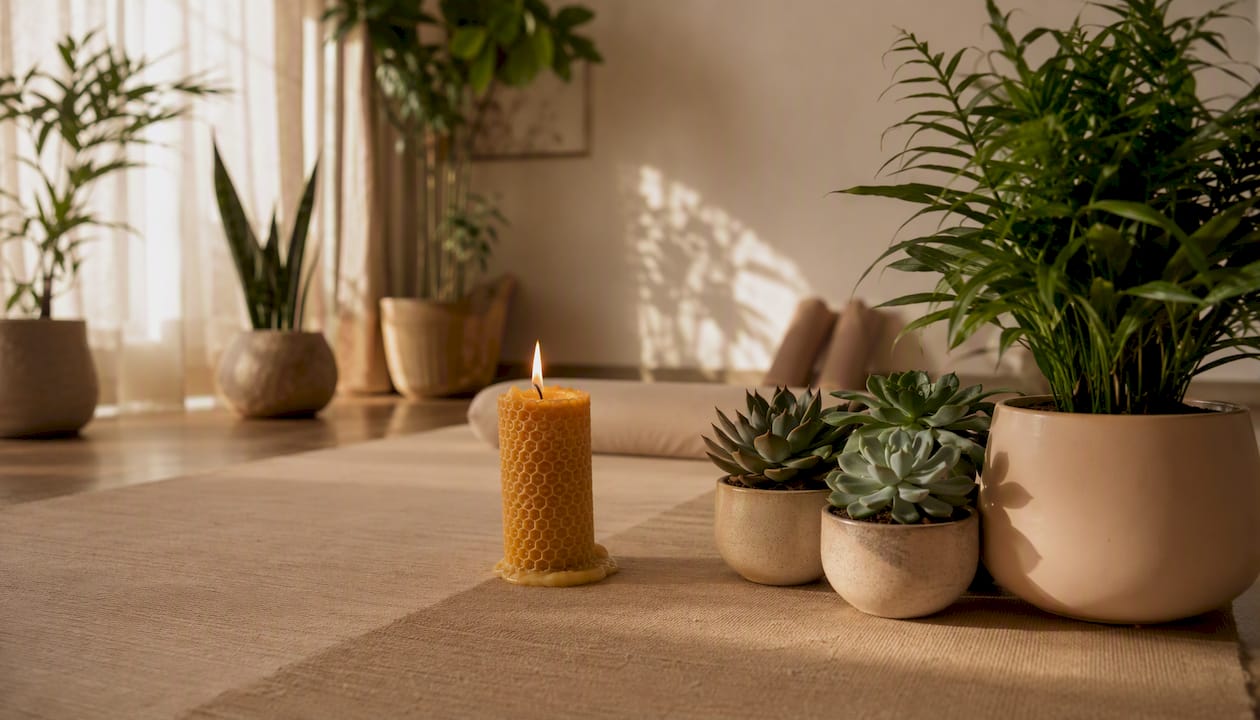
- Long workshops or extended burns: beeswax candle for a naturally clean, slow burn
- Group classes or studio settings: flameless LED candle or an ultrasonic diffuser with a mild essential-oil blend
Table of Contents
- What should you look for when choosing candles for yoga?
- Which scents work best for different yoga styles?
- Do wax type and ingredients actually affect your health?
- How do wick type and jar size match your session length?
- How do you use candles safely during yoga at home and in class?
- What are the best alternatives when you cannot burn a candle?
- Why Wickofhope is a strong choice for yoga-minded buyers
- Key Takeaways
- The candle is not the practice, but it shapes it
- Wickofhope candles, made for your practice
- Useful sources
What should you look for when choosing candles for yoga?
Choosing the right candle comes down to reading labels carefully and knowing which signals matter. Here is the checklist to run through before you buy.
Ingredients and wax type
- Choose coconut-soy blends or pure beeswax; both burn cleaner than paraffin
- Avoid paraffin-based candles, which are petroleum-derived and can release more soot into your practice space
- Look for “phthalate-free” and “paraben-free” on the label; explicit ingredient lists and wick material are the clearest trust signals a brand can offer
Wick type
- Wooden wicks produce a gentle crackle and a wider melt pool; they need a slightly wider vessel and occasional trimming
- Cotton wicks burn steadily and quietly, a good fit for silent meditation sessions
- Both work well; the choice is personal preference for atmosphere
Scent strength and fragrance sourcing
- Look for “essential oils” in the ingredient list rather than vague “fragrance” or “parfum” wording
- Mild concentrations suit home practice; very strong throws can disrupt breathwork
- “Phthalate-free fragrance” is acceptable when essential oils are not used, but essential-oil formulas are the cleaner option
Certifications and trust labels
- Vegan and cruelty-free credentials signal ingredient transparency
- “Clean burn” claims backed by an ingredient list carry more weight than the phrase alone
- Clear burn-time information (in hours) lets you plan sessions accurately
Packaging and sustainability
- Biodegradable packaging and recyclable glass vessels reduce waste
- FSC-certified wooden wicks indicate responsibly sourced materials
- Palm-oil-free formulas matter for environmental reasons; coconut-soy blends typically avoid palm
Purchase logistics
- Confirm U.S. shipping availability and check the return policy before ordering
- Review counts and average ratings give a fast read on product consistency
Pro Tip: Before checkout, search the brand’s site for a full ingredient list. If the page only says “fragrance” with no further detail, that is a gap worth questioning.
Which scents work best for different yoga styles?
Scent is not one-size-fits-all in yoga. The right choice depends on what you are practicing and what you want to feel. Lavender and sandalwood are two of the most well-supported scents for relaxation and grounding in mindfulness contexts, and they anchor most of the recommendations below.
Match your scent to your practice:
- Restorative or yin yoga: lavender, chamomile, or Roman chamomile; these calm the nervous system and ease the body into stillness
- Slow flow or meditation: sandalwood, frankincense, or palo santo; palo santo paired with frankincense creates a grounding, clearing aroma that supports mental clarity
- Morning vinyasa or breathwork: eucalyptus, peppermint, or a citrus blend; these scents feel fresh and alert without being sharp
- Pranayama or breath-focused sessions: unscented, or a very mild lavender; strong scents compete with breath awareness
When to go unscented:
Scent sensitivity, group classes, and sessions where you are layering essential oils in a diffuser are all good reasons to skip fragrance entirely. An unscented candle still creates atmosphere through its warm glow and the soft sound of a wooden wick.
Timing your scent:
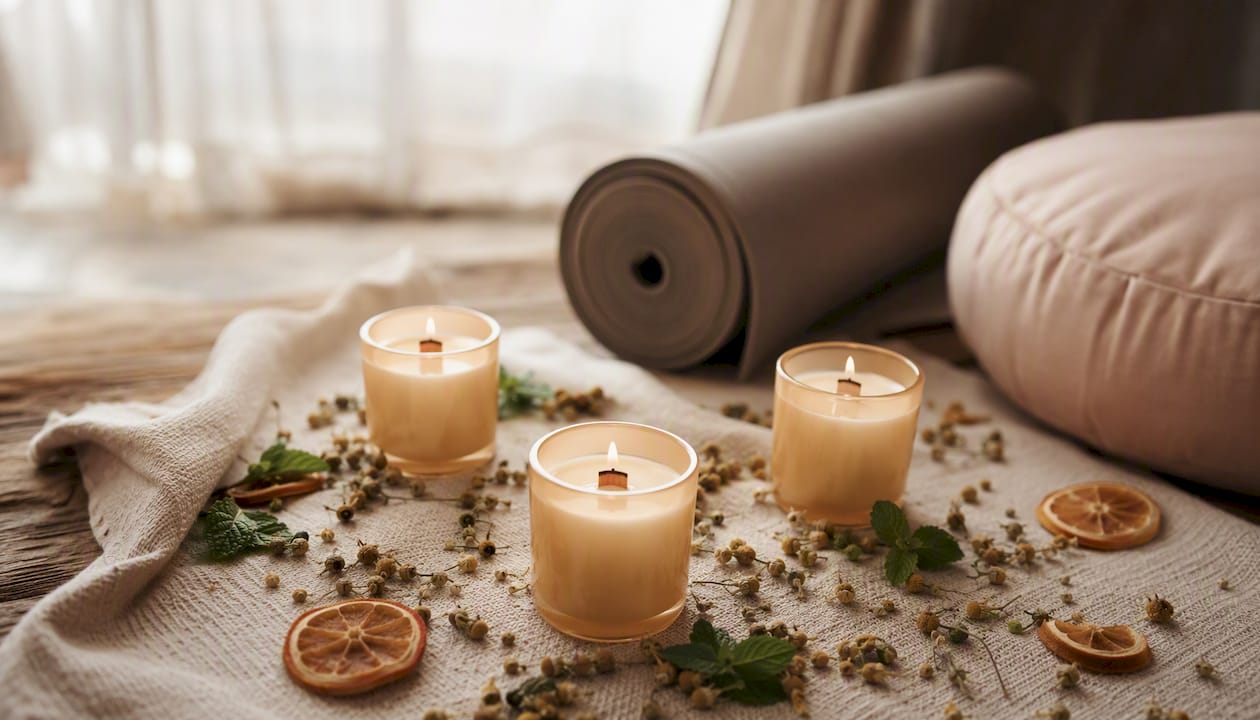
Natural essential-oil candles need time to reach their full scent throw. Plan to light them 1–2 hours before a session if you want the aroma present from the first breath. For a 60-minute evening flow, that means lighting the candle while you prepare your mat and water.
A small altar with a candle, a plant, and optionally a crystal can anchor your practice space even when the candle is not lit. That physical setup acts as a reminder of intention and helps the mind shift into practice mode before you even step on the mat.
Do wax type and ingredients actually affect your health?
Yes, and the difference shows up most clearly in indoor air quality during a session. Here is a plain comparison.
| Wax type | Burn quality | Scent throw | Environmental notes | Best for |
|---|---|---|---|---|
| Coconut-soy blend | Clean, low soot | Good with essential oils | Sustainable, palm-free | Home practice, daily use |
| Beeswax | Very clean, slow burn | Mild, natural honey note | Renewable, not vegan | Long sessions, minimal scent |
| Paraffin | More soot potential | Strong | Petroleum-derived | Not recommended for yoga |
Natural coconut-soy and soy wax candles commonly carry “phthalate-free” and “paraben-free” formulations and use essential-oil blends rather than synthetic fragrance compounds. That matters during yoga because you are breathing more deeply and more frequently than you would sitting at a desk.
What to avoid on the label:
- “Fragrance” or “parfum” with no further detail (may include phthalates)
- Paraffin or “mineral wax” as the primary ingredient
- Synthetic flame-enhancers or dyes with no disclosure
- Palm wax (environmental concern; also less sustainable than coconut-soy)
Beeswax is a strong option for practitioners who want the longest, cleanest burn and do not need a scented candle. Its natural honey note is subtle and pleasant, though it is not vegan. Coconut-soy blends hit the sweet spot for most yoga buyers: clean burn, good scent compatibility, and sustainable sourcing.
How do wick type and jar size match your session length?
Getting the wick and size right means your candle lasts as long as your practice, stays safe, and smells the way you want it to.
Wick types compared:
- Wooden wicks: produce a soft, pleasant crackle that many practitioners find meditative; they need a wider vessel and occasional maintenance to keep the wick centered and trimmed of burnt remnants
- Cotton wicks: burn quietly and steadily; easier to maintain and widely available in smaller jar sizes
Burn-time planning by session length:
- 30–45 minute home flow: a small 4–6 oz candle works well; light it 20–30 minutes before you start so the scent is present when you begin
- 60–90 minute workshop or longer session: choose a candle with at least 40 hours of total burn time so a single session does not consume a large portion of the candle; 7.5 oz soy candles often list 40–50 hours, while larger natural blends can reach 60–70 hours
- Multiple short sessions per week: an 8 oz candle with a wooden wick is a practical size; it gives you enough burn time to spread across several weeks of regular practice
Pro Tip: The first burn is the most important one. Let the wax pool reach the full diameter of the jar before extinguishing, which typically takes 60–120 minutes. Skipping this step causes tunneling, which wastes wax and shortens the candle’s life.
Maintenance habits that protect your candle:
- Trim the wick to about 1/4 inch before each burn
- Never burn longer than 4 hours in a single session
- Keep the candle away from drafts, which cause uneven burning and excess smoke
- Store in a cool, dry place between sessions to preserve the scent
How do you use candles safely during yoga at home and in class?
Safety during yoga is straightforward when you build it into your pre-practice routine. These steps keep your space calm and hazard-free.
Before you light:
- Place the candle on a stable, heat-safe surface at floor level or on a low shelf, away from your mat and any movement path
- Check that it is at least 12 inches from curtains, fabric props, or paper
- Confirm the room has some ventilation; a slightly open window is enough
- Trim the wick to 1/4 inch
During practice:
- Keep the candle within your line of sight at all times
- Never leave a burning candle unattended, even briefly; extinguish before leaving the room
- Keep burning candles out of reach of children and pets
Extinguishing safely:
- Use a candle snuffer rather than blowing the flame out; snuffing preserves the scent and prevents hot wax from splattering
- A tight-fitting lid works well for jar candles and also locks in the scent
- If you must blow it out, do so gently and at an angle to reduce smoke
Studio and group-class etiquette:
- Check with the instructor or studio before bringing any candle; many studios have open-flame restrictions
- In shared spaces, opt for flameless candles or a personal diffuser rather than a burning candle
- Keep scent strength minimal in group settings; what feels mild to you may be strong for someone nearby
- Follow any municipal open-flame rules that apply to the venue
What are the best alternatives when you cannot burn a candle?
Not every space or session calls for an open flame. These options give you atmosphere and scent without the restrictions.
- Ultrasonic diffuser: disperses essential oils as a fine mist; precise scent control, no flame, safe for most studios and pet-friendly homes
- Reed diffuser: passive and consistent; good for a dedicated practice room where you want a constant background scent
- Essential-oil nebulizer: delivers a stronger, purer scent than ultrasonic models; better for larger rooms or practitioners who want a more pronounced aroma
- Battery-operated LED candle: mimics the warm glow of a real flame; zero smoke, zero heat, safe for any setting including children’s classes
- Incense sticks or cones: traditional and effective for grounding scents like sandalwood and palo santo, but produce more smoke than candles; not ideal for small or poorly ventilated spaces
- Wax melts with an electric warmer: delivers candle-quality fragrance without a flame; a wax melt in an electric warmer is a practical choice for studio settings with no-flame policies
When to choose each:
- Studio or group class: flameless LED candle or ultrasonic diffuser
- Solo meditation at home: natural candle or incense, depending on ventilation
- Scent-sensitive practitioner: unscented LED candle or plain diffuser with water only
- Homes with pets or young children: ultrasonic diffuser with pet-safe oils, or no scent at all
Why Wickofhope is a strong choice for yoga-minded buyers
Wickofhope meets every point on the buying checklist above, and it does so with a purpose that goes beyond the candle itself.
Materials and safety credentials:
- Coconut-soy wax blend: clean-burning, sustainable, and palm-free
- FSC-certified wooden wicks: responsibly sourced, produce a gentle crackle, and burn evenly with proper care
- Vegan and cruelty-free formulations with no phthalates, parabens, or synthetic flame-enhancers
- Biodegradable packaging and recyclable glass vessels
Social impact:
Every Wickofhope purchase funds support for women and children escaping crisis. That mission is built into the product, not bolted on as a marketing note. For a buyer who values conscious consumption alongside their wellness practice, that alignment is real.
Trust signals:
Wickofhope carries a 4.9-star average rating from over 650 reviews, with clear ingredient disclosures, stated burn times, and explicit wick-material information on product pages. The Spa Luminary collection highlights the brand’s commitment to clean, non-toxic formulations alongside sustainable packaging.
Customer satisfaction at a glance: Wickofhope holds a high average rating based on extensive customer feedback, with buyers consistently noting the clean burn, scent quality, and the brand’s social mission as reasons to return.
How it fits the yoga checklist:
- Scent options range from grounding (sandalwood-forward blends) to mild and unscented, covering restorative, meditation, and breath-focused sessions
- Wooden wicks and coconut-soy wax align with the clean-burn and low-soot priorities that matter most in a yoga space
- The 8 oz wooden wick candles are a practical size for regular home practice, with burn times suited to multiple sessions
Key Takeaways
A clean-burning coconut-soy candle with a mild essential-oil scent, an FSC-certified wooden wick, and phthalate-free ingredients is the most practical and health-conscious choice for yoga and meditation practice.
| Point | Details |
|---|---|
| Choose clean-burning wax | Coconut-soy and beeswax burn with less soot than paraffin; always check for phthalate-free labeling. |
| Match scent to practice | Lavender and chamomile for restorative; sandalwood and frankincense for meditation; eucalyptus for morning flows. |
| Plan burn time by session | A 7.5 oz soy candle offers 40–50 hours; light natural candles 1–2 hours early for full scent diffusion. |
| First burn prevents tunneling | Let the wax pool reach the jar’s full diameter on the first burn, typically 60–120 minutes. |
| Wickofhope fits the checklist | Coconut-soy wax, FSC wooden wicks, vegan credentials, and a 4.9-star rating from over 650 reviews. |
The candle is not the practice, but it shapes it
There is a tendency in wellness spaces to treat every accessory as optional, and candles often land in that category. After spending time thinking about what actually supports a consistent practice, the candle is one of the few physical objects that earns its place every time. Not because of any mystical property, but because scent and light are two of the fastest signals the nervous system uses to shift state. You light the same candle before every session, and eventually the act of lighting it becomes part of the practice itself.
What most buyers overlook is the air quality question. Yoga involves sustained, deep breathing, often in a small room with limited airflow. A paraffin candle with synthetic fragrance in that environment is a different proposition than the same candle on a dining table. The case for coconut-soy and essential-oil formulations is not marketing language; it is a practical consideration for anyone who practices regularly and cares about what they are breathing.
Wickofhope’s approach, clean materials, transparent labeling, and a mission tied to real social impact, is the kind of combination that holds up when you look closely. The 4.9-star rating from over 650 buyers is a strong signal, but the ingredient list is the real test. Check it before you buy anything, from any brand.
Wickofhope candles, made for your practice
Clean-burning candles that actually belong in a yoga space are harder to find than they should be. Wickofhope’s coconut-soy candles with FSC-certified wooden wicks are formulated without phthalates, parabens, or synthetic flame-enhancers, and they come in scent profiles that map directly to the practices described above.
The signature coconut-soy collection includes grounding and calming scents suited for meditation and slow flows, alongside unscented options for breath-focused sessions. The 8 oz wooden wick candles are sized for regular home practice, with burn times that stretch across weeks of consistent use. Every purchase supports women and children escaping crisis through Wickofhope’s social-impact program.
Ships to the U.S. Browse the full range and check ingredient details on each product page at wickofhope.com/pages/scented-candles.
Useful sources
- Scented Candles – Wick of Hope — ingredient transparency, trust signals, and customer rating data
- 10 Candle Safety Tips to Burn Clean & Safe – Wick of Hope — practical safety checklist for home and studio use
- Top Spa Candle Scents for Stress Relief and Self-Care – Wick of Hope — scent-to-mood mapping for relaxation and mindfulness
- Spa Luminary Collection – Wick of Hope — sustainability and non-toxic formulation details
- Yoga Candle — Cleansing Essentials — clean-burn and phthalate-free claims for natural soy and coconut-blend candles
- Empower Change – Wick of Hope — social-impact program details supporting women and children escaping crisis


