


Essential oils are pure plant extracts. Fragrance oils are formulated scent blends that may contain natural isolates, nature-identical molecules, and synthetics. For most candles, wax melts, and soaps, fragrance oils deliver stronger, more consistent performance. For plant-forward aromatherapy or topical blends, essential oils are the better fit — with proper dilution.
- Essential oils: steam-distilled or cold-pressed from a single botanical source; best for diffusers, topical blends, and aromatherapy intent
- Fragrance oils: engineered blends formulated for heat, pH stability, and repeatable scent throw; best for candles, soaps, room sprays, and any product needing bold, consistent scent
- Safety note: IFRA standards govern safe-use rates for fragrance materials across product categories; the U.S. EPA Safer Choice criteria address hazardous fragrance chemicals including carcinogens and persistent pollutants
The single most important thing to know: “Natural” does not mean safe, and “synthetic” does not mean harmful. Safety is determined by toxicology, exposure, and concentration — not origin. Both essential oils and fragrance oils contain chemicals, and both require responsible formulation.
Table of Contents
- What are fragrance oils and essential oils, really?
- How do they actually perform in candles, soaps, and diffusers?
- Are synthetic fragrances safe? What U.S. guidance actually says
- What are the real environmental trade-offs?
- Cost, availability, and shelf life: what to expect
- Which should you use? A decision guide by product type
- Safe handling, dilution, storage, and small-batch testing
- How Wickofhope chooses fragrances for clean-burning candles
- Key Takeaways
- The case for choosing with intention, not ideology
- Wickofhope’s clean-burning candles: scent you can feel good about
- Useful sources and further reading
What are fragrance oils and essential oils, really?
Essential oils are concentrated aromatic extracts from a single plant species. The extraction method varies by plant: steam distillation for lavender and eucalyptus, cold expression for citrus peels, CO₂ extraction for delicate botanicals like rose hip. Under ISO 9235, a natural fragrance material must derive from a plant source using a physical, microbiological, or enzymatic process. On a label, you’ll see the common name plus a Latin botanical name and plant part — Lavandula angustifolia (flower) is lavender essential oil; there’s no ambiguity.
Fragrance oils go by several names on product labels: “fragrance,” “parfum,” “aroma,” or “proprietary blend.” They are formulated compositions that a perfumer or flavor house builds from multiple ingredients. Those ingredients can include:
- Natural isolates extracted from botanicals (e.g., linalool from lavender, eugenol from clove)
- Nature-identical molecules synthesized to match a compound found in nature
- Fully synthetic aroma chemicals with no natural counterpart
- Small percentages of essential oils for character or top notes
Label tip: If a product lists only “fragrance” or “parfum” with no botanical name, it almost certainly contains a formulated blend rather than a pure plant extract. Some fragrance oils do include essential oils as components, but the reverse is not true — a genuine essential oil is always single-plant.
Many fragrance oils are crafted with care and tested rigorously. The word “synthetic” carries an unfair stigma; some of the most beloved fine fragrances in the world rely heavily on synthetic molecules for their signature character.
How do they actually perform in candles, soaps, and diffusers?
Performance is where the fragrance oil vs essential oil choice gets practical, and the differences are significant depending on your product base.
Candles and wax melts
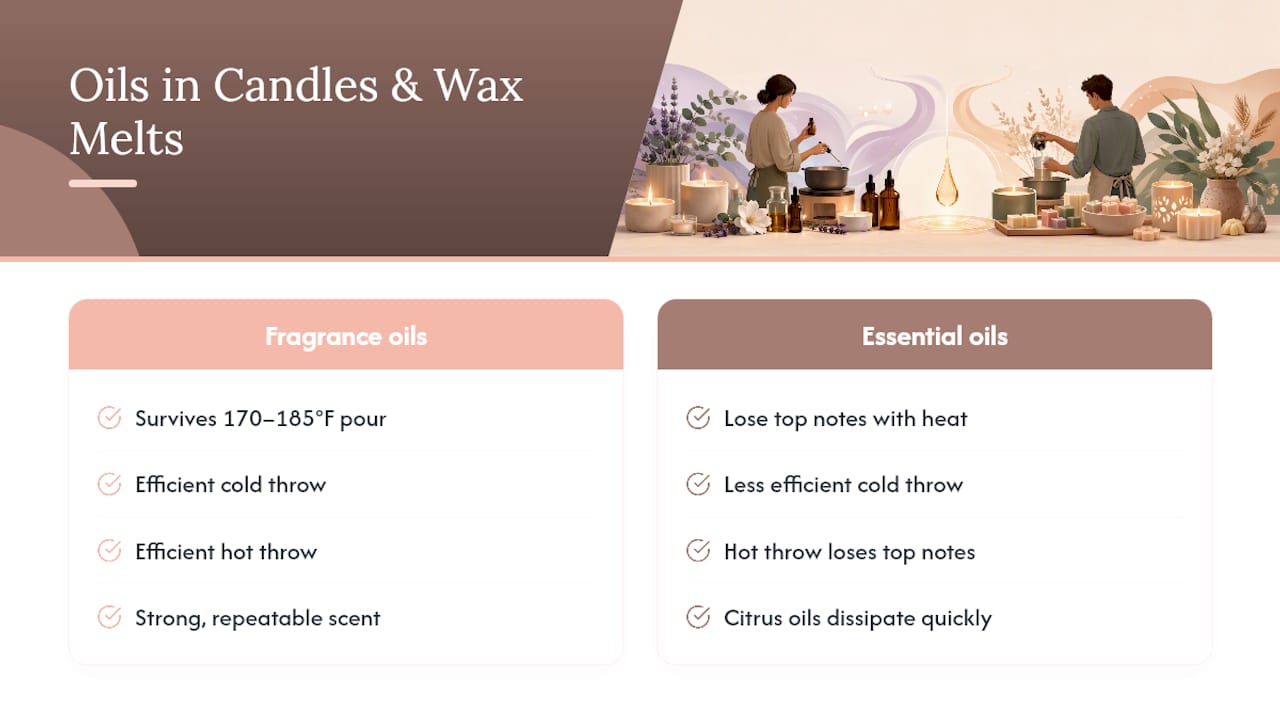
Fragrance oils are formulated to survive wax temperatures (typically 170–185°F at pour) and release scent efficiently during both cold throw (unlit) and hot throw (burning). Most essential oils lose their top notes under heat, and citrus oils in particular dissipate quickly. Makers consistently find that fragrance oils deliver stronger, more repeatable throw in candles and wax melts — which is why most professional candlemakers use them as their primary scent source.
Cold-process and melt-and-pour soaps
High pH in cold-process soap during saponification accelerates the breakdown of many essential oil molecules. Floral essential oils like rose and jasmine can fade significantly over time. Soap-safe fragrance oils are formulated to hold through the cure and remain stable at that pH, making them far more reliable for soap applications.
Diffusers and room sprays
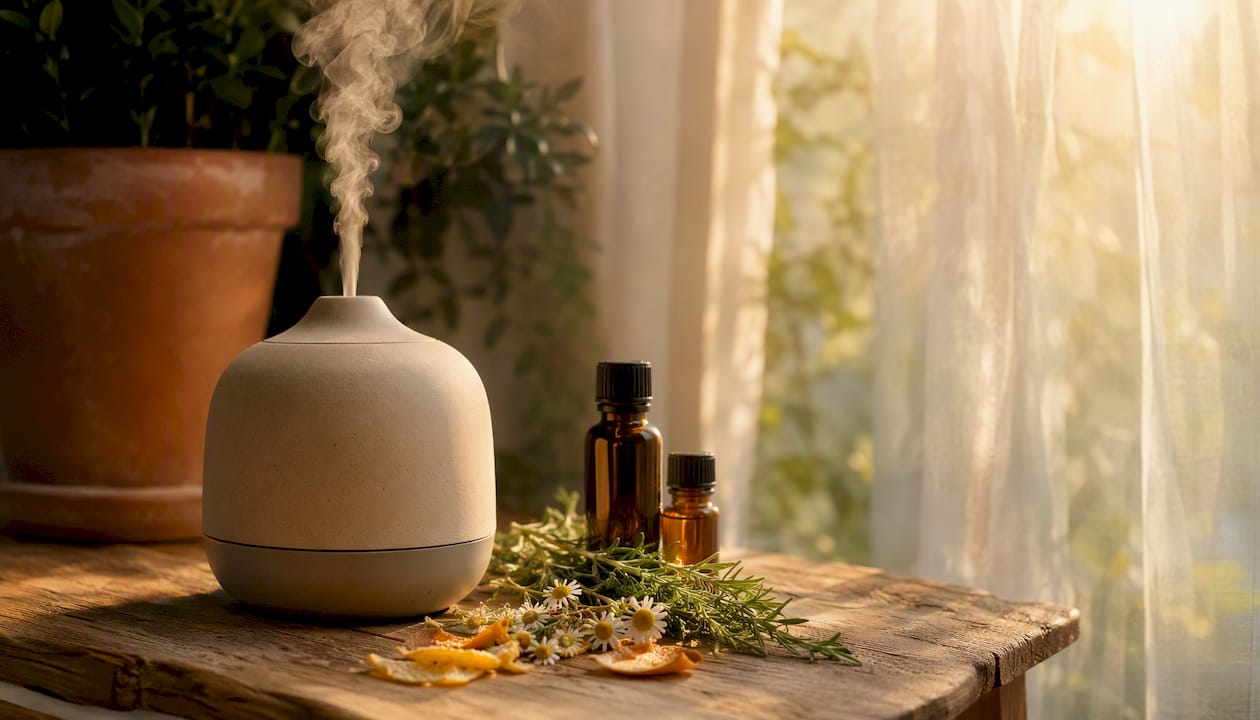
This is where essential oils genuinely shine. For plant-forward aromatherapy, subtle ambient diffusion, and therapeutic intent, essential oils offer the real botanical complexity that fragrance oils cannot replicate. Eucalyptus, peppermint, and lavender essential oils in a diffuser deliver the actual plant compounds associated with their aromatherapy benefits. Fragrance oils work well in room sprays when a bold, signature ambient scent is the goal.
Topicals and leave-on skin products
Essential oils can offer functional aroma in lotions and serums, but conservative concentrations are non-negotiable — typically 0.5–2% depending on the oil and application site. Fragrance oils used in leave-on products must follow IFRA-approved rates for that specific category, which vary by formula.
Pro Tip: Citrus essential oils (bergamot, lemon, lime) can be phototoxic in leave-on products. Always use bergapten-free versions for any skin application, or switch to a fragrance oil formulated without the phototoxic furanocoumarins.
Shelf stability
Essential oils oxidize over time, especially monoterpene-rich oils like citrus, pine, and tea tree. Oxidized oils can become skin sensitizers. Fragrance oils typically include fixatives that slow evaporation and extend scent life, making them more stable in finished products over months of retail shelf time.
Are synthetic fragrances safe? What U.S. guidance actually says
The short answer: safety depends on the specific ingredient, its concentration, and how it’s used — not on whether it came from a plant or a lab. IFRA is clear that both natural and synthetic fragrance materials are composed of chemicals, and safety must be evaluated by toxicological assessment and exposure level.
The “natural = safe” assumption is one of the most persistent misconceptions in the fragrance world. Limonene and linalool — naturally occurring terpenes abundant in citrus and lavender essential oils — oxidize on exposure to air and become potent contact allergens. Some essential oils are more restricted under IFRA than certain synthetic molecules.
The EPA Safer Choice criteria add a U.S.-specific layer: they disallow listed carcinogens, mutagens, and reproductive toxicants (CMRs) as well as persistent, bioaccumulative, and toxic substances (PBTs) in fragrance materials. For Natural Complex Substances (NCSs) — which include essential oils — Safer Choice requires CAS-level ingredient checks and batch data when components of concern are present.
A peer-reviewed review published on PMC documents VOC emissions from fragranced products and links them to cutaneous, respiratory, and systemic effects, with particular concern for asthmatics, migraine sufferers, and other sensitive groups in indoor environments. Ventilation matters regardless of whether you’re burning an essential-oil candle or a fragrance-oil one. For more on managing indoor air with scented products, Wickofhope’s guide on candles and indoor air quality covers practical mitigation steps.
| Safety checkpoint | Essential oils | Fragrance oils |
|---|---|---|
| IFRA usage limits | Yes — apply by product category | Yes — supplier IFRA certificate required |
| Allergen disclosure | Regulated terpenes (limonene, linalool, citral) | Same regulated allergens apply |
| Phototoxicity risk | Some citrus EOs (bergapten) | Rare; formulator controls |
| Safer Choice CMR/PBT check | NCS batch data required | CAS-level ingredient check required |
| Patch testing for topicals | Always recommended | Always recommended |
What are the real environmental trade-offs?
Sustainability in fragrance is more nuanced than “natural good, synthetic bad.” Both categories carry environmental costs and benefits worth weighing honestly.
- The honest complexity: Synthetic production depends on petrochemical or bio-based feedstocks, and manufacturing processes carry their own environmental footprints. Industry analysis consistently shows that sustainability should be evaluated on sourcing transparency, biodegradability, and supplier certification rather than origin alone.
- What to look for: — Fair-trade certification, organic sourcing for essential oils, and supplier environmental disclosures for fragrance oils are more meaningful signals than the natural/synthetic label.
Cost, availability, and shelf life: what to expect
Essential oils vary enormously in price based on raw-material demands. Lavender and eucalyptus are relatively affordable; rose absolute, jasmine absolute, and sandalwood can cost hundreds of dollars per ounce. Fragrance oils are significantly cheaper and easier to source at consistent quality, which is why they scale well for production runs.
- Shelf life for fragrance oils: — Fragrance oils typically retain their color and scent profile longer than essential oils because they include fixatives and are less prone to oxidation. Expect 1–2 years or more when stored properly.
Which should you use? A decision guide by product type
The right choice usually comes down to three questions: What is the product base? What is the intended experience? What does your customer expect?
When fragrance oils are the better choice
- Candles and wax melts: — Fragrance oils survive wax temperatures and deliver consistent hot and cold throw. Most professional candle lines use them as the primary scent source.
Safe handling, dilution, storage, and small-batch testing
Good fragrance practice comes down to a few non-negotiable habits, whether you’re working with essential oils or fragrance oils.
- Storage: — Keep essential oils in dark amber or cobalt glass, away from heat and light. Refrigerate citrus oils if you won’t use them within a few months of opening. Fragrance oils store well in sealed containers at room temperature, away from direct sunlight.
Pro Tip: For candle testing, evaluate your fragrance at three points: immediately after pouring (cold throw), after a 48-hour cure (cold throw development), and during a full burn test (hot throw and scent diffusion). A fragrance that smells strong in the jar but weak when burning usually needs a higher fragrance load or a different wax blend.
For small-batch soap testing, cure a test bar for the full 4–6 weeks before evaluating scent retention. Many essential oils that smell strong at pour will fade significantly by the time the bar is ready to use.
How Wickofhope chooses fragrances for clean-burning candles
Wickofhope builds every candle on a base of natural coconut soy wax with FSC-certified wooden wicks — a combination chosen for clean combustion and a gentle, crackling burn. The fragrance selection process goes well beyond picking a scent that smells good.
Before any fragrance material enters a Wickofhope product, the brand requests:
- An IFRA certificate confirming the fragrance is compliant at the intended use rate for candle/wax melt applications
- A full allergen report identifying regulated sensitizers present in the formula
- Batch GC/MS data (gas chromatography/mass spectrometry) for essential oil components, confirming the actual chemical profile of that specific lot
The Cozy Spice Embrace Wax Melt | Amber Romance + Vanilla is a clear example of this approach in practice. The warm, spiced amber and vanilla profile is achieved through a carefully selected fragrance oil rather than an essential-oil-only blend — because the fragrance oil delivers consistent throw across every batch, survives the wax melt temperature cycle without losing its character, and carries a verified IFRA certificate for wax melt use. An essential-oil-only version of that scent profile would be prohibitively expensive, inconsistent batch to batch, and likely to fade under heat.
Wickofhope’s non-toxic fragrance sourcing approach reflects the same principle: the goal is a safer home environment, not a marketing label. Every purchase also supports women and children escaping crisis, connecting product quality directly to social impact.
Key Takeaways
Essential oils suit aromatherapy, topical blends, and plant-forward products; fragrance oils deliver stronger, more consistent performance in candles, soaps, and ambient scent applications — and safety depends on formulation and IFRA compliance, not on whether the ingredient is natural or synthetic.
| Point | Details |
|---|---|
| Origin and composition | Essential oils are single-plant extracts; fragrance oils are formulated blends of naturals, nature-identicals, and synthetics. |
| Performance by base | Fragrance oils outperform essential oils in high-heat and high-pH bases like candles and cold-process soap. |
| Safety is dose-dependent | Natural does not mean safe; IFRA limits and allergen reports apply to both essential oils and fragrance oils. |
| Environmental trade-offs | Synthetics can reduce pressure on over-harvested botanicals; sustainability depends on sourcing transparency, not origin alone. |
| Wickofhope’s approach | Wickofhope uses IFRA-certified fragrance oils in wax melts like the Cozy Spice Embrace for consistent, clean-burning performance. |
The case for choosing with intention, not ideology
The fragrance world has a habit of sorting itself into camps: natural purists on one side, synthetic advocates on the other. Neither position serves you well as a maker or a consumer.
What actually matters is purpose. If you’re diffusing lavender for a calm evening wind-down, a genuine essential oil gives you the full botanical complexity that a fragrance oil cannot replicate. If you’re making a wax melt that needs to fill a room with warm spiced amber every single time someone uses it, a well-formulated, IFRA-certified fragrance oil is the honest choice. Insisting on essential oils in that context doesn’t make the product safer or more natural — it makes it less reliable and potentially more expensive without a real benefit to the person burning it.
The brands worth trusting are the ones that ask the same questions regardless of which material they choose: Where does this come from? What does the supplier documentation say? Is it safe at the rate we’re using it? That’s the standard Wickofhope holds its fragrance sourcing to, and it’s the standard worth applying to any scented product you bring into your home.
Wickofhope’s clean-burning candles: scent you can feel good about
Wickofhope’s scented candles are built on natural coconut soy wax, FSC-certified wooden wicks, and fragrance materials that are IFRA-certified and vetted for clean combustion — no paraffin, no phthalates, no compromise on what goes into your home. The warm, crackling burn of a wooden wick paired with a carefully sourced fragrance is a genuinely different experience from a mass-produced candle.
If you want to try the approach in practice, the Cozy Spice Embrace Wax Melt is a good starting point — a rich amber, romance, and vanilla blend that holds its scent through every melt cycle. Every purchase directly supports women and children escaping crisis. Browse the full collection and find the scent that fits your space at Wickofhope’s scented candles page.
Useful sources and further reading
These are the authoritative references behind this guide. If you’re formulating products or making purchasing decisions, these are worth bookmarking.
- Questions about fragrance | IFRA
- Safer Choice Criteria for Fragrances
- Fragrance compounds and potential human health impacts | PMC
- Synthetic Scents vs. Naturals: Separating Myth from Reality in Perfumery - SpFragrance
- Fragrance Oils vs Essential Oils — What’s the Difference? | FragranceOils
- Natural vs Synthetic Fragrance: Which Is Safer, Longer-Lasting and More Sustainable? - Stock Fragrance
- Natural is better than synthetic? It is not that simple. - Parfinity
- Essential Oils vs Fragrance Oils: What’s the Difference? - EssentialOilNerd
- Scented Candles – Wick of Hope
This article is general information, not professional safety or formulation advice. Confirm current IFRA limits, regulatory requirements, and ingredient safety with your supplier documentation or a qualified formulation professional before use.


