


A coconut soy blend is a plant-based container wax that combines soy and coconut oils to deliver better scent throw, smoother tops, and improved glass adhesion than pure soy alone.
A few things worth knowing upfront:
- Blend ratios are not standardized across the industry. As Golden Brands 454 documentation confirms, soy is typically the dominant wax and the exact coconut-to-soy ratio is proprietary.
- Performance varies meaningfully by supplier, vessel shape, and fragrance formulation.
- “Coconut soy wax” is the recognized industry term; “coconut soy blend” is the common shorthand you’ll see on supplier pages and maker forums.
Key Takeaways
A coconut soy blend delivers stronger scent throw, smoother tops, and better glass adhesion than pure soy, but every blend is proprietary and requires hands-on testing before production.
| Point | Details |
|---|---|
| Ratios are proprietary | Soy is typically dominant; ask your supplier for the approximate coconut-to-soy ratio before ordering. |
| Test three wick sizes | Coconut soy’s softer texture changes burn-pool behavior; always test one size below, nominal, and one size above. |
| Start fragrance at 7% | The typical range is 5%–7%; 7% gives balanced throw without seepage risk on a first test. |
| Request TDS and SDS | Verify melt point, pour temp range, and storage guidance from the supplier’s own documentation before scaling. |
| Wickofhope as a reference | Wickofhope’s finished coconut soy candles show what the blend achieves with wooden wicks and careful pour practice. |
Table of Contents
- What does a coconut soy blend actually do for your candles?
- Where coconut soy blends work best
- How much fragrance can a coconut soy blend handle?
- Step-by-step workflow for consistent pours
- Fixing common problems with coconut soy candles
- What to check before buying a coconut soy blend
- How Wickofhope works with coconut soy blends
- A maker’s honest take on coconut soy blends
- Wickofhope’s finished coconut soy candles
- Sources
What does a coconut soy blend actually do for your candles?
The appeal of this wax category comes down to a handful of physical properties that directly affect how your finished candle looks, smells, and burns.
Surface finish and appearance
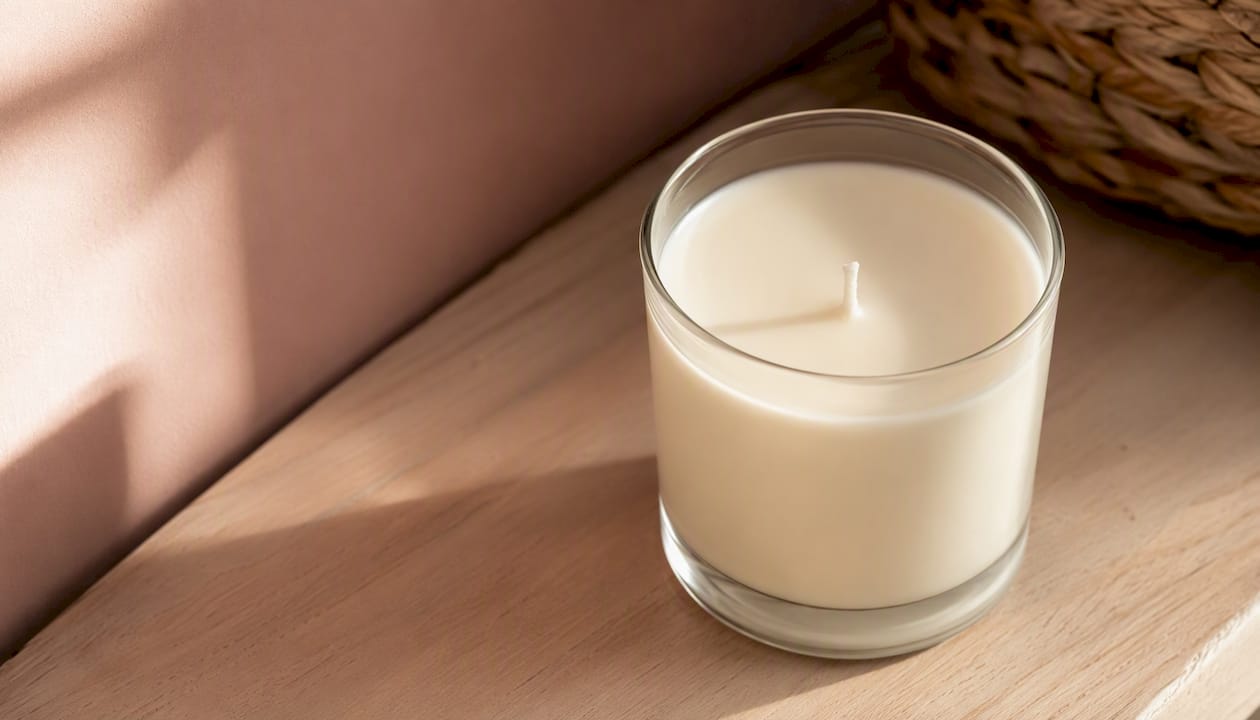
Coconut soy blends typically produce a creamy, off-white finish that looks clean and intentional in clear glass jars. One of the most practical advantages is the single-pour capability: the wax contracts less on cooling than pure soy, which means you can often fill a jar once and skip the second top-up pour. That matters when you’re running a small-batch production line and every step counts.
Adhesion to glass
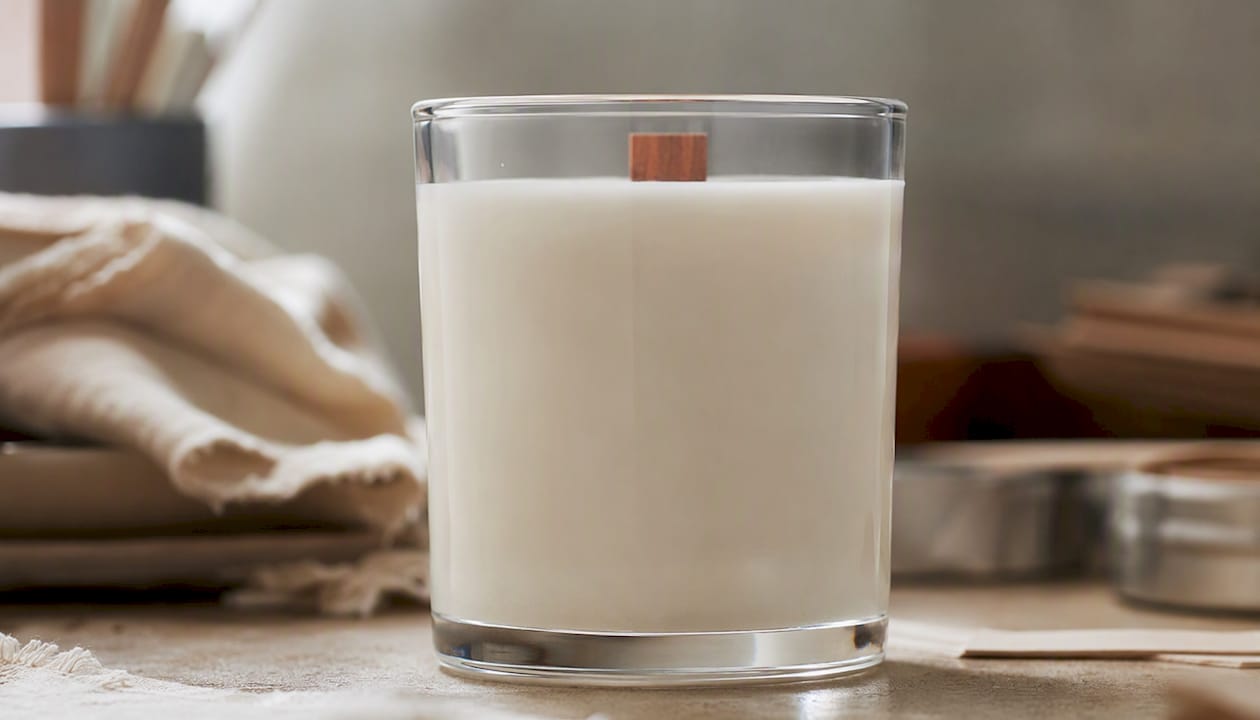
Good glass adhesion reduces wet spots, those cloudy patches where the wax pulls away from the jar wall. NatureWax C-6 product information highlights excellent jar adhesion as a defining feature of coconut/soy blends, and supplier guidance consistently ties adhesion quality to pour temperature and container prep. Pouring too hot or into a cold jar are the two fastest ways to create adhesion problems, regardless of wax quality.
Frosting and texture variability
Frosting, the white crystalline bloom that appears on soy candles, is reduced in coconut soy blends but not always eliminated. Cold ambient temperatures during cooling can still trigger surface texture differences. Some makers treat light frosting as an aesthetic marker of natural wax; others adjust pour temperature or add a small amount of stabilizer to minimize it.
Scent throw
Compared with paraffin, plant-based blends generally produce a softer, more diffuse throw rather than a sharp initial burst. Plant-based waxes like soy and coconut are also promoted as cleaner-burning than paraffin, emitting fewer soot-producing compounds, though formulation and additives still influence final emissions.
Pro Tip: Cure your test candles for at least 48 hours before evaluating cold throw. Coconut soy blends often need a full 72-hour cure to reach their scent peak, so a quick sniff the next morning will underestimate the finished fragrance.
Melting points for coconut soy blends typically fall in a softer range than pure soy, which affects how the burn pool forms and how quickly the wax liquefies around the wick. A softer wax can require a slightly larger wick to maintain a full melt pool, which is why wick testing is non-negotiable with this category.
Where coconut soy blends work best
This wax category has a clear home: fragranced container candles. Jars, tumblers, and tealight cups all suit the blend’s soft texture and adhesion properties. The wax flows well into containers, bonds to glass, and holds fragrance at rates that make scented candles genuinely rewarding to make.
Where it struggles:
- Pillar candles and freestanding forms. Coconut soy blends are too soft to hold a defined shape without a mold. They’re not designed for this application.
- Wax melts with complex layering. The softer texture can make clean release from molds inconsistent.
- High-humidity environments without climate control. Coconut wax is moisture-sensitive, and blends can sweat or develop surface issues if stored or sold in humid conditions.
Common pairings that work well:
- 8 oz straight-sided jar + wooden wick: The flat, even burn pool suits the wax’s soft melt behavior, and the crackling wooden wick adds a sensory layer that complements the natural wax story.
- 4 oz tin + cotton wick: Smaller vessels need careful wick sizing; the contained space amplifies throw nicely.
- Tealight cups + pre-tabbed wicks: Single-pour convenience makes tealight production fast and consistent.
If you need a wax that works across both containers and pillars, adding paraffin or switching to a harder soy blend is worth considering. For pure container work, coconut soy is a strong fit. You can also read more about coconut vs. soy wax performance to understand how each base wax contributes to the blend’s behavior.
How much fragrance can a coconut soy blend handle?
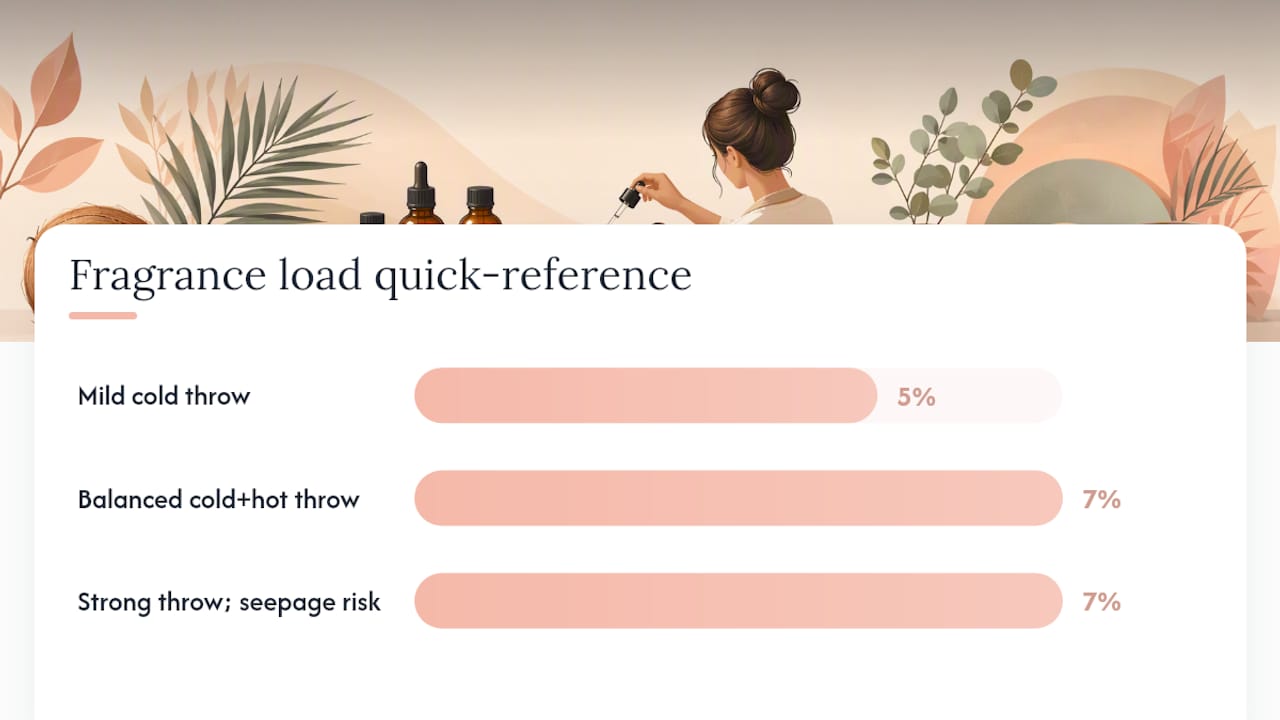
Fragrance load is where coconut soy blends earn their reputation. Most suppliers recommend fragrance loads within a supplier-specified range, with some blends accepting higher loads when additives or stabilizers are included. Direct Candle Supply’s handling guidance recommends adding fragrance at around 170°F and pouring within a 160°F–180°F window, with fragrance loads within supplier recommended ranges. Some blends include a small amount of food-grade paraffin to improve performance at higher loads.
Fragrance load quick-reference
| Fragrance Load | Expected Result | Notes |
|---|---|---|
| 5% | Mild cold throw, reliable hot throw | Safe starting point for any new blend |
| 7% | Balanced cold and hot throw | Good baseline for most fragrances |
| 7% | Strong throw, possible seepage risk | Test wick size carefully; check supplier ceiling |
Timing and temperature
Adding fragrance at the right temperature matters more than most makers expect. Too hot and volatile top notes burn off before the wax sets. Too cool and the fragrance doesn’t bind evenly, which shows up as inconsistent throw across the candle’s burn life. The 170°F add point is a reliable starting target; stir gently for 2 minutes to distribute evenly before cooling.
Cold throw develops during cure. Hot throw depends on wick size and melt pool diameter. If your cold throw is strong but hot throw is weak, the wick is likely undersized. If hot throw is strong but the candle smokes, the wick is too large.
You’ll get throw and burn data from a single test session instead of two separate rounds.*
Step-by-step workflow for consistent pours
Repeatable results come from a fixed process, not from intuition. Here’s a workflow that works for small-batch coconut soy production:
- Melt slowly. Use a double boiler or dedicated wax melter. Heat to 180°F–185°F and hold for 5 minutes to fully liquefy any remaining crystals. Avoid direct heat, which scorches the wax and degrades fragrance binding.
- Cool to fragrance-add temperature. Remove from heat and let the wax cool to approximately 170°F. Stir gently to equalize temperature throughout the pour pot.
- Add fragrance. Pour your measured fragrance oil into the wax, not the other way around. Stir for 2 minutes with a consistent motion. Avoid whipping air into the wax.
- Cool to pour temperature. Let the wax cool to your target pour range, typically 160°F–165°F for most coconut soy blends. NatureWax C-6 guidance and similar supplier documentation consistently recommend this window to secure adhesion and avoid discoloration.
- Prepare containers. Warm jars to room temperature at minimum; some makers warm to 80°F–90°F in an oven to further reduce wet spots. Center and secure wicks before pouring.
- Pour steadily. Fill in one pass, leaving about half an inch of headspace. Avoid disturbing the candle for at least 24 hours.
- Cure. Allow 48–72 hours before evaluating. Wooden wicks may need a full 72 hours.
Wick selection protocol
Supplier guidance for Golden Brands 454 specifically notes that coconut soy blends can require different wicking than pure soy due to their softer texture and burn-pool behavior. The standard test protocol:
- Select three candidate wicks: one size below your nominal, your nominal, and one size above.
- Pour three identical jars at the same temperature, fragrance load, and cure time.
- Burn each for 4 hours. Measure the melt pool diameter (target: within 0.25 inches of the jar’s inner diameter).
- Check for soot on the jar rim and mushrooming on the wick tip.
- Trim wicks to 0.25 inches before each subsequent burn test.
The wick that produces a full melt pool without soot or mushrooming is your starting point for production.
Fixing common problems with coconut soy candles
Most issues with coconut soy blends trace back to three variables: pour temperature, wick size, and fragrance load. Here’s how to read the symptoms:
- Weak scent throw (cold): Fragrance load is likely below 7%, or the candle hasn’t cured long enough. Extend cure to 72 hours and retest before changing anything else.
- Weak scent throw (hot): Wick is undersized and not creating a full melt pool. Move up one wick size and retest.
- Frosting: Pour temperature was too low, or the candle cooled too quickly in a cold room. Try pouring 5°F warmer and keep finished candles at room temperature during the first 24 hours of cooling.
- Tunneling: Wick is undersized. The melt pool never reaches the jar walls, leaving a wax tunnel around the wick. Move up one wick size.
- Soot or black smoke: Wick is oversized or untrimmed. Trim to 0.25 inches and retest; if soot persists, move down one wick size.
- Wet spots: Pour temperature was too high, or the jar was cold at pour time. Lower pour temp by 5°F and pre-warm containers.
- Sinkholes: Wax cooled too fast or wasn’t fully melted before pouring. Slow your cooling rate and verify full melt at 185°F before adding fragrance.
For ongoing burn care guidance, the candle care guide covers trimming, burn time, and vessel handling in practical detail.
What to check before buying a coconut soy blend
Supplier product pages vary widely in what they disclose. Before placing an order, verify these specs:
- Melt point range: Confirms softness and helps predict burn-pool behavior.
- Recommended pour temperature: Should be a specific range, not a vague “medium heat” instruction.
- Recommended fragrance load: Look for a ceiling percentage, not just a starting suggestion.
- Single-pour claim: Confirms whether the wax is formulated to avoid sinkholes without a second pour.
- Appearance description: “Creamy off-white” is a good sign; vague descriptions warrant a sample order first.
- Hot and cold throw notes: Supplier-stated throw quality is a starting point, not a guarantee.
Questions to ask your supplier directly:
- What is the typical coconut-to-soy ratio, even if approximate?
- Does the blend contain any food-grade paraffin or performance additives? Some suppliers market blends as “no-additive” while others disclose a small amount of paraffin to stabilize throw and reduce frosting.
- Is a TDS (Technical Data Sheet) or SDS available? The SDS for Golden Brands 454 is a useful model for what a complete safety and handling document should include.
- What is the recommended storage temperature and shelf life?
- What is the return or sample policy?
Blends are available in 1 lb, 5 lb, and larger wholesale quantities. Starting with a 1–5 lb sample before committing to a bulk order reduces buying risk significantly. Amazon and wholesale listings carry small-batch options that let you compare price-per-pound and test before scaling. Retailer pages like Bramble Berry’s coconut soy wax listing also publish appearance specs and pour temps worth cross referencing.
Store your wax in a cool, dry place away from direct sunlight. Heat and humidity degrade fragrance absorption over time, which means a bag of wax stored in a warm garage through summer may perform differently than a freshly ordered batch. Request storage guidance from your supplier and check the SDS for shelf-life specifics.
How Wickofhope works with coconut soy blends
At Wickofhope, the choice to build every candle on a natural coconut soy wax base wasn’t accidental. The blend’s ability to carry fragrance cleanly, burn without the soot associated with paraffin, and present beautifully in glass aligned directly with the brand’s commitment to non-toxic, clean-burning candles. Wooden wicks were chosen to complement the wax’s soft melt behavior, creating a gentle crackling burn that feels as restorative as the scent itself.
Pour temperature is one of the variables Wickofhope takes seriously in production. Pouring at the lower end of the recommended window, around 160°F, consistently reduces wet spots in the glass jars used across the product line, without sacrificing the hot throw that makes the fragrances genuinely noticeable from across a room. That trade-off, a slightly cooler pour for better adhesion, is the kind of small calibration that separates a polished finished candle from one that looks handmade in the wrong sense. You can read more about why coconut soy wax candles outperform other wax types for home use.
A maker’s honest take on coconut soy blends
The coconut soy category gets a lot of enthusiasm from the candle-making community, and most of it is deserved. But there’s a gap between what supplier pages promise and what your first test batch will deliver, and that gap is almost always about wicking.
The softness that makes coconut soy blends so appealing for fragrance load and surface finish is the same property that makes wick selection genuinely tricky. A wick that works perfectly in a pure soy candle will often underperform in a coconut soy blend because the softer wax creates a wider, shallower melt pool faster. Makers who skip the three-wick test and go straight to production are the ones who end up with tunneling or soot problems and blame the wax when the wick was the variable.
The other underestimated factor is supplier variability. “Coconut soy blend” is a category description, not a formula. Two blends with the same name from different suppliers can behave very differently at the same pour temperature and fragrance load. That’s not a flaw in the category; it’s just the reality of proprietary formulations. The fix is simple: treat every new supplier as a new wax, run your full test protocol, and don’t assume your existing wick and pour settings will transfer.
For small-batch makers, coconut soy blends offer a genuinely rewarding combination of natural ingredients, strong fragrance performance, and a finish that photographs well. The cost is slightly higher than pure soy, and the testing investment is real. Both are worth it.
Wickofhope’s finished coconut soy candles
If you’re drawn to what a well-made coconut soy candle can do but prefer a finished product over a production run, Wickofhope offers a small, carefully crafted collection worth knowing.
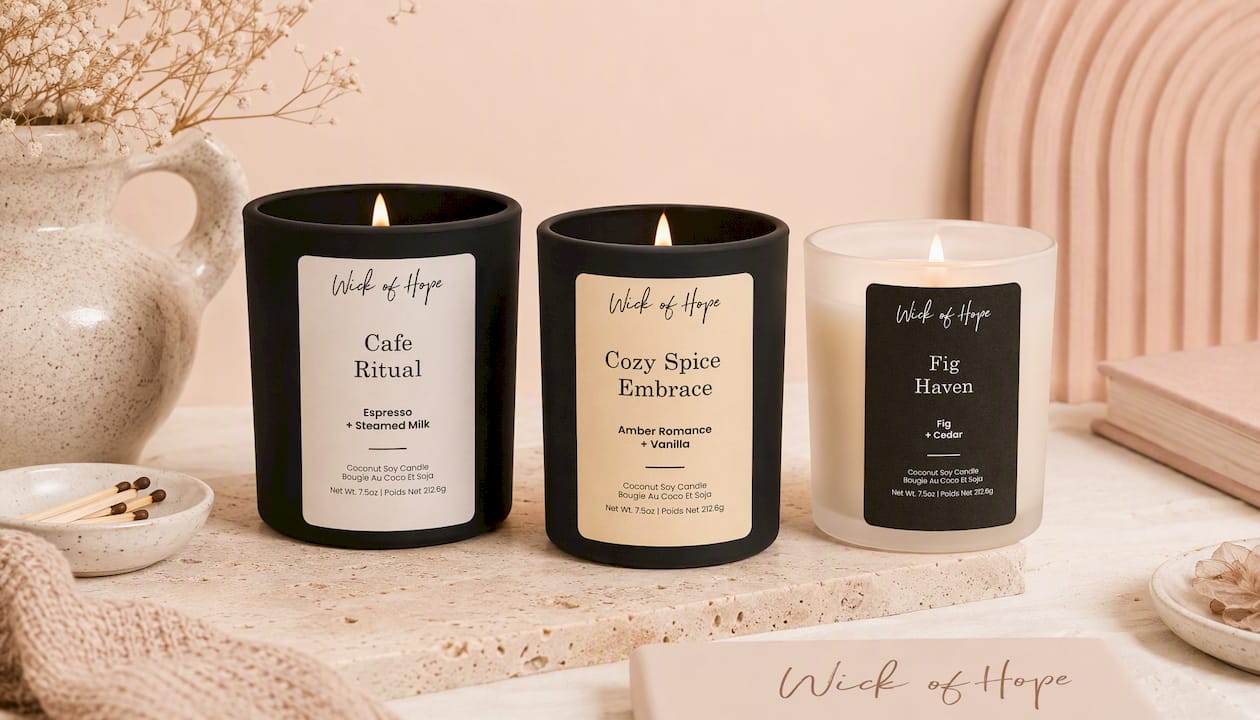
The Cafe Ritual Candle in Espresso + Steamed Milk brings a warm, roasted comfort to any room, the kind of scent that makes a space feel lived-in and calm. The Cozy Spice Embrace Candle in Amber Romance + Vanilla layers warm spice and soft sweetness in a way that works year-round, not just in fall. And the Fig Haven Candle in Fig + Cedar is earthy and grounding, a quieter fragrance that rewards a slow afternoon.
Each is made with the same natural coconut soy wax and FSC-certified wooden wicks that this guide covers, so they’re also useful reference points for makers evaluating what a finished coconut soy candle should look, smell, and burn like. These are finished-product options, not a supplier comparison. Browse the full scented candle collection to see the complete range.
Sources
- Golden Brands 454 Coconut Soy Wax - CandleScience
- NatureWax C-6 Coconut/Soy Wax - The Flaming Candle
- Benefits of Coconut and Soy Wax Candles Over Paraffin Wax - Guests on Earth
On each page, look specifically for: melt point (°F), recommended pour temperature range, fragrance load ceiling, single-pour claim, and any wick series recommendations. If a supplier page doesn’t list these, request the TDS directly before ordering.


