


Fragrance-free means no fragrance materials were intentionally added to a product; unscented usually means fragrance chemicals were used to mask any raw-material smell, leaving a scent-free result. If you have eczema, allergies, or respiratory sensitivity, choose fragrance-free and confirm it by scanning the ingredient list or looking for a certification seal. Neither word is a legal guarantee, so treat the label as a starting point, not proof.
TL;DR:
- Masks in “unscented” products are still fragrance chemicals that can cause skin sensitization despite not being detectable by smell.
- Fragrance-free products explicitly avoid adding any scent materials, making them a safer choice for sensitive skin and allergy-prone individuals.
- Ingredient lists revealing fragrance compounds, allergens, or botanical extracts are key signals that a product may still pose allergy risks, even if labeled “unscented.”
- Many products marketed as “fragrance-free” still contain undisclosed fragrance-related compounds, so verification through ingredient review is essential.
- For households with sensitivities, choosing third-party verified fragrance-free cleaning, skincare, or home fragrance items reduces exposure to potentially irritating chemicals.
Table of Contents
- What “Unscented” Really Means (and Why It’s Not Chemical-Free)
- What “Fragrance-Free” Actually Promises
- Reading the Fine Print: Ingredient Signals That Reveal the Truth
- Who Should Avoid Which Label, and Why It’s a Skin Issue, Not a Nose Issue
- Your Buying Checklist: What to Actually Do at the Shelf or Checkout
- Fragrance-Free and Unscented, Defined in Plain Terms
- Publisher Perspective: How Wickofhope Thinks About Fragrance and Transparency
- Wax Melts Worth Trying, Whatever Your Scent Preference
- Sources
- FAQ
What “Unscented” Really Means (and Why It’s Not Chemical-Free)
“Unscented” is an industry shorthand for one thing: the finished product has no perceptible smell. It says nothing about what’s inside.
Most raw ingredients in skincare, laundry products, and cleaners have a natural odor of their own, sometimes unpleasant. Rather than leave that smell exposed, manufacturers add masking agents, fragrance compounds formulated to cancel out or override that raw scent so the final product reads as neutral to your nose. The EPA’s Safer Choice program describes this distinction directly: fragrance-free generally means no fragrance materials were added at all, while unscented often relies on those masking agents to neutralize odor.
Here’s the part that catches people off guard:
- A masking agent is still a fragrance chemical, chemically indistinguishable from the ones used to make a product smell good.
- It can act as a skin sensitizer even though you can’t detect it by smell.
- Products labeled “unscented” can legally contain these compounds without disclosing them as fragrance on the front of the package.
That gap is exactly why dermatology experts have started calling “unscented” a labeling trap for consumers who assume no smell means no risk.
What “Fragrance-Free” Actually Promises
Fragrance-free is the stronger claim of the two, but it’s still a convention, not a regulated category. In practice, it means the manufacturer didn’t add fragrance oils, essential oils, or synthetic scent compounds for the purpose of making the product smell a certain way.
That said, “fragrance-free” has real limits worth knowing before you assume a product is automatically safe:
- Functional ingredients, like certain plant extracts, oils, or preservatives, can carry their own natural scent even though they weren’t added for fragrance.
- These functional ingredients still show up on the ingredient list, just under their botanical or chemical name rather than as “fragrance” or “parfum.”
- Labeling enforcement is inconsistent. Health Canada’s cosmetic labeling guidance explains that fragrance-free and unscented are marketing terms, not legally defined, mutually exclusive categories.
The practical takeaway: fragrance-free narrows your risk considerably, but it doesn’t remove the need to read the ingredient list.
Reading the Fine Print: Ingredient Signals That Reveal the Truth
Scent throw meaning aside (that’s a candle and wax-melt term for how strongly a fragrance fills a room, which we’ll get to later), the real signal you want when shopping for skin, laundry, or home products is what’s hiding in the ingredient list itself.
Here’s what to scan for, in order:
- Explicit fragrance terms. “Fragrance,” “parfum,” and “perfume” on an ingredient list mean scent compounds were deliberately added, full stop.
- Named allergens. Limonene, linalool, geraniol, citronellol, eugenol, and benzyl alcohol are common fragrance-related compounds that must often be disclosed individually once they cross certain concentration thresholds, even in products marketed as fragrance-free.
- Botanical extracts and essential oils. Ingredients like lavender oil or citrus extract can function as fragrance while appearing under a plant name, which sidesteps the word “fragrance” entirely.
- List length. Shorter, simpler ingredient lists generally carry fewer hidden fragrance risks than long, multi-extract formulas.
Pro Tip: Keep a running list of the allergen names your dermatologist has flagged for you, then do a quick search of any new product’s ingredient list before you buy. It takes thirty seconds and catches most surprises.
If a label still leaves you unsure, contact the manufacturer directly and ask whether the product contains any fragrance materials, including masking agents. A company confident in its formula will usually answer plainly.
Who Should Avoid Which Label, and Why It’s a Skin Issue, Not a Nose Issue
Contact allergies happen at the molecular level. Your skin’s immune response reacts to a compound’s chemical structure, not whether you can smell it. That’s why an odorless masking agent in an “unscented” moisturizer can still trigger the same rash as an overtly perfumed one.
This is precisely why dermatologists and organizations focused on eczema care consistently steer sensitive patients toward fragrance-free over unscented. The distinction isn’t cosmetic; it changes your actual exposure to sensitizing chemistry.
The scale of the mislabeling problem is bigger than most shoppers assume. Research tracked in dermatology literature has found that a meaningful share of products marketed as “fragrance-free” still list fragrance-related compounds on their ingredient panels, a gap peer-reviewed contact allergy research has documented directly.
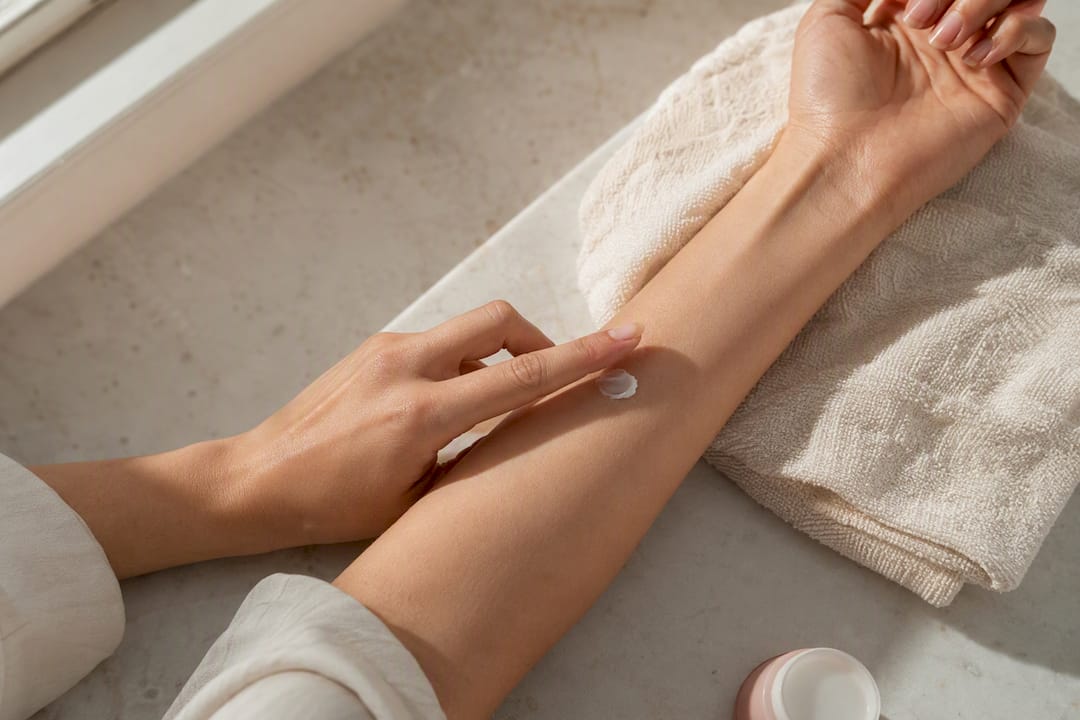
If you’re managing eczema, contact dermatitis, or respiratory sensitivity, treat every new product as a trial. Patch test on a small area of skin for 48 hours, buy trial sizes before committing to full bottles, and talk to a dermatologist if reactions persist despite fragrance-free choices, since other preservatives or actives can be the culprit too.
Your Buying Checklist: What to Actually Do at the Shelf or Checkout
Skip the marketing copy and go straight to verification. Here’s the sequence that actually protects sensitive skin:
- Choose the fragrance-free variant first, not unscented, whenever one is available.
- Flip the package and read the full INCI (International Nomenclature of Cosmetic Ingredients) list before you read anything else on it.
- Search unfamiliar ingredient names against known allergens like linalool or limonene.
- Favor shorter formulas with fewer botanical extracts if you have a known sensitivity history.
- Look for third-party verification, like the National Eczema Association Seal of Acceptance or the EPA Safer Choice label, since both apply stricter ingredient screening than the words on the front of the bottle.
Laundry deserves its own note here. Fragrance molecules in detergents and fabric softeners are engineered to cling to fibers and release slowly over days, which means a scented or masked-unscented detergent keeps re-exposing sensitive skin every time you wear that shirt. If anyone in your household reacts to fragrance, the detergent aisle is not the place to compromise.
Pro Tip: If you only make one swap this year, make it your laundry detergent. It touches every fabric that touches your skin, all day, every day.
Unscented is perfectly fine for people who simply dislike perfume but have no diagnosed sensitivity. If that’s you, unscented options for skincare or cleaning products are a reasonable middle ground; you’re choosing based on preference, not medical necessity.
Fragrance-Free and Unscented, Defined in Plain Terms
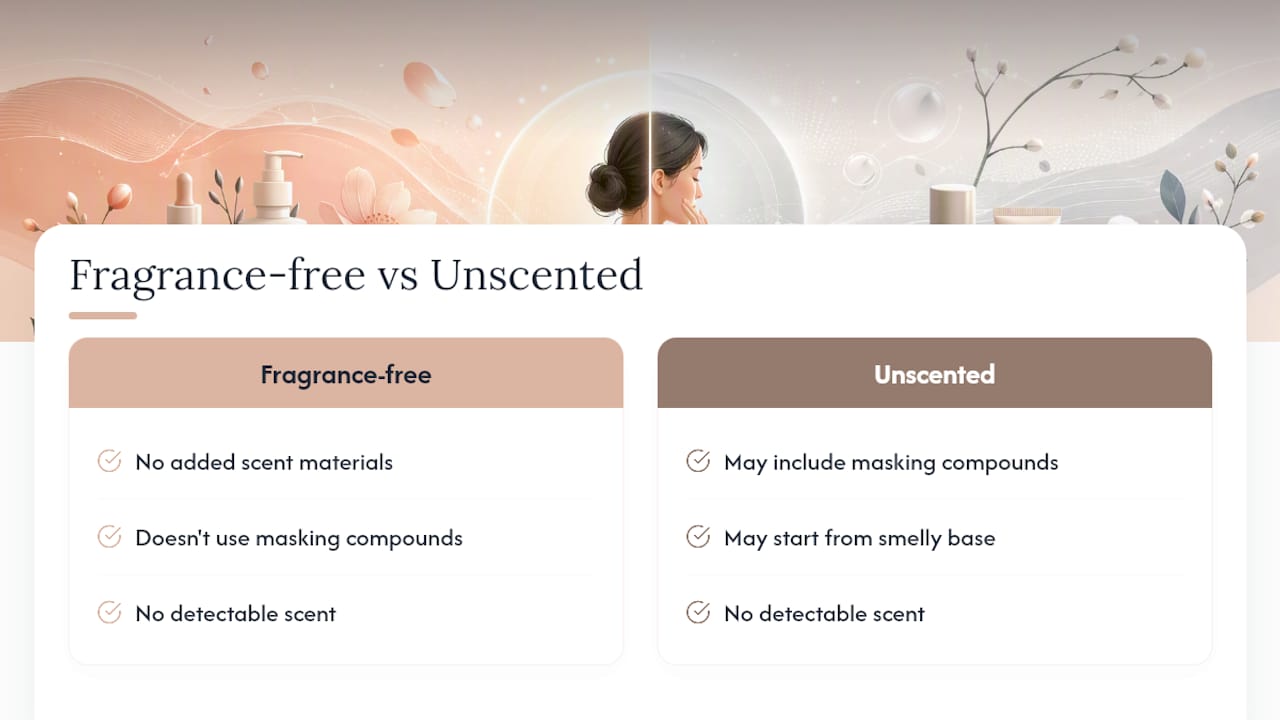
Strip away the marketing, and the core difference is simple: fragrance-free means nothing was added for scent. Unscented means nothing is detectable by smell, regardless of what was used to get there.
Think of it this way. A fragrance-free lotion skips the perfume aisle entirely during formulation. An unscented lotion might use a raw base that smells like plastic or tallow, then blend in a masking compound to erase that smell before it reaches your bathroom shelf. Both end up odorless. Only one of them avoided adding fragrance chemistry in the first place.
This same logic extends beyond skincare. Fragrance-free products, broadly, are formulated without added scent materials, whether that’s a moisturizer, a candle in a personalized glass jar, or a load of laundry. Unscented vs. scented is really a spectrum of intensity and intention: scented products are built around a fragrance profile, unscented products hide one, and fragrance-free products simply don’t include one to begin with.
For home fragrance specifically, the terms shift slightly. A candle’s scent throw, meaning how strongly its fragrance fills a room, breaks down into hot throw (the smell released while burning) and cold throw (the smell noticeable from an unlit candle sitting on a shelf). A fragrance-free candle has neither, by design, which matters if you’re choosing wax melts or candles for a household with respiratory sensitivity rather than a preference for quiet.
Publisher Perspective: How Wickofhope Thinks About Fragrance and Transparency
Some companies build candles from natural coconut soy wax with FSC-certified wooden wicks, and offer both scented and unscented options rather than treating fragrance-free as an afterthought category. That matters in a home fragrance context, where fragrance-free choices reduce your household’s exposure to unnecessary fragrance chemicals without asking you to give up the ritual of lighting a candle.
The ingredient transparency that matters for skincare labels applies just as much to what burns in your living room. If you’re shopping for a household with sensitivities, our guide on hypoallergenic candles walks through what to look for beyond the word “unscented” on a candle label, and it follows the same verification logic covered above.
— Andy
Wax Melts Worth Trying, Whatever Your Scent Preference
If you’re ready to bring a low-toxicity fragrance option into your home, coconut soy wax melts offer a way to test scent strength and profile without committing to a full candle line. Each one is formulated without the synthetic additives common in mass-produced wax.
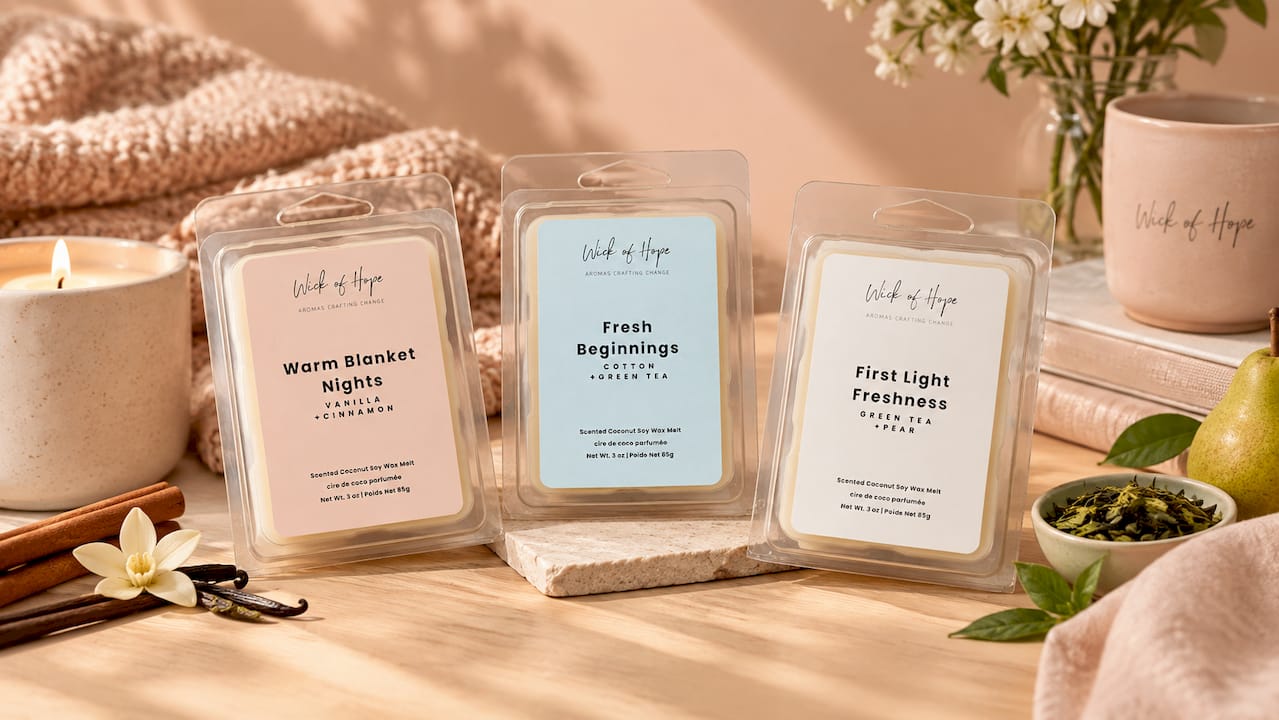
The Warm Blanket Nights Wax Melt in Cinnamon and Vanilla suits anyone who wants a cozy, enveloping scent for a bedroom or living room, without reaching for a heavily perfumed synthetic blend. For a lighter touch, the Fresh Beginnings Wax Melt in Cotton and Green Tea offers a soft, clean scent profile that works well for shoppers easing into home fragrance after avoiding it for sensitivity reasons. And if you prefer something crisp and outdoor-leaning, the First Light Freshness Wax Melt in Green Tea and Pear delivers a fresher throw without veering into heavy floral or musk territory.
Not sure which scent strength fits your space? Our guide on choosing a candle for every room breaks it down by room size and airflow. Start with a single wax melt in a scent that matches your household’s tolerance, and see how it performs before committing to a full collection.
Sources
- Health Canada — Cosmetic advertising, labelling and ingredients
- EPA Safer Choice — Fragrance-free factsheet
- National Eczema Association — About the Seal of Acceptance
- PubMed — relevant dermatology / contact allergy study
FAQ
Is it better to use fragrance-free body wash?
Yes, for anyone with eczema, sensitive skin, or a history of contact allergies, fragrance-free body wash carries lower risk than unscented because it skips added fragrance materials entirely rather than masking them.
Why avoid fragrance in skincare?
Fragrance chemicals are among the most common causes of contact allergy and irritation, and they trigger reactions based on their chemical structure, not whether you can smell them.
Is it better to use unscented deodorant?
Unscented deodorant is fine for people without diagnosed sensitivities, but those with allergy-prone skin should check the ingredient list for masking agents or choose a fragrance-free formula instead.
Is it better to use fragrance-free detergent?
Yes, especially for sensitive households, since fragrance molecules in detergent are built to linger on fabric and re-expose your skin every time you wear that clothing.


