


Biodegradable packaging is material that microorganisms can break down into water, carbon dioxide, and biomass, but the word alone tells you almost nothing about when or where that happens. A wrapper labeled “biodegradable” might vanish in three months inside an industrial compost facility or sit nearly intact in a landfill for decades. Understanding the difference between the materials, the standards behind them, and the disposal environment they actually need is what separates a smart purchase from a well-meaning guess.
TL;DR:
- Biodegradable packaging requires specific industrial conditions to fully break down, with many materials failing to biodegrade properly in landfills or home composts.
- Materials like PLA demand high-temperature composting facilities, while PHA and mycelium are more versatile and can biodegrade across different environments, including marine settings.
- Certification standards such as EN 13432 and ASTM D6400 verify environment-specific biodegradability, but many products lack these, increasing the risk of greenwashing.
- Improper disposal, such as throwing uncertified biodegradable plastics into recycling or regular trash, can lead to contamination and exclude environmental benefits.
- Reducing or reusing single-use packaging remains more effective than relying solely on biodegradable options, which are suitable only in specific use cases like short-term food service or agricultural films.
Table of Contents
- What Biodegradable Packaging Actually Is (And Why the Term Gets Slippery)
- Common Biodegradable Materials and What to Realistically Expect
- Certifications and Standards: What the Logos on the Box Actually Mean
- How to Spot a Real Biodegradability Claim (And Skip the Fake Ones)
- The Real Trade-Offs: Where Biodegradable Packaging Helps and Where It Backfires
- Where Each Material Actually Belongs: A Disposal Cheat Sheet
- How Wickofhope Applies These Principles to Our Own Packaging
- Andy’s Take: Biodegradable Packaging Is a Tool, Not a Cure-All
- Our Biodegradable Packaging, and Where to Start Exploring
- Sources
- FAQ
What Biodegradable Packaging Actually Is (And Why the Term Gets Slippery)
Biodegradation is a microbial process. Bacteria, fungi, and algae consume the material and convert it into water, carbon dioxide, and new microbial biomass, leaving nothing toxic behind when the process runs to completion. That is the technical definition, and it is also where most marketing claims quietly part ways with reality.
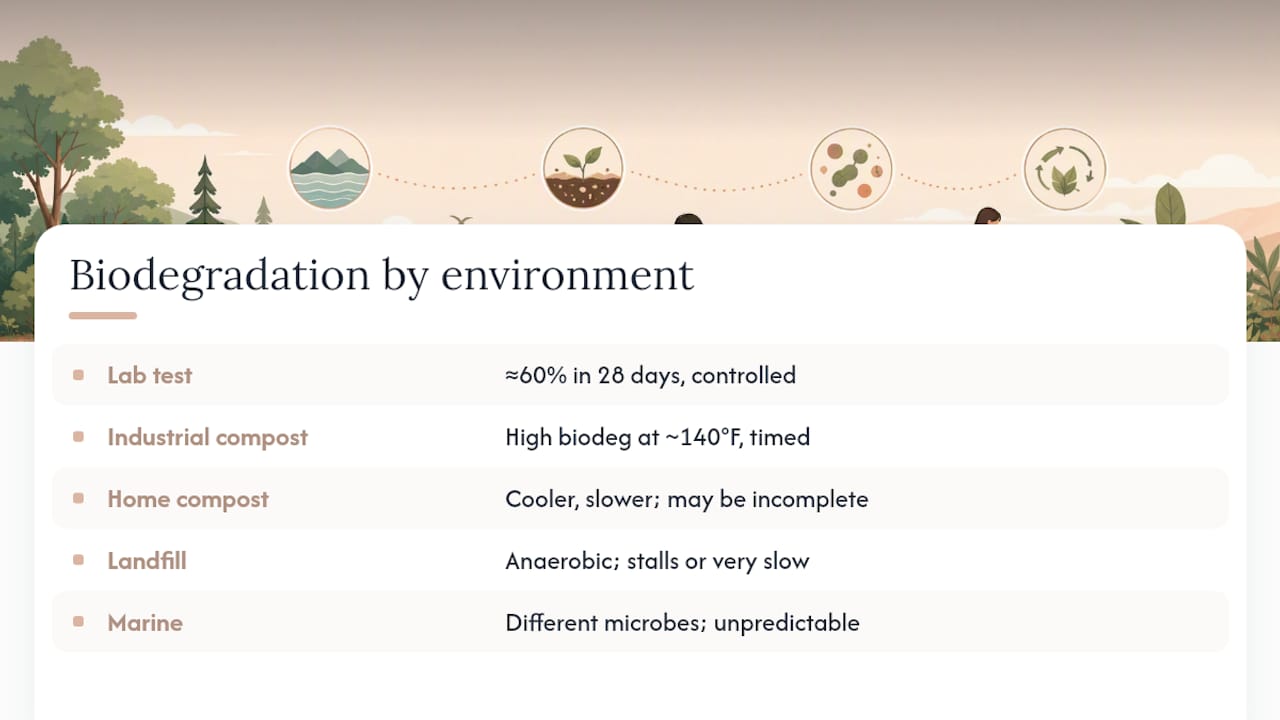
The scientific community measures this with tests like OECD Test No. 301, which assesses “ready biodegradability.” A substance typically needs to break down by around 60% within 28 days under tightly controlled lab conditions to pass. That threshold sounds strict, and in a lab it is. But a lab is not a landfill, a backyard compost pile, or the open ocean.
Full industrial compostability standards require a high level of biodegradation within a defined time frame under specific conditions typically found in commercial composting facilities. Home compost bins run cooler and slower. Landfills are often anaerobic, oxygen-starved environments where biodegradation crawls or stalls entirely. Marine environments have their own microbial makeup, temperature range, and salinity that behave nothing like soil.
This is the core nuance most shoppers miss: biodegradable doesn’t mean biodegradable everywhere. A material engineered to disappear in an industrial facility running at 140°F with constant turning can behave like ordinary plastic if it ends up in a curbside landfill instead. Researchers and packaging reviewers increasingly frame biodegradability as context-dependent rather than a fixed material property, meaning the right question is never just “is this biodegradable?” It is “biodegradable under what conditions, and will my community actually provide them?” according to a European Environment Agency review of packaging plastics and their end-of-life outcomes.
There’s a second layer of confusion worth naming directly: bio-based does not mean biodegradable. A plastic made from corn starch or sugarcane can be chemically identical, in terms of how it breaks down, to a plastic made from petroleum. Biodegradability depends on molecular structure, not feedstock origin, which is why the Ellen MacArthur Foundation points out that some fossil-derived polymers biodegrade readily while some plant-based ones do not biodegrade at all under normal conditions. “Plant-based” on a label is a feedstock claim, not an end-of-life promise.
Marketing teams have leaned hard into the ambiguity. “Biodegradable” sounds green, feels reassuring, and rarely gets challenged at the checkout counter. But the technical use of the term, the one that shows up in peer-reviewed testing standards, always comes bundled with a timeframe and an environment. The marketing use of the term routinely drops both. That gap is where greenwashing lives, and it’s the reason the rest of this guide focuses on specifics: which materials, which conditions, which certifications actually back up the claim on the box.
Common Biodegradable Materials and What to Realistically Expect
Not all biodegradable materials are created equal, and the differences matter far more than most packaging labels let on. Some break down in your backyard compost bin within a season. Others need the sustained heat of an industrial facility and will barely budge anywhere else. A literature review of biodegradable food packaging lays out the most common materials in commercial use, and the performance gap between them is significant.
Paper and cardboard. The most familiar biodegradable material and, in most cases, the most forgiving. Uncoated paper and cardboard biodegrade in home compost, industrial compost, and most soil environments within weeks to a few months. The catch is coatings: wax linings, plastic laminates, and some grease-resistant treatments can slow or block biodegradation entirely, so a pizza box with a plastic sheen behaves very differently from a plain kraft box.
Bagasse. Made from sugarcane fiber left over after juice extraction, bagasse is sturdy enough for takeout containers and clamshells, and it breaks down in home compost within a few months. It handles moisture reasonably well but doesn’t offer strong grease or oxygen barriers, which limits its use for anything that needs a long shelf life.
PLA (polylactic acid). Derived from corn starch or sugarcane, PLA is one of the most widely used bioplastics in food packaging. Here’s the catch that trips up most consumers: PLA generally requires industrial composting conditions with sustained elevated temperatures to biodegrade effectively, and may persist for long periods in home compost or landfill environments.
PHA (polyhydroxyalkanoates). Produced by microbial fermentation, PHAs are the standout performer for flexibility across environments. Several PHA formulations biodegrade in home compost, soil, and even marine settings, not just industrial facilities, according to material breakdowns comparing bioplastic alternatives. That versatility comes at a higher production cost, which is why PHA remains less common than PLA despite the environmental upside.
PBAT (polybutylene adipate terephthalate). Often blended with PLA or starch to improve flexibility and tear resistance, PBAT is compostable under industrial conditions and shows up frequently in compostable bags and films. On its own it’s rarely used, but as a blending agent it’s everywhere in the “compostable plastic” category.
Starch-based plastics. Thermoplastic starch, often blended with other biopolymers, breaks down relatively quickly in both home and industrial compost. Moisture resistance is its weak point. These materials can soften or lose structural integrity when exposed to humidity, which limits their use for liquid-heavy products.
Mycelium. Grown from fungal root structures, mycelium packaging is one of the newer entrants and one of the most promising for cushioning and protective applications. It biodegrades in home compost and natural soil within weeks, with no industrial infrastructure required.
Seaweed-based films. Still relatively niche, seaweed-derived films are edible in some formulations and biodegrade rapidly in both soil and marine environments. Production scale remains a limiting factor, so you’ll mostly encounter these in specialty or premium packaging.
A quick reference on realistic expectations:
- Paper and cardboard (uncoated): home compost, weeks to a few months
- Bagasse: home compost, a few months
- PLA: industrial compost required; years if landfilled
- PHA: home compost, soil, and marine settings; months
- PBAT: industrial compost; typically blended, not used alone
- Starch-based plastics: home or industrial compost; weak moisture resistance
- Mycelium: home compost or soil, weeks
- Seaweed films: soil or marine, rapid breakdown; limited availability
The trade-offs are real. Materials that biodegrade fastest, like mycelium and bagasse, tend to offer the weakest barrier protection against moisture and oxygen. Materials with strong performance, like PLA, often need infrastructure that most municipalities don’t have. And any biodegradable material that ends up in a conventional recycling stream can contaminate an entire batch of recyclable plastic, since sorting facilities aren’t built to separate compostable look-alikes from PET or HDPE.
Certifications and Standards: What the Logos on the Box Actually Mean
A logo on packaging is only as good as the standard behind it, and several distinct certification systems get lumped together in casual conversation despite testing very different things.
OECD 301 measures ready biodegradability in a lab setting, roughly 60% breakdown within 28 days. It’s a screening test, not a real-world guarantee, and it doesn’t certify a finished product for any specific disposal environment.
EN 13432 is the European standard for industrial compostability. This is the benchmark behind most “industrially compostable” claims on European packaging.
ASTM D6400 is the North American equivalent for compostable plastics, setting similar disintegration and biodegradation thresholds for materials intended for industrial composting facilities. ASTM D6868 extends the same logic to compostable coatings and packaging components attached to non-plastic substrates, like a compostable coating on a paper cup.
BPI (Biodegradable Products Institute) certification confirms a product meets ASTM D6400 or D6868 and has been independently verified, not just self-declared by the manufacturer. BPI’s own guidance is direct on the distinction that matters most here: compostable is a stricter, better-defined subset of biodegradable, and mixing the two terms is exactly what lets uncertified “lookalike” products slip into composting streams and contaminate them.
TÜV OK Compost and its OK Biodegradable variants operate similarly but split by environment. OK Compost Industrial mirrors EN 13432. OK Compost Home certifies a product for backyard composting, a meaningfully harder bar to clear since home piles run cooler and less consistently than industrial ones. OK Biodegradable Soil and OK Biodegradable Marine certify breakdown in those specific environments, which matters enormously for agricultural mulch films or fishing gear.
The practical checklist:
- Look for a named standard (EN 13432, ASTM D6400) or third-party mark (BPI, TÜV OK Compost), not the word “biodegradable” standing alone.
- Check whether the certification specifies industrial or home compostability. They are not interchangeable.
- If the product claims marine or soil biodegradability, confirm it carries the specific OK Biodegradable Marine or Soil mark rather than a generic industrial compost certification.
- Treat “eco-friendly,” “green,” or “earth-conscious” as marketing language with zero testing behind it.
Regulators are catching up. The Sustainable Packaging Coalition has publicly recommended that companies avoid vague “biodegradable” claims altogether in favor of specific, certifiable terms like “compostable,” precisely because unqualified claims confuse consumers and increase contamination in recycling and composting streams. Some jurisdictions are moving toward treating unqualified biodegradable claims as potentially misleading marketing, which puts pressure on brands to either certify their claims or drop them.
How to Spot a Real Biodegradability Claim (And Skip the Fake Ones)
Greenwashing thrives on vague adjectives and confident-sounding packaging design. Here’s how to cut through it in under a minute at the shelf or the checkout screen.
- Look for a named standard or certification logo. EN 13432, ASTM D6400, the BPI mark, or a TÜV OK Compost stamp. If none of these appear anywhere on the packaging, treat the biodegradable claim as unverified.
- Check for a stated disposal environment. A trustworthy claim tells you where the material breaks down: home compost, industrial compost, soil, or marine settings. A claim with no environment listed is the biggest red flag on this list.
- Look for manufacturer test reports or a linked data sheet. Some brands post third-party lab results or a QR code linking to certification documentation. That transparency is a good sign the claim was actually tested rather than assumed.
- Check whether your municipality accepts the material. A certified compostable item is only genuinely useful to you if your city’s composting program, or your own backyard bin, can process it. Many municipal programs still reject “compostable” plastics even when certified, because their facilities aren’t built for the required heat and turnover.
- Watch for lookalike packaging. Compostable-look films (matte, slightly translucent, often labeled “plant-based”) can be visually indistinguishable from conventional plastic film. If it isn’t certified, assume it’s not compostable and put it in regular trash rather than risk contaminating a compost or recycling stream.
Pro Tip: Before assuming a “biodegradable” product belongs in your compost bin, search your municipality’s website for its accepted materials list. Many cities publish a straightforward PDF, and it takes less time to check than to guess wrong and contaminate a batch.
For a second, independent breakdown of how these terms differ in plain language, Tri Crow Coffee’s explainer on compostable versus biodegradable packaging is a useful quick read if you want the distinction reinforced from another source.
The Real Trade-Offs: Where Biodegradable Packaging Helps and Where It Backfires
Biodegradable packaging solves a genuine problem when it’s disposed of correctly. Material that fully mineralizes in the right composting environment doesn’t persist in the environment for centuries the way conventional plastic does, and it can feed back into soil-building organic matter instead of ending up as landfill volume or ocean debris. For products with inherently short lifespans, single-use foodservice items, agricultural films, and packaging with no realistic path to reuse, that’s a legitimate environmental upgrade.
But the trade-offs are just as real, and they get far less airtime in marketing copy.
- Landfill methane. Organic material breaking down in an anaerobic landfill doesn’t just sit inert; it can generate methane, a greenhouse gas far more potent than carbon dioxide over a short time horizon. Biodegradable packaging that ends up landfilled instead of composted can create an emissions problem it was designed to avoid.
- Contamination of recycling and compost streams. A biodegradable item tossed into a recycling bin can ruin an entire batch of recyclable plastic during sorting. The reverse happens too: a non-certified “biodegradable-looking” plastic tossed into a compost bin can contaminate finished compost with plastic fragments.
- Limited infrastructure. Industrial composting facilities capable of processing PLA or PBAT at scale remain unevenly distributed. A material that’s technically compostable is functionally not compostable for a huge share of consumers who have no access to that infrastructure.
- Fragmentation before full breakdown. Emerging research raises a subtler concern: some biodegradable materials fragment into smaller particles before they fully mineralize, creating microplastic-like intermediates that can interact with ecosystems in ways a simple “biodegradable” pass/fail test doesn’t capture, according to analysis published via Phys.org. Combining standard biodegradability testing with ecotoxicity assessment is an emerging best practice precisely because of this gap.
The OECD 301 standard requiring roughly 60% breakdown within 28 days is a meaningful screening benchmark, but it’s a lab measurement, not a landfill outcome. That distinction is the single most important thing to carry forward from any biodegradability claim you read on a package.
Where Each Material Actually Belongs: A Disposal Cheat Sheet
Getting the material right only matters if it ends up in the correct bin. Here’s the practical breakdown, organized by what you should actually do with each type.
- Paper and cardboard (uncoated): recycling bin if clean and dry, or home/industrial compost if food-soiled. Coated versions (wax, plastic lining) generally belong in regular trash unless your municipality specifies otherwise.
- PLA items (cups, cutlery, clamshells): industrial compost only, if your city has access to a facility that accepts it. Never recycling bin. If no industrial composting is available, regular trash is the honest answer, disappointing as that is.
- PHA-based packaging: home compost or industrial compost, since PHA tends to perform well in both. Check the specific product certification to confirm.
- Bagasse and mycelium packaging: home compost or municipal organics collection. These are among the easiest materials to dispose of correctly almost anywhere.
- Starch-based films and bags: industrial compost preferred; home compost works for some formulations but check the certification for “home compostable” specifically before assuming.
- Seaweed-based films: home compost or soil; some formulations are even safe in marine environments, though you should confirm before assuming.
Before tossing anything labeled biodegradable or compostable, a quick search of your municipality’s accepted-materials list saves real headaches. Many cities that offer curbside organics collection still exclude “compostable” plastics because their facilities can’t hit the required processing temperatures, and finding this out before you toss the item is far more useful than finding out after.
There’s also a hierarchy worth keeping in mind before reaching for any single-use item, biodegradable or not: reduction and reuse beat compostable disposal every time. A biodegradable coffee cup is still a resource extracted, manufactured, shipped, and discarded once. A reusable cup used daily for a year outperforms it environmentally by a wide margin. For household items like candle jars and packaging specifically, checking what’s actually recyclable before you toss it is worth the extra thirty seconds, and general guidance on disposing of candle components responsibly covers the specifics.

How Wickofhope Applies These Principles to Our Own Packaging
We built our packaging decisions around the same disposal logic covered in this guide, not around whichever material sounded greenest on a supplier sheet. Every order ships in biodegradable packaging chosen specifically because it breaks down without leaving synthetic residue behind and paired with vegan, cruelty-free ingredients throughout the product line itself. That pairing matters to us: a clean-burning coconut soy candle wrapped in packaging that contradicts its own values would defeat the point.
We selected our packaging materials the same way this guide recommends evaluating any material: by asking where it will realistically end up and whether the material actually performs there, not just in a lab. Customers get clear disposal guidance with their order rather than a vague “biodegradable” sticker and no further instruction, because a claim without disposal context isn’t much of a claim at all.
Andy’s Take: Biodegradable Packaging Is a Tool, Not a Cure-All
The waste hierarchy still applies here, and I think it gets ignored constantly in sustainability conversations: reduce first, reuse second, recycle third, compost last. Biodegradable packaging is a targeted fix for a narrow set of problems, not a blanket solution you can slap on any product to call it sustainable.
Where it genuinely earns its place: short-lifespan foodservice items with no realistic reuse path, agricultural mulch films that are meant to stay in soil, and certified compostable bags for organic waste collection. Outside those niches, ask whether reduction or reuse solves the problem better before reaching for compostable packaging. And always check your local infrastructure and the certification, not the adjective, before assuming a material will actually break down where you’re about to put it.
— Andy
Our Biodegradable Packaging, and Where to Start Exploring
Every candle shipped arrives in biodegradable packaging built around the same logic this guide just walked through: coconut soy wax, wooden wicks, and packaging materials chosen because they perform in the environments they’re actually disposed in, not just on a spec sheet. It’s a small, deliberate choice, but one that adds up across every order, especially paired with the fact that each purchase also contributes to social support causes.
If you’re curious what that looks like in practice, the Evergreen Stillness Candle in Pine and Cedar is a strong starting point for anyone building a more mindful, eco-conscious home. Browse the full natural coconut soy candle collection to see the range of scents and unscented options available, and check the product page for the packaging details on your next order before it ships.
Sources
- OECD Test No. 301: Ready Biodegradability
- Compostable, biodegradable and bio-based plastics: what’s the difference? — Ellen MacArthur Foundation
- Biodegradable and compostable plastics: challenges and opportunities — EEA
- An overview of biodegradable packaging in food industry — PMC
- “Biodegradable” Packaging — Sustainable Packaging Coalition
FAQ
What are the downsides of biodegradable packaging?
The main downsides are methane generation when organic material breaks down in anaerobic landfills, contamination of recycling or compost streams when materials are mislabeled or missorted, and limited access to the industrial composting facilities many biodegradable plastics actually need.
What are examples of biodegradable packaging?
Common examples include paper and cardboard, bagasse (sugarcane fiber), PLA, PHA, PBAT, starch-based plastics, mycelium packaging, and seaweed-based films, each with different disposal requirements and breakdown timelines.
Is biodegradable or compostable better?
Compostable is the stricter, better-defined term, since it requires certification against a standard like EN 13432 or ASTM D6400 with a proven timeframe and environment; biodegradable alone carries no such guarantee, which is why the Biodegradable Products Institute treats compostable as a subset of biodegradable rather than a synonym.
Are biodegradable bags actually biodegradable?
Only if they carry a specific, verifiable certification and are disposed of in the environment that certification specifies; an uncertified bag labeled “biodegradable” with no standard, logo, or disposal instructions listed may take years to break down, especially in a landfill.
What does biodegradable packaging actually mean in practice?
It means the packaging can be broken down by microorganisms into water, carbon dioxide, and biomass, but the real-world outcome depends entirely on the specific material and the disposal environment it ends up in, which is why checking for certification matters more than the word itself.


