


Yes, some candle wicks have historically contained lead, and burning them releases lead into your air. The safest move is simple: avoid any candle with a stiff, metal-cored wick and choose lead-free options like braided cotton or wooden wicks instead. The Consumer Product Safety Commission (CPSC) banned lead-cored wicks in 2003, and safer materials are now widely available.
TL;DR:
- Lead-containing wicks were banned in the US in 2003, but imported candles or unregulated products may still pose a risk.
- Emissions from lead cored wicks can raise indoor lead levels above safety limits within hours, especially in small or poorly ventilated rooms.
- Visual inspection cannot reliably identify lead wicks; instead, rely on clear labeling, material disclosure, and seller transparency.
- Natural fiber, wooden, and certain metal-free wicks are safer choices, with third-party testing validation being the most reliable indicator.
- Limiting burn time, ventilating rooms, and cleaning surfaces reduce lead exposure, especially for households with children.
Table of Contents
- What Regulators Say About Lead in Candle Wicks
- What the Research Shows About Exposure and Health Risk
- How to Tell if a Candle Wick Has Lead
- Safer Wick Materials and Their Tradeoffs
- Practical Steps to Reduce Lead Exposure at Home
- Why Trust This Guidance
- Why We Won’t Touch Metallic Cores
- Ready for a Wick You Don’t Have to Second-Guess
- Sources
What Regulators Say About Lead in Candle Wicks
The CPSC’s 2003 ban was not a symbolic gesture. It made manufacturing and selling lead-cored wicks illegal in the United States after regulators confirmed that burning these wicks released measurable amounts of lead into household air. That ban still shapes what reputable candle makers use today.
Health Canada takes a similarly direct stance. Its official candle safety guidance warns that some metallic-core wicks may contain lead, and that burning them can produce lead vapors and dust that pose a health risk in the home. Australia has taken comparable regulatory steps, part of a broader international pattern of treating metal-cored wicks as a genuine hazard rather than a minor manufacturing quirk.
Here’s what this means for your shopping cart:
- Legitimate retailers in North America rarely stock lead-cored candles anymore.
- Imported or unregulated products, especially from marketplaces with limited oversight, carry higher risk.
- Labeling still varies widely, so a candle’s safety often comes down to how transparent the seller is about materials.
- Bans reduce risk. They don’t eliminate the need to check what you’re buying.
What the Research Shows About Exposure and Health Risk
Regulatory bans exist because the underlying science was concerning enough to act on. A University of Michigan study measured lead emissions from commercially available candles and found levels that, in small or poorly ventilated rooms, could push indoor air lead concentrations above recommended limits after just a few hours of burning.
Statistic Callout: Peer-reviewed combustion-chamber testing measured emission rates high enough that researchers modeled child exposure scenarios showing a real risk of elevated blood lead levels under certain burning patterns, particularly repeated use in small spaces.
The exposure risk doesn’t stop when the candle goes out, either. Emitted lead particles tend to be sub-micron in size and chemically bioavailable, meaning your body absorbs them readily once inhaled or ingested. That matters because these particles settle into household dust, and young children who crawl, touch surfaces, and put their hands in their mouths pick up more of that dust than adults do.
A few factors change how serious this risk is in your own home:
- Room size and ventilation directly affect how much lead builds up in the air.
- Burn duration matters. Longer, repeated burns compound exposure.
- Households with infants or toddlers face higher stakes, since no safe blood lead threshold has been identified for children.
Given that last point, caution isn’t overreaction. It’s just good sense.
How to Tell if a Candle Wick Has Lead
Visual inspection alone won’t save you. A metal-cored wick can look dull gray or silvery, but so can a coreless wick with a thin metallic-looking coating, and most people can’t tell the difference by sight or touch. Treat any wick that feels stiff, wire-like, or resistant to bending as a red flag worth investigating further.
- Check the label for explicit “lead-free” language. Vague terms like “premium wick” or “eco wick” mean nothing without a direct safety claim.
- Look for materials disclosure. Trustworthy brands state whether the wick is cotton, paper-core, wooden, or metal-core, not just the wax type.
- Ask the seller directly if it’s unclear. A brand that can’t answer basic questions about wick composition or third-party testing hasn’t earned your trust.
- Watch for red flags. Extremely low prices with zero safety information, no country of origin, and no materials list are common warning signs on marketplace listings.
Since vendor transparency and clear labeling remain your best practical protection, a company willing to answer these questions is telling you something important about how it operates.
Safer Wick Materials and Their Tradeoffs
Once you rule out metal cores, you’re choosing between a handful of genuinely safe options, each with its own burn character.
- Braided cotton wicks are the most common lead-free choice. They burn cleanly, self-trim during use, and work well across most wax types, though they can occasionally mushroom if not sized correctly for the candle’s diameter.
- Paper-core wicks offer more rigidity than pure cotton, which helps in taller or wider candles, and they’re another reliable coreless option.
- Wooden wicks deliver a gentle crackle and a slower, steadier burn, especially well-suited to natural waxes like coconut soy. Some people find them slightly trickier to relight without a proper trim.
One caveat worth knowing: zinc-based wicks have occasionally tested positive for trace lead, likely from contamination somewhere in the materials or manufacturing process. That means “zinc-core” isn’t an automatic safety guarantee the way many shoppers assume. Natural fiber and wooden wicks sidestep that ambiguity entirely, since there’s no metal core to test in the first place.
Pro Tip: Look for brands that reference third-party heavy-metal testing on their product pages, not just a “lead-free” sticker. A specific claim backed by testing means far more than a vague reassurance.
Practical Steps to Reduce Lead Exposure at Home
Small habits make a real difference here, and none of them require giving up candles altogether.
- Limit burn duration, especially in rooms where children spend a lot of time. An hour or two at a stretch is plenty for most evenings.
- Ventilate the room. Crack a window or run an exhaust fan, particularly in smaller spaces where air doesn’t circulate freely.
- Wipe down surfaces regularly and wash hands after handling candles, since dust is one of the quieter routes of exposure.
- Discard any candle you suspect has a metal-cored wick, or at minimum, only burn it outdoors, away from where kids play.
Health Canada’s guidance backs up the ventilation and burn-time advice directly, and it’s worth building into a habit rather than treating as a one-off precaution.
Pro Tip: Keep candles on a high shelf or mantle, out of a toddler’s reach, even after they’ve burned out. Cooled wax and wick residue can still carry dust particles.

Why Trust This Guidance
This article was written by Andy, who has covered wick safety and non-toxic candle materials across multiple pieces, including deep dives into paraffin toxicity and safer wax comparisons. That background shapes a straightforward approach here: cite regulators, translate the science, and recommend materials with a track record.
The company builds every candle around natural coconut soy wax and FSC-certified wooden wicks, with vegan, biodegradable packaging by design. That approach reflects customer trust, too. It holds a 4.9-star rating from more than 650 reviews, a signal that safety-first choices and genuine fragrance quality aren’t mutually exclusive.
Why We Won’t Touch Metallic Cores
Wooden wicks and coconut soy wax are used specifically to remove the metal-core question from the conversation entirely. There’s no ambiguity to explain to a customer, no “trust us” moment required.
Price should never outrank safety, especially in a product you burn near kids and pets daily. That principle sits at the center of why Wickofhope ties every purchase to helping women and children escape crisis, because safer products and safer lives are the same mission.
— Andy
Ready for a Wick You Don’t Have to Second-Guess
Reading labels and grilling sellers about wick composition gets old fast. This company skips that entire guessing game: every candle is built on natural coconut soy wax with FSC-certified wooden wicks, so there’s no metal core to question in the first place.
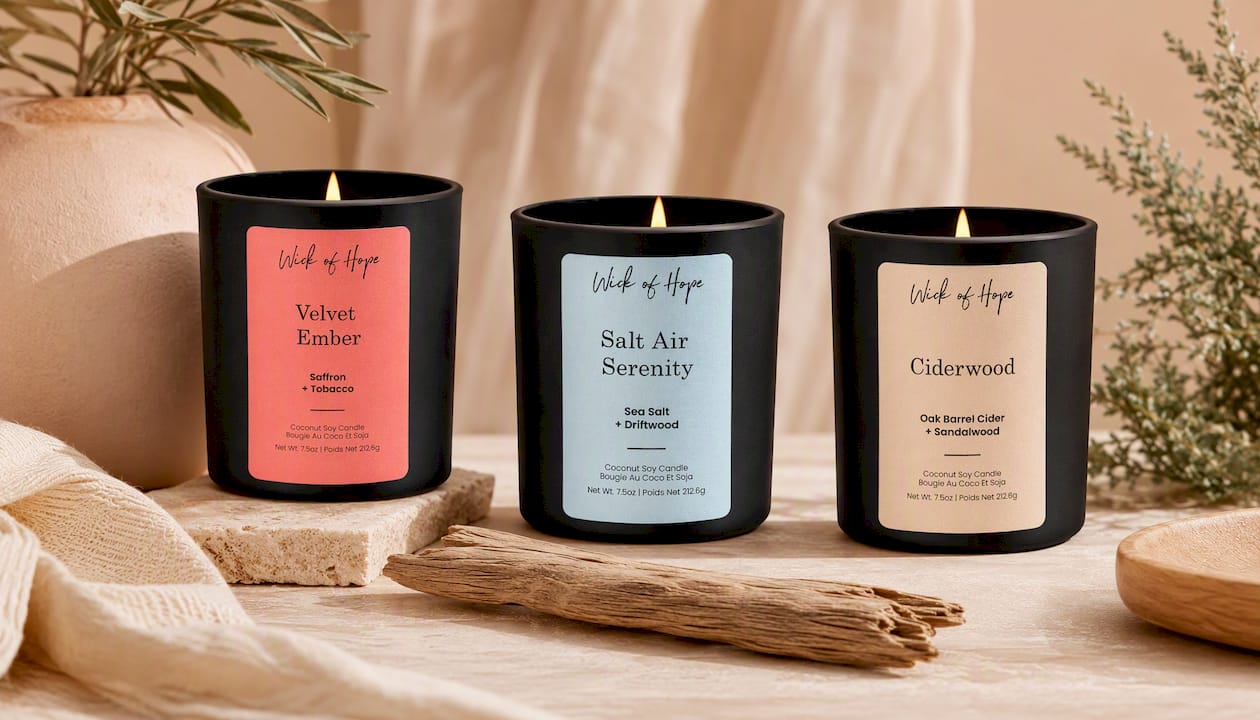
The Velvet Ember Candle | Saffron + Tobacco pairs a warm, layered scent with the slow, crackling burn wooden wicks are known for. If you’re drawn to something breezier, the Salt Air Serenity Candle | Sea Salt + Driftwood delivers that same natural-wick foundation in a lighter, coastal fragrance. And for a cozier profile, the Ciderwood Candle | Oak Barrel Cider + Sandalwood brings spiced warmth without a single ingredient you’d need to look up.
Every candle ships in vegan, biodegradable packaging, and some purchases support women and children rebuilding their lives after crisis. Browse the collection and pick a scent that fits your space, knowing what’s burning in it.
Sources
- Cpsc
- Some candles with lead wicks emit lead into the air | University of Michigan News
- Emission testing and inhalational exposure-based risk assessment for candles having Pb metal wick cores (ScienceDirect)
This article is general information, not a substitute for advice from a qualified doctor. Consult a qualified healthcare professional about your own circumstances before acting on anything here.


