


Every candle sold in Canada must pass one hard legal test: it cannot spontaneously reignite once extinguished, under Candles Regulations (SOR/2016-165). Relight (trick) candles have been banned outright since 1977, and Health Canada actively monitors the marketplace for lead-core wicks. Add the Canada Consumer Product Safety Act’s general duty against “unreasonable danger,” and you have the full regulatory floor every manufacturer, importer, and seller must clear.
TL;DR:
- Canada strictly prohibits candles that reignite spontaneously after extinguishing, requiring materials and additives to prevent flare-ups.
- Importing relight or trick candles is illegal since 1977, and lead-core wicks are actively monitored and phased out by Health Canada.
- Proper labeling should disclose wick and wax materials, include safety instructions on burn limits and supervision, and be placed on all product packaging and online listings.
- Enforcement involves market monitoring, incident investigations, and batch record checks, with noncompliance risking recalls, market removal, and reputational damage.
- Regular verification of wick materials and up-to-date documentation are essential for maintaining compliance and avoiding regulatory and safety issues.
Table of Contents
- Key Legal Requirements for Candle Manufacturers, Importers, and Sellers in Canada
- Labeling and Consumer Safety Information That Actually Reduces Risk
- What Health Canada and Provincial Fire Officials Actually Check
- Your Compliance Checklist Before the Next Production Run
- How Wick of Hope Builds Compliance Into Every Candle
- Who Regulates Candle Safety in Canada
- Are There Canadian Standards Like CAN/ULC for Candles?
- Ingredient Rules and Toxic Emission Concerns
- Packaging and Disposal Information Requirements
- How Canadian Consumers Can Report an Unsafe Candle
- What Compliance Managers Should Prioritize This Quarter
- Where to Find Compliant, Ready-to-Sell Candles
- Sources
- FAQ
Key Legal Requirements for Candle Manufacturers, Importers, and Sellers in Canada
Candle regulations in Canada rest on a short but strict rulebook. The core text of SOR/2016-165 is blunt: “A candle must not reignite spontaneously after it is extinguished.” That single sentence governs wax formulation, wick composition, and any additive that could cause a smoldering wick to flare back up after a customer blows it out. If your supplier can’t explain, in plain language, why their wax and wick combination won’t do that, you have a compliance gap before you have a product.
Relight or “trick” candles, the kind that reignite on purpose as a novelty, have been banned from import, sale, and advertising in Canada since 1977. That means a manufacturer sourcing “magic candle” wicks from an overseas novelty supplier isn’t just risking a product recall. They’re importing an item that was never legal to bring into the country in the first place.
Lead-core wicks are the other flashpoint. Health Canada doesn’t run a formal certification scheme for wicks, but it does monitor the market and works with industry to eliminate lead-core products, since lead exposure carries particular risk for children and pregnant women.
Your compliance checklist should cover:
- Confirm no additive or wax blend causes reignition after extinguishing.
- Reject any wick sourced as a “relight” or “trick” novelty item.
- Verify wick cores are metal-free, particularly lead-free.
- Treat construction and materials as CCPSA obligations, not just SOR/2016-165 line items.
Labeling and Consumer Safety Information That Actually Reduces Risk
Canada’s candle rules don’t hand you a rigid label template the way food or cosmetics regulations do. What they do is create liability for candles that reach consumers without adequate safety guidance, especially since most candle-related fire incidents trace back to how the candle was used, not how it was made.
A defensible label and product listing should include:
- Manufacturer or importer name and country of origin.
- Wax and wick material disclosure, including a “lead-free wick” statement where applicable.
- Recommended wick trim length before each burn, roughly 5 to 7 millimeters (about a quarter inch), a detail drawn from Health Canada’s own burn guidance.
- Maximum continuous burn time, commonly capped at a moderate duration per session as a prudent safety guideline.
- Instructions to burn on a stable, heat-resistant surface, away from drafts and flammable material.
- A clear warning to never leave a burning candle unattended around children or pets.
Put these instructions on the physical label, the insert card, and the online product description. A candle care page on your website is not optional marketing fluff. It’s a documented safety touchpoint that stands up when a customer, or a regulator, asks what you told buyers about safe use.
What Health Canada and Provincial Fire Officials Actually Check
Testing and enforcement for candle safety in Canada happen through a mix of routine market monitoring and incident-driven investigation. When something goes wrong, a house fire, a burn injury, a product complaint, Health Canada often coordinates with local fire officials to investigate the cause. That investigation typically asks two questions: did the candle behave the way it should, and did the packaging tell the user how to use it safely?
What gets checked in practice:
- Combustion and ignition behavior, including whether a candle reignites after being extinguished.
- Wick composition, checked for metallic cores and lead content.
- Label and packaging content, compared against what actually happened during the incident.
- Batch and supplier records tying a specific unit back to its production run.
Noncompliance consequences scale with severity. A single flagged batch might trigger a market removal request. A pattern of complaints can escalate into a formal recall, and Health Canada retains the authority to pull products it judges pose unreasonable danger under the CCPSA. Reputational damage tends to outlast the regulatory penalty. Retailers remember which suppliers got recalled.
Pro Tip: Keep a simple paper test kit on hand for incoming wick shipments. Separate a few wick fibers, rub the exposed core against plain white paper, and look for a grey mark. That non-destructive check, recommended by Health Canada, won’t replace lab testing, but it catches obvious problems before a shipment ever reaches your production floor.

Your Compliance Checklist Before the Next Production Run
Building a repeatable compliance process beats scrambling after a complaint. Here’s the order that actually works:
- Request a materials declaration from every wick and wax supplier before the first order.
- Ask for third-party test reports confirming no metallic wick core and no spontaneous-reignition behavior.
- Run the paper-rub wick check on a sample from every incoming batch, not just the first shipment.
- Assign batch numbers and log production dates so any unit can be traced back to its supplier and test report.
- Update label copy and online listings to include trim length, burn time limits, and supervision warnings.
- Set a recordkeeping window, most compliance teams hold supplier documents and test reports for at least the product’s full retail life plus two years.
- If a suspect wick turns up, quarantine the batch, notify the supplier in writing, and hold the units until lab confirmation clears or condemns them.
| Compliance Step | What to Collect | Who Handles It |
|---|---|---|
| Supplier vetting | Materials declaration, prior test reports | Purchasing or compliance officer |
| Batch testing | Lab results, paper-rub check notes | Quality control |
| Labeling review | Trim length, burn time, supervision warnings | Marketing/packaging team |
| Recordkeeping | Batch numbers, dates, supplier contacts | Compliance officer |
A comparative look at non-toxic candle brands shows how widely material quality varies across the Canadian market, which is exactly why supplier vetting can’t be a one-time formality.
How Wick of Hope Builds Compliance Into Every Candle
Some candle makers focus on addressing the two biggest flags regulators watch for in candle safety. Using coconut soy wax and FSC-certified wooden wicks can help address the lead-core wick concern by avoiding metal cores. Biodegradable, vegan packaging is an example of design discipline extended to consider disposal after use.
- Non-toxic coconut soy wax, formulated with no reignition additives.
- Wooden wicks, sourced with no metal core to test for.
- Biodegradable, vegan packaging designed with disposal in mind.
- Product care information built into every listing, not buried in fine print.
Who Regulates Candle Safety in Canada
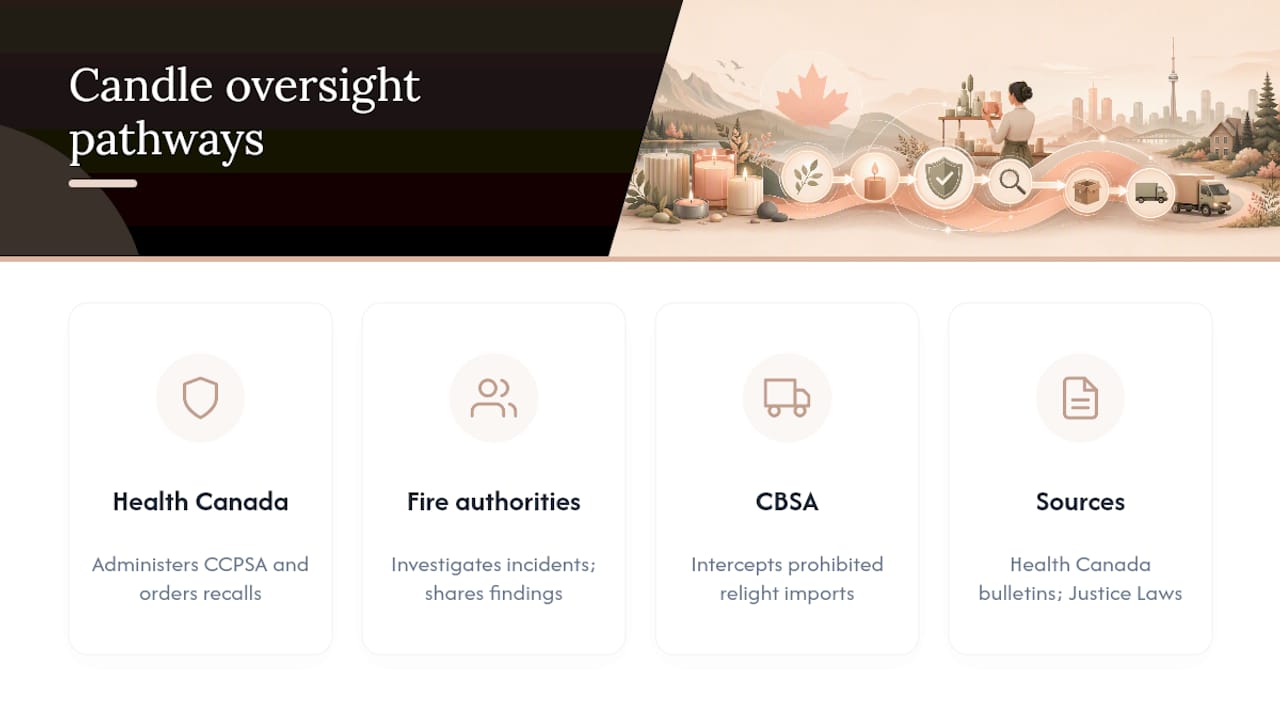
Health Canada holds the primary federal authority here, administering the Canada Consumer Product Safety Act and the Candles Regulations that sit underneath it. That gives Health Canada the power to monitor the marketplace, investigate complaints, and order recalls when a candle poses unreasonable danger.
Provincial and municipal fire authorities play a complementary role, particularly after an incident. When a house fire or burn injury involves a candle, local fire departments typically document the scene and share findings with federal investigators. That partnership matters for manufacturers because a single incident can trigger scrutiny from two directions at once: a federal product-safety review and a provincial fire-code inquiry.
The Canada Border Services Agency enters the picture for importers specifically. Since relight candles have been prohibited from import since 1977, CBSA has authority to intercept shipments that fail that test at the border, before they ever reach a Health Canada review.
There’s no separate “candle board” or dedicated candle regulator in Canada. The oversight structure is intentionally general. The CCPSA framework covers thousands of consumer product categories, with candles singled out for their own regulation only because of the reignition and relight risks specific to an open flame product. That structure means compliance officers can’t rely on a single candle-specific portal for updates. Tracking changes means watching Health Canada’s consumer product safety bulletins and the Justice Laws consolidation of SOR/2016-165 directly, since amendments get folded into the general consumer product safety apparatus rather than announced through candle-specific channels.
Are There Canadian Standards Like CAN/ULC for Candles?
Canada doesn’t run a mandatory, candle-specific certification program the way it does for electrical appliances under CSA standards or building materials under CAN/ULC fire codes. There’s no equivalent “candle safety mark” a manufacturer applies for and stamps on packaging. What exists instead is the regulatory floor set by SOR/2016-165 combined with the general CCPSA duty to avoid unreasonable danger, backed by Health Canada’s market monitoring.
That gap surprises manufacturers who expect a formal accreditation path similar to what exists in flammability testing for furniture or children’s sleepwear, where CAN/ULC and CSA standards do apply directly. Candles sit in a lighter-touch category. The absence of a mandatory certification doesn’t mean the bar is low. It means the compliance burden shifts onto the manufacturer and importer to prove, through their own testing and documentation, that a candle meets the spontaneous-reignition rule and poses no unreasonable danger.
Third-party lab testing fills that gap voluntarily. A manufacturer can commission independent combustion and wick-composition testing and use those reports as evidence of due diligence, even without a formal certification mark to display. That paperwork becomes critical if Health Canada ever asks for proof of compliance during a market review. Retailers and wholesale buyers increasingly ask for these reports before agreeing to carry a new candle line, treating voluntary lab documentation as the de facto standard the regulations themselves don’t formally require.
Ingredient Rules and Toxic Emission Concerns
Canadian candle regulations focus narrowly on reignition and relight behavior, but ingredient safety and emissions fall under the CCPSA’s broader unreasonable-danger standard rather than a candle-specific chemical list. That means there’s no published Health Canada roster of banned candle waxes or fragrance additives the way cosmetics regulation lists prohibited substances.
Lead is the one ingredient concern Health Canada calls out explicitly, tied specifically to wick cores rather than wax or fragrance oil. Paraffin wax, the most common candle base in mass-market products, isn’t banned in Canada, but it does produce more soot and volatile organic compounds during combustion than plant-based waxes like soy or coconut blends. That distinction matters for indoor air quality, particularly in smaller living spaces where ventilation is limited.
Fragrance oils and dyes fall under general consumer product safety obligations rather than a candle-specific ingredient list, which puts the burden on manufacturers to source fragrance compounds that don’t introduce combustion byproducts beyond what a reasonable consumer would expect. Reviewing options like clean-burning candle formulations shows how material choice, wax type, wick construction, fragrance load, shapes the emissions profile well before any regulation gets involved. For manufacturers building a new line, the practical move is treating ingredient sourcing the way Health Canada treats wicks: verify before you commit, document what you verified, and don’t assume “widely used” means “regulator-approved.”
Packaging and Disposal Information Requirements
Canada doesn’t mandate a specific disposal icon or take-back instruction on candle packaging the way some batteries or electronics regulations require. The obligation is softer but still real: packaging shouldn’t mislead consumers about how to safely extinguish, cool, and dispose of a spent candle.
Practical packaging content that reduces risk and supports the general CCPSA safety duty includes:
- A clear “let wax cool completely before handling or disposing” instruction.
- Guidance on removing hardened wax from a vessel before recycling glass or metal containers, since wax residue can contaminate municipal recycling streams.
- A note on whether the container itself is recyclable, reusable, or intended for disposal.
- Biodegradable or compostable packaging claims stated plainly, without vague “eco-friendly” language that regulators increasingly scrutinize as unsubstantiated environmental marketing.
That last point carries weight beyond candle-specific rules. Canada’s Competition Bureau has grown more active in policing unsupported green claims across consumer products generally, which means a candle brand stamping “eco-friendly” on a box without backup documentation is exposing itself to a different kind of regulatory risk entirely, separate from anything SOR/2016-165 covers.
How Canadian Consumers Can Report an Unsafe Candle
Consumers who experience a candle malfunction, unexpected reignition, excessive smoke, a wick that sparks or flares, have a direct path to report it. Health Canada accepts consumer product incident reports through its online consumer product incident reporting system, and that data feeds directly into the market monitoring that can trigger a manufacturer investigation or recall.
Provincial consumer protection offices offer a secondary reporting channel, particularly useful when a complaint involves a specific retailer’s return or refund practices rather than the product’s underlying safety. Fire departments remain the right first call for anything involving an actual fire or injury, since documenting the incident scene matters for both insurance claims and any downstream federal investigation.
For manufacturers and importers, consumer reporting isn’t an adversarial process to fear. It’s the feedback loop that catches problems your own testing might miss. A pattern of consumer reports about a specific batch is often the first signal a compliance officer gets that something in the supply chain went wrong, well before a formal lab result would surface the same issue.
What Compliance Managers Should Prioritize This Quarter
If you take one thing from this, verify your wicks first. That single check, materials declaration plus the paper-rub test, catches the highest-liability issue fastest. Next, pull current test reports for reignition behavior, and rewrite your label and online listing copy to include trim length and burn time limits.
Give yourself thirty days for wick verification, sixty for updated documentation and labels across your full catalog. Regulators move slowly until they don’t. Being ready costs less than being caught unready.
— Andy
Where to Find Compliant, Ready-to-Sell Candles
Retailers and wholesale buyers vetting new candle lines need products that already reflect the standards this article just walked through, not promises to fix issues later. Wickofhope’s catalog is built around that principle from the wax up.

The Maple Sugar Candle, blended with maple syrup and brown sugar notes, and the Pumpkin Spice Candle, built around nutmeg and cinnamon, both use coconut soy wax and FSC-certified wooden wicks, no metal core to test for, no reignition additives to question. Every product page carries ingredient and care information upfront, and each purchase also supports women and children escaping crisis, which means your compliance documentation request comes with a social impact story your customers will actually want to hear. If you’re sourcing for a retail shelf or a wholesale order, reach out through the product pages for full ingredient declarations and care documentation before you commit to a purchase order.
Sources
FAQ
What legally needs to be on a candle label in Canada?
Canada has no single mandatory candle-specific label template, but manufacturers should include material and wick composition, recommended trim length, maximum burn time, and supervision warnings to meet the general CCPSA duty to avoid unreasonable danger.
What is the three-hour rule for candles?
It’s a common safety guideline, not a legal mandate: avoid burning a candle unattended for more than about three hours at a stretch, a practice Health Canada highlights because most candle fire incidents stem from misuse rather than product defects.
Are candles considered a fire hazard in Canada?
Yes, candles are treated as a fire hazard, which is why SOR/2016-165 prohibits spontaneous reignition and why relight candles have been banned from import and sale since 1977.
Are relight or trick candles legal to sell in Canada?
No. Relight candles have been prohibited from import, advertising, and sale in Canada since 1977, making any novelty “trick candle” product illegal regardless of where it was manufactured.
How do I check if a candle wick contains lead?
Separate a few wick fibers and rub the exposed core against plain white paper. A grey mark suggests a metallic core, a signal to pull the batch and pursue formal lab testing before selling it.


