


A clean burning candle is one that combusts with minimal soot, visible smoke, and VOC emissions, an outcome shaped by wax, wick, and fragrance working together. Clean burning describes what happens after you light the wick, not just what’s listed on the label. The three determinants are wax choice, wick type and sizing, and how the fragrance is formulated. If you want to spot it yourself, look past “natural” claims and watch the flame: steady, quiet, and soot free is the real signal.
TL;DR:
- The actual cleanliness of a candle depends on wax, wick size, and fragrance formulation working together, not just ingredient labels.
- Soot, smoke, and VOC emissions scale with burn time, ventilation, and the number of candles lit simultaneously, requiring proper safety habits.
- Signs of a clean burn include a steady flame, minimal soot accumulation, and an even melt, while flickering flames and soot suggest a dirty burn.
- Certifications and detailed ingredient disclosures help verify if a candle genuinely burns clean, beyond vague marketing claims.
- Photos and observations during burning are the most reliable indicators of a candle’s performance, not just its ingredient list.
Table of Contents
- What Clean Burning Candles Meaning Actually Refers To
- The Three Factors That Determine a Clean Burn
- Do Candles Actually Affect Indoor Air Quality?
- How To Tell If Your Candle Is Burning Clean
- Red Flags That Undermine a “Clean” Label
- How Wickofhope’s Materials Line Up With These Standards
- What Most Candle Marketing Gets Backwards
- Start With the Fresh Beginnings Candle: Cotton and Green Tea
- Where This Information Comes From
- Sources
What Clean Burning Candles Meaning Actually Refers To
Most candle shoppers assume “clean” describes the ingredients sitting in the jar before you strike a match. That’s only half the story. Clean burning is a performance term. It describes soot output, particulate matter, visible smoke, lingering odor, and how completely the wax and fragrance oil combust once the wick is lit.
Health Canada’s guidance on candle safety draws this same line: “non-toxic” typically describes what’s in the candle before lighting, while clean burning describes how it behaves once it’s lit. A candle can list beeswax, coconut wax, and pure essential oils, and still burn dirty if the wick is the wrong diameter or the fragrance load overwhelms the wax’s ability to vaporize it cleanly.
This is why an ingredient list, on its own, tells you less than you’d think. Manufacturing quality, wick sizing relative to jar diameter, and fragrance chemistry all interact to determine what actually comes off that flame. A poorly matched wick will produce a sooty, tunneling burn even in a jar of 100% coconut soy wax. A fragrance oil with a high flash point can throw off more smoke than a “cleaner” sounding synthetic blend, depending on formulation.
That’s the gap most marketing copy skips over. Brands love to lead with “natural,” “non-toxic,” or “eco-friendly,” because those are input claims, easy to state and hard to verify at a glance. Clean burning is an output claim. It shows up in the flame height, the color of the smoke curling off a blown-out wick, and the ring of soot (or lack of one) on the inside of the jar after a few burns. You can’t fake that with label language alone. You can only get there through the right combination of materials and craftsmanship, then confirm it by watching the candle actually burn.
The Three Factors That Determine a Clean Burn
Three variables decide whether a candle burns clean, and none of them work in isolation. Get one wrong and the other two won’t save you.
Wax sets the baseline. Beeswax burns hot and slow with a naturally sweet scent, but it’s expensive and can be blended with cheaper waxes without much disclosure. Soy and coconut waxes burn cooler, hold fragrance well, and tend to produce less soot than petroleum-based paraffin, which Green America warns can release petroleum-derived compounds when burned, especially in undisclosed “wax blends” that hide a paraffin base behind a vaguer label. Coconut soy blends split the difference: a lower, steadier burn temperature with good scent throw.
Wick is where most at-home candle problems actually start. Cotton and wood wicks are the common non-metal options, and each needs to be sized to the jar’s diameter. A wick too small for its vessel drowns in melted wax and tunnels down the middle. A wick too large burns too hot, throws soot, and can crack glass. Lead-core wicks were a known hazard before industry-wide bans phased them out, and the National Candle Association’s FAQ still advises checking that any wick you burn is lead-free.
Fragrance and craftsmanship tie the two together. Essential oils and phthalate-free synthetic fragrances behave differently in a flame depending on their chemical makeup and how much is loaded into the wax, which makes understanding harmful chemicals in mass perfumes especially important. Too much fragrance oil for a given wax-and-wick combination is one of the most common causes of a smoky, uneven burn, and it’s rarely something a shopper can detect just by reading a label.
- Wax sets burn temperature and how cleanly it vaporizes fragrance.
- Wick size must match jar diameter, or expect tunneling and soot.
- Fragrance load has to be calibrated to the wax and wick, not maxed out for scent throw.
Pro Tip: If a candle brand won’t tell you the wax type as a percentage (not just “wax blend”) or won’t name where the fragrance comes from, treat that as a formulation you can’t evaluate, no matter how nice it smells in the store.
Do Candles Actually Affect Indoor Air Quality?
Burning candles release some level of VOCs and particulate matter, and the real question is how much, and under what conditions, that becomes a concern. Research on this is more nuanced than either candle skeptics or candle marketers usually admit.
A peer-reviewed study on indoor air pollution from candles found that scented candles can emit measurable VOCs and particulate matter, with exposure linked to irritation and other health effects in some contexts. That doesn’t mean every lit candle is a hazard. Other research in the same body of literature is more mixed: one industry-linked study from 2014 found low risk under typical household use, while an independent 2015 study out of South Korea measured notable VOC emissions from scented candles under different burn conditions.
Emissions tend to scale with burn intensity: how many candles are lit at once, how long they run, and how much air is moving through the room.
That’s the practical takeaway. A single well-made candle burning for a couple of hours in a ventilated living room is a very different exposure scenario than three candles burning unattended overnight in a closed bedroom. Ventilation, burn duration, and candle density in a room are the levers you actually control.
A few habits meaningfully cut your exposure:
- Crack a window or run an exhaust fan while a candle burns, especially in smaller rooms.
- Stick to the label’s recommended burn window rather than letting a candle run for hours unattended.
- Never burn candles overnight while sleeping, and keep lit candles away from children, pets, and anyone with respiratory sensitivities.
How To Tell If Your Candle Is Burning Clean
You don’t need lab equipment to judge burn quality. Your eyes and a few minutes of attention will tell you most of what you need to know.
Signs of a clean burn: a steady, teardrop-shaped flame that doesn’t flicker wildly or lean sideways, a clear glass rim with no black soot ring, an even melt pool that reaches the edges of the jar, and little to no visible smoke when you blow it out.
Signs of a dirty burn: a tall, flickering, or mushroom-capped flame, black soot climbing the inside of the jar, a melt pool that stays narrow while wax builds up untouched around the edges (that’s tunneling, one of the most common candle complaints), and a heavy plume of dark smoke after you extinguish it.
Run through this sequence for a new candle and for routine upkeep after that:
- Before the first light, trim the wick to about 1/8 to 1/4 inch. A too-long wick is the single most common cause of soot.
- Let the first burn run long enough for the melt pool to reach the jar’s edges, usually one to two hours, so the wax “remembers” that full diameter for future burns.
- Cap most single burn sessions around three to four hours, per most manufacturers’ guidance, then let the candle cool and re-trim before relighting.
- Keep the candle away from drafts, air vents, and fans. Moving air is a frequent, overlooked cause of flickering and soot.
- Avoid crowding several candles into one small room at once, which multiplies particulate load faster than most people expect.
Pro Tip: Run a quick safety checklist before lighting anything new. Ninety seconds of prep, wick length, placement, draft check, saves you a sooty jar and a smoky room.
Red Flags That Undermine a “Clean” Label
Marketing language is where clean-burning claims fall apart fastest. Watch for a handful of vague phrases that sound reassuring but disclose almost nothing.
“Natural” on its own means very little without a specifying detail. “Wax blend” without a percentage breakdown often means paraffin is doing more work than the label lets on. “Fragrance” listed with no further detail could be a single essential oil or a complex mix of dozens of synthetic compounds, and you have no way to know which from that word alone.
Trustworthy labeling looks different. According to consumer guidance on non-toxic candle labeling, that kind of specific disclosure, paired with third-party certification where available, is the most reliable signal a shopper actually has.
Before buying, it’s worth asking a maker or retailer directly:
- What is the exact wax composition, by percentage?
- Is the wick lead-free, and what material and size is it?
- Are fragrance oils phthalate-free, and where are they sourced?
- Is there any third-party certification behind these claims?
How Wickofhope’s Materials Line Up With These Standards
Wickofhope builds every candle around the same three levers this article just walked through: wax, wick, and fragrance craftsmanship. The base is natural coconut soy wax, chosen for its cooler, steadier burn rather than paraffin’s petroleum-derived profile. Wicks are FSC-certified wood, sized and tested to avoid the tunneling and soot problems that come from a mismatched setup.
Packaging is biodegradable, and the fragrance and wax approach uses vegan, cruelty-free ingredients. Every candle purchase also supports women and children escaping crisis, tying the clean-burning mission to a wider social one. Customer response backs it up: a 4.9-star rating across more than 650 reviews suggests the burn quality holds up once candles actually reach people’s homes, not just on a spec sheet.
What Most Candle Marketing Gets Backwards
Most candle marketing sells you the ingredient list and hopes you stop reading there. That’s backwards. A “natural” label tells you what went into the wax before anyone struck a match. It tells you nothing about what happens after.
The candles that actually burn clean are the ones where wax, wick, and fragrance were engineered to work together, then tested, not just sourced from a “clean” supplier and hoped for the best. That’s the gap between an ingredient claim and a combustion outcome, and it’s the gap most shoppers never get shown.
If there’s one habit worth adopting, it’s this: judge candles by what you can observe, not just what you can read. Watch the flame. Check the jar rim after a burn or two. Trim the wick before every light. Ingredient transparency earns your trust upfront, but the burn itself is where a candle either backs that trust up or doesn’t.
— Andy
Start With the Fresh Beginnings Candle: Cotton and Green Tea
If you want to see these clean-burning principles in a single jar, the Fresh Beginnings Candle in Cotton + Green Tea is a straightforward place to start. It pairs coconut soy wax with an FSC-certified wood wick, sized specifically to avoid the tunneling and soot issues that plague mismatched candles, and the cotton and green tea fragrance is built to burn without overwhelming that wax-and-wick balance.
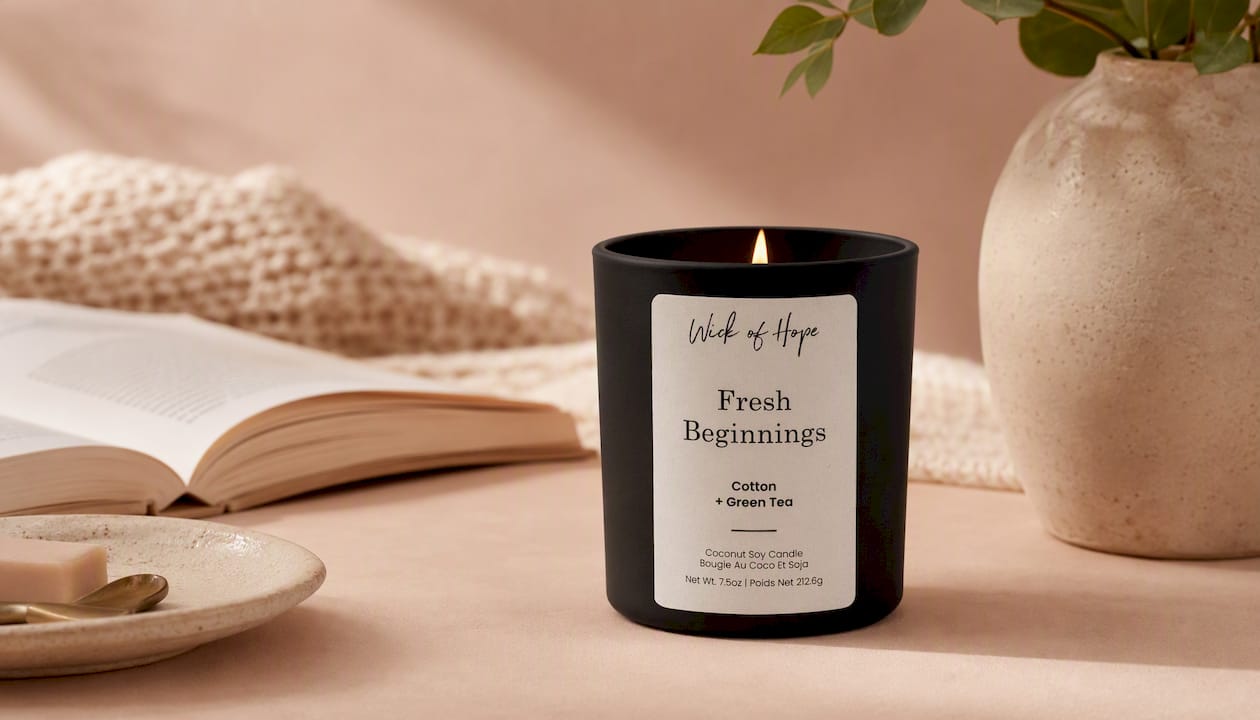
Unlike candles that lean on a “natural” label and stop there, this one is meant to be judged by the burn itself: a steady flame, a clean melt pool, and a jar rim that stays clear. For the best results, trim the wick to about 1/8 to 1/4 inch before lighting and keep each session within the recommended three to four hour window. If you’re deciding between a mass-market candle and one built around these three factors, the Fresh Beginnings Candle is worth putting to your own soot-and-flame test tonight.
Where This Information Comes From
Claims in this article draw on Health Canada’s candle safety guidance, a peer-reviewed study on candle emissions, Green America’s consumer guidance on candle toxicity, and the National Candle Association’s burning guide.
Sources
- PMC article on indoor air pollution from candles
- Green America — Are Your Candles Toxic?
- National Candle Association — Your foolproof guide to burning a candle correctly


