


Office-friendly candles work when you pick low-throw, non-toxic scents and burn them in short sessions rather than letting them fill a shared room all day. The safest, most effective picks lean toward citrus, mint, or light lavender blends. Wickofhope’s Sunlit Grove, Zen Whisper, and Cozy Spice Embrace candles cover the three most common desk scenarios. Keep the room ventilated, cap burns at three to four hours, and skip lighting anything near a shared workstation.
TL;DR:
- Citrus, mint, and light lavender candles are best for focus, but their scent throw depends on room size and session duration.
- Natural soy or coconut wax candles with wooden or cotton wicks burn cleaner and are safer in shared office environments.
- Heavy floral, sweet gourmand, and large jar candles produce overpowering scents unsuitable for desks or open-plan offices.
- Unscented or low-throw candles are ideal for shared spaces, especially when ventilation or sensitivities are concerns.
- Burning candles with proper technique and selecting scents aligned with specific work tasks enhances safety and effectiveness.
Table of Contents
- Which Scents Actually Support Concentration?
- Essential Oil vs. Fragrance Oil Candles: What’s Safer for Shared Air?
- What Scents (and Sizes) Should You Avoid at Your Desk?
- Unscented and Low-Throw Options for Open-Plan Offices
- How to Choose the Right Office Candle for Your Work Type
- How Do You Burn an Office Candle the Right Way?
- Why Clean-Burning Candles Belong in Every Workspace
- Our Recommended Office Candles, Matched to Your Workday
- Selected Sources and Further Reading
Which Scents Actually Support Concentration?
Not every scent belongs at a desk, but a handful of scent families consistently show up in guidance on focus-friendly fragrance because of how they read to the brain: bright, clean, and non-intrusive rather than heavy or food-like.
- Citrus (lemon, grapefruit, bergamot): reads as bright and energizing, good for morning tasks or slow afternoons.
- Mint, rosemary, eucalyptus: sharp and refreshing, useful when you need a mental reset between meetings.
- Light lavender or lavender-bergamot blends: calming without tipping into sleepy territory, better suited to focused work than florals alone.
Retail guidance on home-office candles routinely points to citrus, rosemary, and bergamot as the go-to notes for concentration, and that pattern holds for a reason: these scents tend to be perceived as “clean” rather than “sweet,” which matters in a shared space.
Room size changes the math. A candle’s scent throw, meaning how far and how strongly the fragrance travels, hits differently in a 10 by 10 foot private office than in an open floor plan. Creative work can tolerate a slightly stronger throw since a little stimulation helps. Deep, sustained focus work usually pairs better with something subtler that fades into the background instead of demanding attention.
Essential Oil vs. Fragrance Oil Candles: What’s Safer for Shared Air?
Essential oil candles use plant-derived extracts, while fragrance oil candles rely on blended compounds, natural or synthetic, engineered for a specific scent profile. Neither is automatically the safer choice. What actually matters for office air quality is the wax and wick underneath the fragrance.
Natural coconut-soy wax paired with a wooden or cotton wick burns cleaner and produces far less soot than paraffin candles with metal-core wicks, which is one reason why clean-burning formulas have become the standard for anyone burning candles in enclosed workspaces. Look for phthalate-free and non-toxic on the label, then verify what those terms mean on the actual product page rather than taking them at face value, since neither term is strictly regulated.
- Check the wax type: soy or coconut blends beat straight paraffin.
- Check the wick: wood or cotton, never a metal core.
- Check for phthalate-free labeling on the fragrance itself.
- Avoid concentrated essential-oil candles around coworkers with asthma or pet allergies, since stronger plant oils can trigger sensitivities faster than a lighter fragrance blend.
Pro Tip: Before buying, scan the product description for wax type and wick material first. If a listing skips both details entirely, that’s usually a sign the brand isn’t prioritizing clean-burning ingredients.
What Scents (and Sizes) Should You Avoid at Your Desk?
Some candles that are perfectly lovely at home become a problem the moment they sit near a shared desk.
- Heavy florals (gardenia, tuberose, heavy rose) tend to linger and can read as overpowering in enclosed rooms.
- Gourmand sweets (frosting, caramel, sugar cookie) smell wonderful in a kitchen but distracting, even hunger-inducing, at a desk.
- Strong spice blends in large format can dominate a room within minutes, especially in a jar sized for a living room rather than a cubicle.
- Oversized jars with heavy throw are a sizing mistake for office use. A candle built to scent 400 square feet has no business on a 3 by 5 foot desk.
If open flames aren’t allowed in your building or a nearby coworker has sensitivities, aroma diffusers and plug-in fragrance options deliver scent without fire and with far more control over intensity.
Unscented and Low-Throw Options for Open-Plan Offices
Unscented candles skip fragrance oils entirely, low-throw candles carry a light scent that stays close to the flame, and travel tins are simply built smaller so there’s less wax, and less scent, to spread in the first place.
Unscented is the right call whenever you share a wall, desk cluster, or ventilation system with people who haven’t opted into your fragrance choice. Small tins and short sessions keep scent localized instead of drifting across an open floor plan.
- Choose a tin or small jar over a large three-wick candle.
- Place it to the side of your monitor, not directly in your airflow path.
- Burn for shorter stretches rather than letting it run all day.
How to Choose the Right Office Candle for Your Work Type
Matching a candle to your actual task beats picking whatever smells best on the shelf.
- Match the scent family to the task. Citrus or mint for alertness during deep work, lavender-bergamot for calming focus before a big meeting, and lighter florals only for solo creative sessions.
- Check the ingredients and wick. Natural coconut-soy wax with a wooden or cotton wick burns cleaner and produces less soot, an easy filter for eliminating low-quality candles fast.
- Pick the right size and burn time. Small tins built for desk use are meant for short sessions rather than all-day burning.
- Account for allergies, pets, and ventilation. If you work near others, or bring a candle home to a pet-friendly space, favor lighter, low-throw formulas.
- Read the product page before buying. Look for phthalate-free labeling, wax type, and wick material listed clearly, not buried in a generic “eco-friendly” claim.
Pro Tip: Keep a small notebook of which scent you burned during your most productive days. Patterns show up fast, and it’s the cheapest personal research you’ll ever do.
How Do You Burn an Office Candle the Right Way?
- Let the first burn create a full melt pool across the top before extinguishing, which prevents tunneling later.
- Trim the wick before every burn and cap sessions at three to four hours.
- Set it away from vents or drafts so scent stays where you want it.
- Crack a window briefly afterward to clear any residual soot or fragrance.
- Never leave it burning unattended, even for a quick meeting down the hall.
Why Clean-Burning Candles Belong in Every Workspace
Most office candle advice stops at “pick something subtle.” The bigger issue is what’s inside the wax. Wickofhope builds every candle on natural coconut soy wax and wooden wicks specifically to cut down on soot and airborne residue, the same particulate concerns that make cheap paraffin candles a poor fit for a shared office. Some candles come in biodegradable packaging with vegan ingredients, and some purchases support women and children escaping crisis. That combination is why many prefer burning one clean candle a day rather than multiple lower-quality ones that may leave a film on the monitor.
— Andy
Our Recommended Office Candles, Matched to Your Workday
Three candles cover almost every desk scenario we hear about, and each one is built around a specific kind of workday rather than a generic “office scent.”
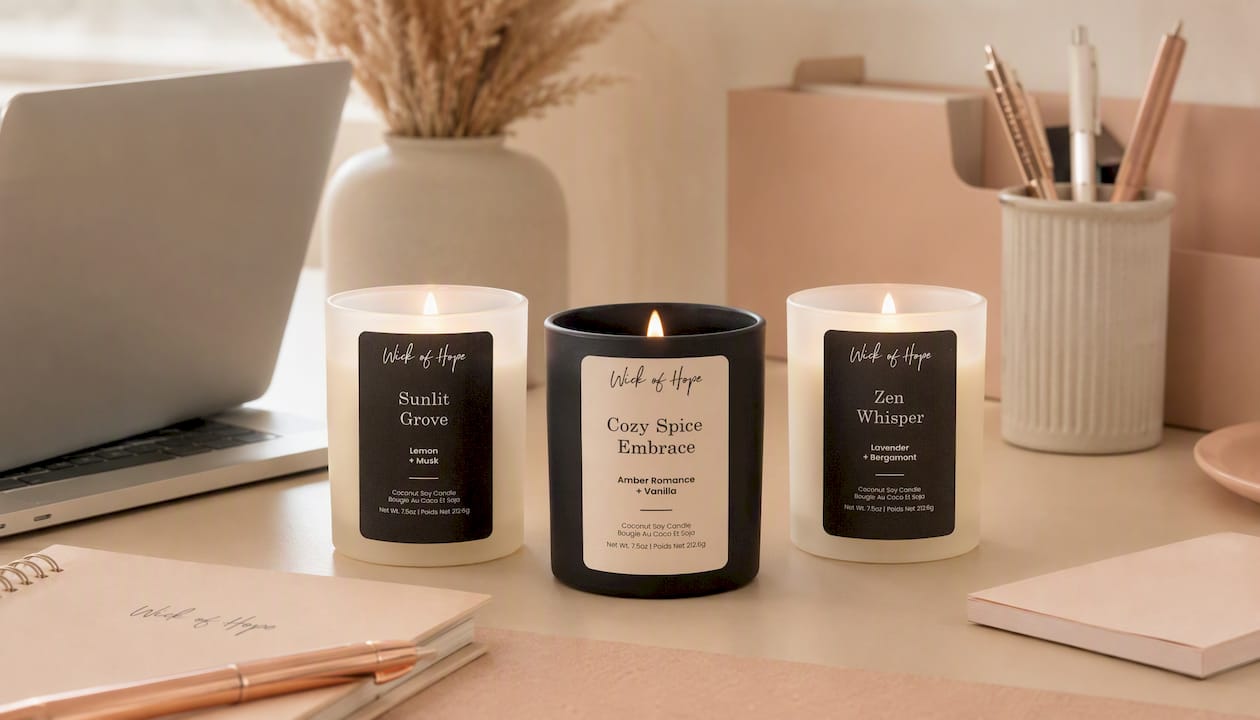
The Sunlit Grove Candle, a lemon and musk blend, is the one to reach for during deep-focus stretches. Its citrus-forward profile stays bright without turning cloying, and it’s built in a format small enough for a desk without overwhelming a shared room.
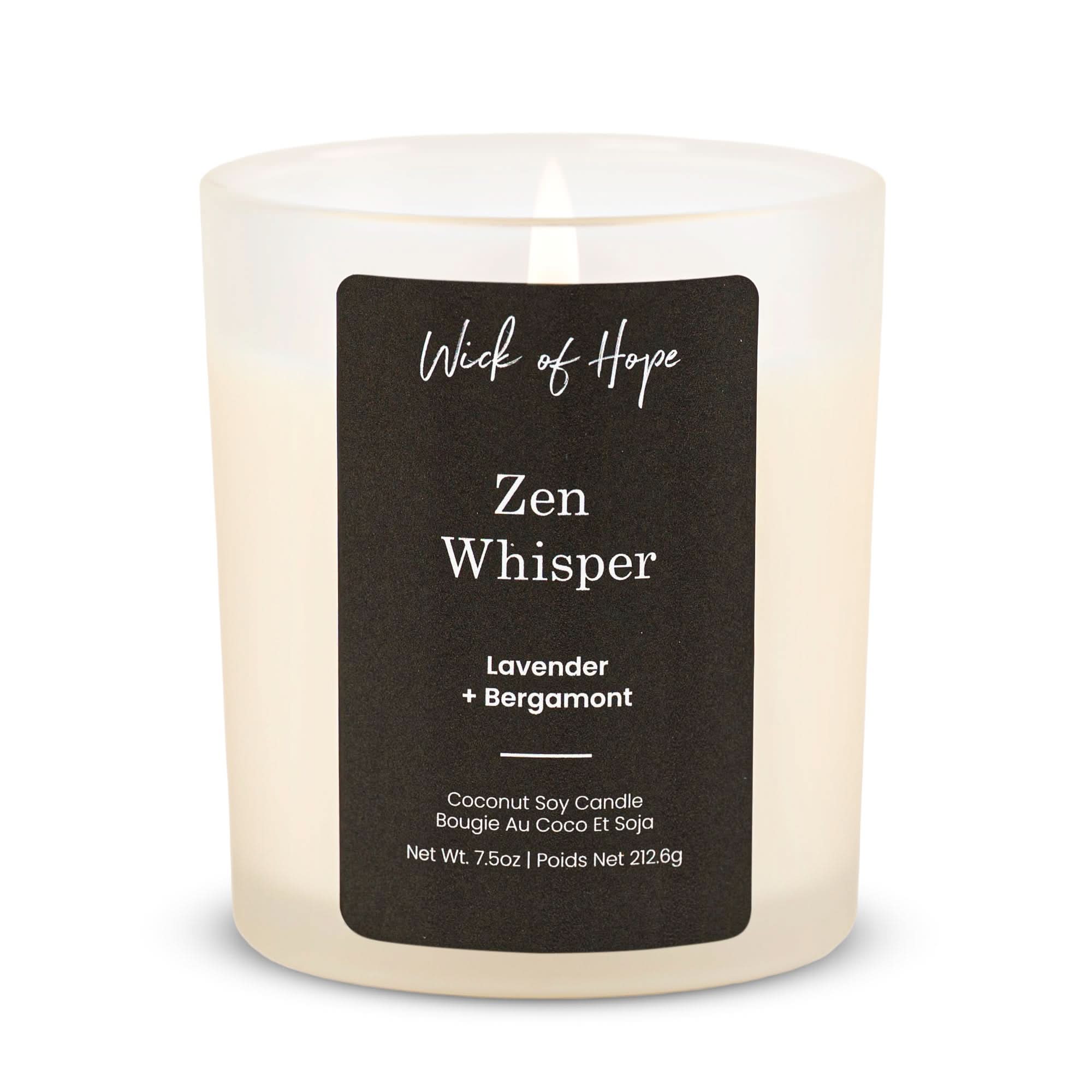
Heading into a big presentation or a stretch of back-to-back calls? The Zen Whisper Candle, a lavender and bergamot pairing, delivers calm without the drowsy pull of straight lavender, which makes it the better pick for meeting prep than a heavier floral.
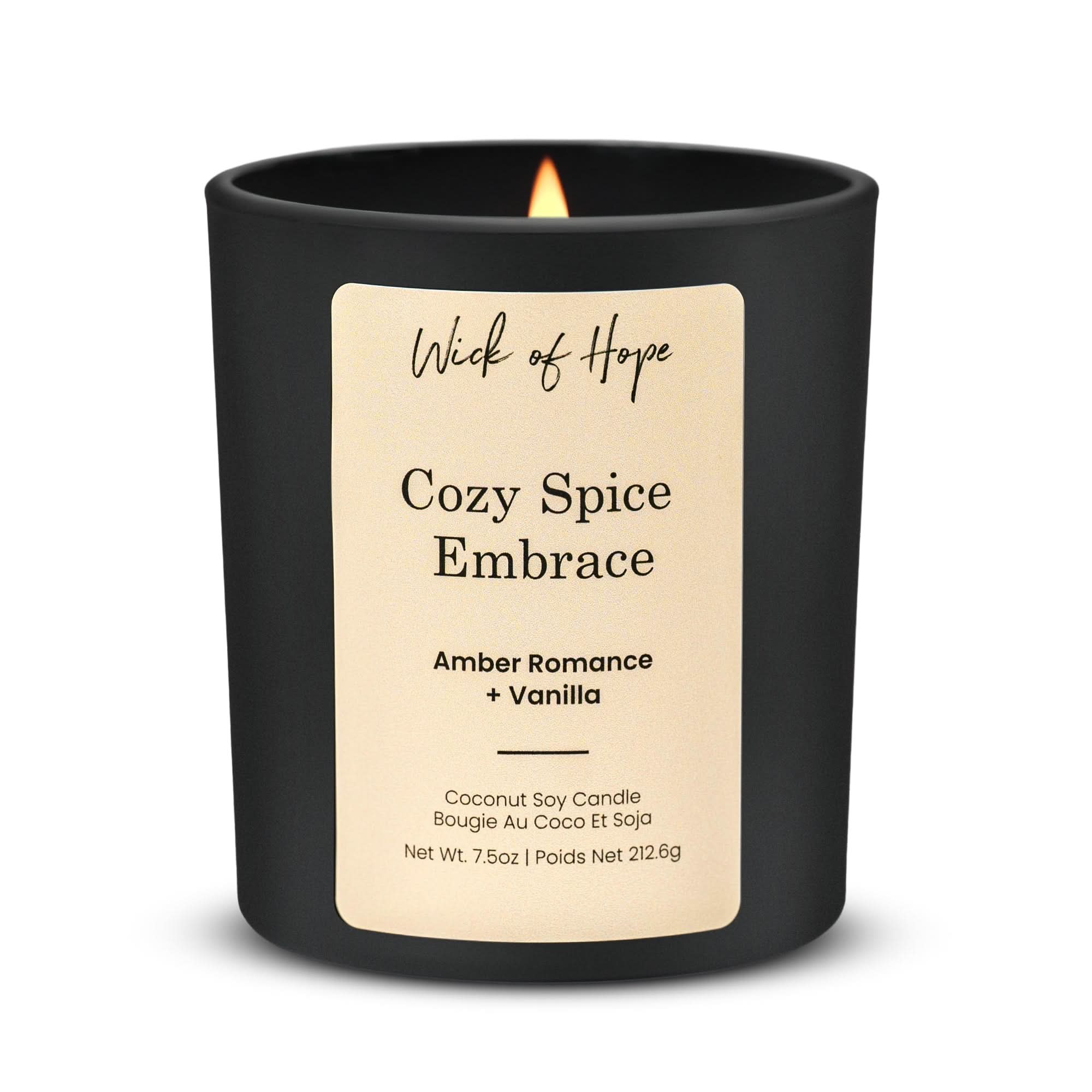
For a private office or a home workspace where you have more room to enjoy a fuller scent, the Cozy Spice Embrace Candle, an amber romance and vanilla blend, works well in shorter sessions when you want warmth without competing with a colleague’s space.
All three are designed to burn with natural wax and wick materials, aiming to keep soot low and sessions manageable at three to four hours. If a candle doesn’t work out for your space, some brands offer return policies to make swapping scents straightforward.
Selected Sources and Further Reading
For a deeper look at wax and wick choices, Wickofhope’s buyer’s guide to safe candles breaks down what “non-toxic” should actually mean on a label. The candle care guide covers first-burn technique and wick trimming in more detail, and the essential oil candle safety guide is worth a read if pets or asthma are a factor in your space. If you’re rethinking how your workspace is laid out entirely, Bodaq’s small office design ideas offer practical layout tips that pair well with a low-throw candle setup.


